Stockholm runs on Telia, Telenor, Tele2 and Tre, and your eSIM rides one of them as its host. Sweden is one of the better-connected countries in Europe: dense 4G everywhere a visitor goes, extensive 5G across the city, and coverage that holds up remarkably well into the archipelago and the countryside. You will not think about signal here. You will think about your card.
Sweden is among the most cashless societies on earth, and Stockholm is its sharpest edge. Many businesses do not accept cash at all - not reluctantly, but as policy, with a sign on the door. Cafés, museums, buses, market stalls, some public toilets.
This inverts the usual travel advice. In most of the world you carry cash as the fallback when cards fail. Here, cash is the failure mode.
What actually works:
- Contactless Visa or Mastercard, for everything from a 30 SEK coffee to a hotel bill. Tap is the default and often the only option - many terminals will not take a chip-and-PIN insert.
- Apple Pay or Google Pay, which is why your phone's battery is a payment concern here and not just a navigation one.
- A small emergency reserve - 200-300 SEK is plenty, drawn from an ATM rather than an exchange bureau - for the rare cash-only oddity.
Swish is not available to you. It is the payment layer Swedes actually use, and it requires a Swedish bank account and a personal identity number. You will see it requested everywhere - flea markets, community events, someone selling waffles - and you simply cannot use it. This is the Swedish equivalent of the M-Pesa problem in Nairobi: the local rail runs on an identity you do not have. Cards cover you in the city; the gaps appear at the margins.
Stockholm's public transport takes contactless directly at the gate. Tap your card or phone on the reader at the metro turnstile, at the platform validator, or as you board a bus. No ticket to buy, no app account to create, no machine to queue at.
Two consequences worth knowing:
- It must be contactless. There is generally no insert-and-PIN option on the readers.
- Tap with the same card or device every time, because the fare capping and the checks are tied to the card you tapped with.
The SL app exists and is good for planning and for passes; for a short visit, tapping is simpler.
Honestly, rarely. This is a well-covered city. The gaps are specific:
The archipelago. Stockholm's 30,000-odd islands are the reason to come in summer, and coverage thins as you go out. The inner archipelago - Vaxholm, Fjäderholmarna - is fine. The outer islands toward Sandhamn and Utö are patchier, and on the water between them you drop in and out. If your ferry ticket or your return time lives in an app, screenshot it.
The deep metro stations. Stockholm's tunnelbana is blasted into bedrock and some stations are very deep - which is also what makes them the world's longest art gallery. Coverage in stations is good; the deepest tunnels between them are less so.
Bedrock generally. The city is built on granite islands and a lot of its infrastructure is cut into rock - tunnels, garages, the Fotografiska basement galleries.
- Your wallet, functionally. See above - your phone is a payment device here more than in most of Europe.
- SL for transport planning, and Waxholmsbolaget for the archipelago ferries, whose timetables are seasonal and genuinely worth checking rather than guessing.
- Maps. Stockholm spreads across fourteen islands and the water makes routes counterintuitive - two places that look adjacent can be a long way apart on foot.
- A daylight check in winter. Not really an app, but plan around it: in December, useful light runs roughly 09:00 to 15:00, and it changes what you can do with a day.
Roaming is a non-issue: Sweden is in the EU, so an EU SIM works on home terms. UK visitors should check their operator's current post-Brexit position, which varies by provider.
Arlanda (ARN) is about 40 km north. The Arlanda Express train reaches Central Station in around 18 minutes and is the fast option; regional trains and the Flygbussarna coaches are slower and cheaper. All of them take contactless.
Bromma (BMA) is much closer to the city and handles some domestic and short-haul routes. Skavsta and Västerås, marketed as Stockholm by low-cost carriers, are 100 km away and are not Stockholm in any useful sense - budget properly if you land there.
Light to moderate. The city is compact, walkable and well signposted, and transport needs no app.
For a long weekend, 1GB per 3 days is comfortable; a week sits around 3GB. Size up if you are working, or if the archipelago is on the plan and you will be pre-downloading maps and timetables.
Layers, and take the weather seriously in winter. -5C with wind off the water is colder than the number suggests. Proper coat, hat, gloves, and boots with grip - the pavements ice.
Summer is short, bright and genuinely warm, with light until nearly midnight in June. Bring something for the evening anyway: the water keeps the air cool once the sun drops.
Swedes dress well and simply - understated, good quality, dark colours. Nowhere expects formality, but scruffy stands out.
Indoors: take your shoes off when entering a home. This is not optional and visitors get it wrong constantly.
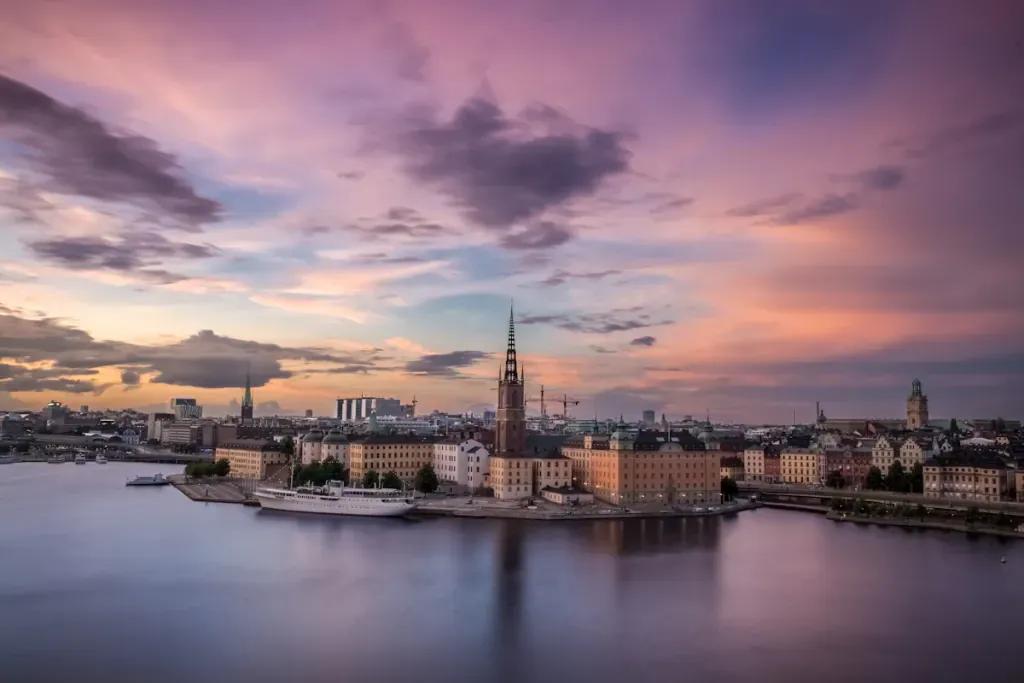
Gamla Stan from Monteliusvägen, the walkway along the Södermalm cliff - the classic view across the water to the old town's spires and ochre facades, and it is best in the last hour of light.
Stortorget, the small square in Gamla Stan with the row of narrow coloured houses. Early morning, before the crowds.
The tunnelbana as art gallery. Stockholm's metro is the longest art exhibition in the world - Solna Centrum's red cavern, T-Centralen's blue vines, Kungsträdgården's excavated ruins. A transit card and an hour gets you all of them.
Fjäderholmarna at golden hour, the nearest archipelago island, twenty-five minutes by boat from the centre.
Stockholm City Hall's tower for the wide view over the water and the islands.
Stockholm is built across fourteen islands at the point where Lake Mälaren meets the Baltic, and the archipelago beyond it runs to roughly 30,000 islands, islets and skerries.
The tunnelbana has more than 90 stations decorated by over 150 artists, which makes it the longest art gallery on earth.
Allemansrätten - the right of public access - lets anyone walk, forage and camp on most uncultivated land, including in the archipelago, provided you disturb nothing and leave no trace.
And the Nobel Prizes are awarded here every 10 December, with the banquet in the City Hall's Blue Hall - which is not blue.
Midsummer, the weekend nearest 24 June, is the biggest date in the Swedish year - and Stockholm empties, because everyone leaves for the countryside. Much of the city closes. Plan around it or join the exodus.
Nobel Week in early December fills the city with ceremony.
Stockholm Pride in early August is one of the largest in the Nordics.
Lucia, 13 December, brings candlelit processions and choral singing into the darkest part of the year, and it is genuinely lovely.
The love: Stockholm is beautiful in a way few capitals manage - built on water, with light that does extraordinary things in both summer and winter. It works: transport is clean and punctual, everything is well designed, and English is spoken to a standard that makes daily life effortless. The archipelago on the doorstep is a genuine luxury. The museums - Vasa, Fotografiska, Skansen - are excellent.
The complaints are consistent. It is expensive, seriously so, and visitors from most of Europe find restaurant and drink prices startling. Winter darkness is heavier than the cold - a December afternoon that ends at three in the afternoon affects people more than they expect. The city can feel reserved, and striking up conversation with strangers is not the local mode. And the cashless system, brilliant when your card works, leaves you genuinely stuck when it does not - which is the argument for carrying two cards from different banks.
Come in June for the light or December for Lucia, carry a backup card, and Stockholm is one of the easiest cities in Europe to enjoy.
Often not. Sweden is among the most cashless countries in the world and many businesses refuse cash as policy. Use contactless Visa or Mastercard, or Apple/Google Pay, and keep only a small emergency reserve of 200-300 SEK. Carry two cards from different banks - a declined card is a bigger problem here than a lost wallet.
No. Swish requires a Swedish bank account and a personal identity number, so it is not available to visitors. You will see it requested at markets and small events where cards are not taken - that is the one gap worth keeping a little cash for.
Tap a contactless card or phone directly at the turnstile, platform validator or bus reader. There is no ticket to buy and generally no chip-and-PIN option, so it must be contactless. Use the same card every time so fare capping works.
In the inner archipelago, yes. Further out toward Sandhamn and Utö it thins, and on open water between islands it comes and goes. Download ferry timetables and any tickets before you sail.