Saint Petersburg runs on MTS, MegaFon, Beeline and t2, and your eSIM rides one of them as its host. The networks themselves are excellent, including deep inside a metro that goes deeper than any other in the world. Two things need arranging before you arrive rather than after, and one thing about this city will strand you at two in the morning if you do not know about it.
The Russia-wide practicalities are covered at length in our Kaliningrad and Moscow guides, so this is the compressed version - but do not skip it, because none of it can be fixed once you are here.
Foreign cards do not work. Visa, Mastercard, Maestro, American Express and JCB issued outside Russia have not functioned inside the country since 2022 - not in shops, not in ATMs. Bring cash to exchange, or arrange a Mir card or UnionPay before travelling.
You need a visa, and for many nationalities the e-visa is the straightforward route: applied for online, valid for a stay of up to 30 days, issued in around four working days, and requiring medical insurance valid in Russia. No invitation letter.
There are no direct flights from the West. Airspace is closed both ways, so routings go through a third country - Istanbul to Pulkovo is the usual one.
Install your eSIM before you arrive, and expect a delay. Foreign SIMs and eSIMs registering on a Russian network face a cooling-off block on mobile data and SMS for up to 24 hours. Since late 2025 it can be lifted early by following a verification link sent by SMS and passing a captcha. Plan for a first day where hotel wifi is your connection.
Check your government's travel advice before booking. Several advise against travel to Russia, and travel insurance is generally void where you have travelled against that advice - which matters more here than usual, given the e-visa requires insurance in the first place.
This is the thing that catches visitors, and it is completely specific to Saint Petersburg.
From around 10 April to 30 November, the bridges over the Neva are raised every night. The Neva is the final stretch of the Volga-Baltic Waterway, and ships too large to pass under the spans move through the city in the small hours.
They go up at roughly half past one in the morning and come down between four and five. During that window there is no way across the river on foot or by road.
The city genuinely divides. Vasilyevsky Island and the Petrograd Side are separated from the centre for several hours. If your hotel is on one side and your evening is on the other, you are staying put until dawn.
This catches people constantly. Taxi drivers will refuse a fare across at 1:20am because they know they cannot get back.
Check the schedule for the specific bridge. They do not all open at the same moment, the times shift slightly through the season, and a gap between openings sometimes allows a crossing - but this is not something to gamble a night on.
The metro does not save you. It closes around midnight and reopens before six.
And it is a spectacle. The raising of the Palace Bridge, with the Peter and Paul Fortress lit behind it, is one of the great free sights in Europe, and boat operators run night cruises built entirely around watching it from the water. Go and see it deliberately - just know which side of the river you need to be on afterwards.
The metro is covered, which is worth noting because this is the deepest metro system in the world. Admiralteyskaya sits around 86 metres down, and the escalator ride alone takes minutes.
The Hermitage is a great deal of thick stone, and interior signal in the further galleries is poor.
Peterhof and Pushkin, the palace estates outside the city, are fine in the grounds and patchier inside.
The Gulf of Finland on a hydrofoil out to Peterhof drops in and out.
Kronstadt, on its island, is covered but the causeway is variable.
During periods of heightened security, mobile internet in Russian cities has been restricted at short notice. Hotel wifi generally keeps working. Keep offline maps and some cash.
- Yandex Go for taxis. Uber does not operate in Russia. Set it to pay the driver in cash, since your foreign card will not work in the car either.
- Yandex Maps or 2GIS, both far better here than the international alternatives, and both usable offline.
- A translation app with camera input. Cyrillic signage is the norm and English is thin outside the main tourist sites.
- The bridge schedule, on any local listings site, checked against the date.
- A metro map, though the system is straightforward once you accept the depth.
Pulkovo (LED) is about 20 km south of the centre, and modern and efficient.
Yandex Go and official taxis work from the terminal; there is also a bus-and-metro combination that is cheap and slow.
By train from Moscow is genuinely excellent - the Sapsan takes around four hours between the two city centres and is the best way to combine them.
In the city, the metro is fast and cheap, paid for with a Podorozhnik card bought at a ticket window with rubles. Foreign contactless cards do not work at the turnstiles.
More than you would think, because when your cards do not work you lean on your phone for maps, translation and calling taxis constantly, and you cannot tap your way out of a problem. Budget generously, install before arrival, and keep offline maps against both the registration delay and any restriction.
Waterproof everything. This is one of the wetter, greyer cities in Europe and the rain is persistent rather than heavy.
Serious winter kit from November to March - it is cold, dark and damp, a combination that feels worse than the numbers.
Layers in summer, which is mild rather than warm and turns quickly.
Comfortable shoes. The distances between the Hermitage, the Russian Museum and the Church of the Spilled Blood are longer than the map suggests, and the pavements are hard going.
Something smarter for the Mariinsky, where the ballet and opera are world-class and cheap by Western standards, and the audience dresses.
Palace Bridge raised at night, with the Peter and Paul spire behind it. The classic.
Church of the Saviour on Spilled Blood, the onion domes on the canal, which look nothing like the rest of the city.
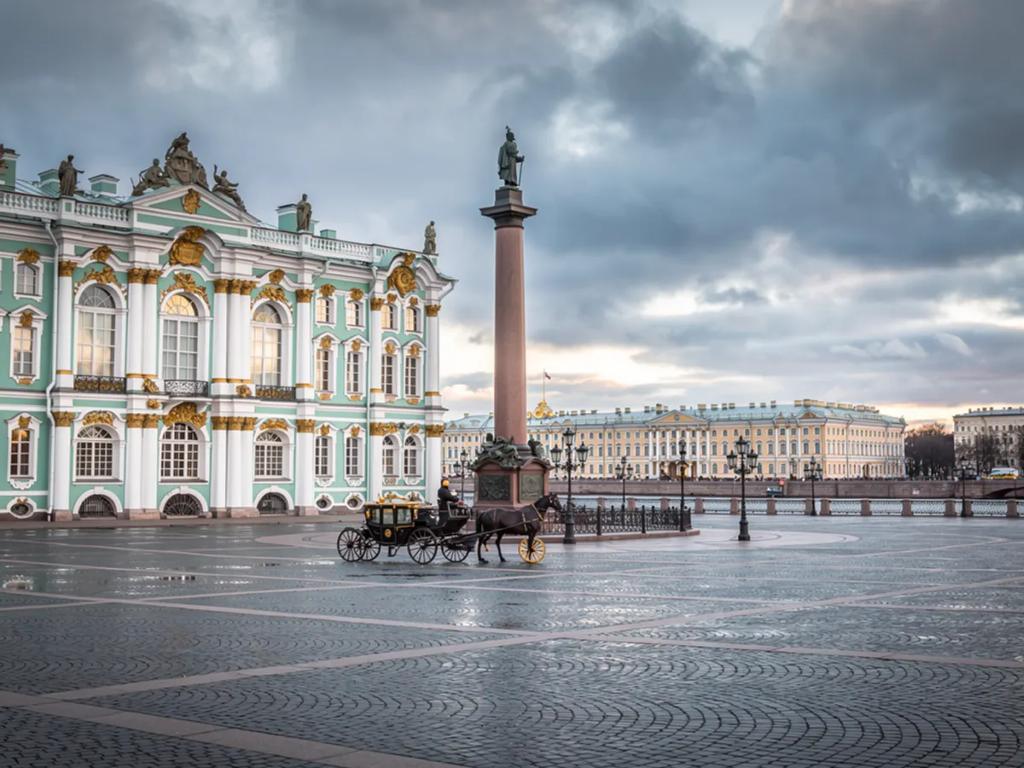
The Hermitage's Jordan Staircase, and the Winter Palace facade from Palace Square.
Peterhof's Grand Cascade when the fountains start in summer - they run on gravity alone, with no pumps, which is the impressive part.
The Griboyedov and Moika canals at dusk, which is why the Venice comparison gets made.
Admiralteyskaya metro station, if only to photograph the escalator disappearing.
Catherine Palace at Pushkin, and the reconstructed Amber Room.
The white nights in June, when the sky never fully darkens and the whole city stays out.
The city has had four names - Saint Petersburg, Petrograd, Leningrad, and Saint Petersburg again - and locals still call it Piter.
It was built on a swamp by decree in 1703, at enormous human cost, because Peter the Great wanted a Baltic port and a window on Europe.
Peterhof's fountains use no pumps. The whole system runs on a gravity-fed aqueduct designed in the eighteenth century, and it still works.
The Hermitage employs cats. They have guarded the cellars against rodents since the reign of Elizabeth, they are on the staff, and they have their own press coverage.
The metro is the deepest in the world by average station depth, a consequence of the swampy ground - engineers had to go below it.
And the siege of Leningrad lasted nearly 900 days, one of the most destructive blockades in history, and the memorials to it across the city are not incidental decoration.
The White Nights, roughly late May to mid-July, when the sun barely sets and the city does not sleep. This is the season everyone comes for.
Scarlet Sails, in late June, a school-leavers' festival with a tall ship on the Neva and enormous crowds - one of the largest public events in Europe.
The Mariinsky and Stars of the White Nights festival through the summer.
City Day, 27 May, marking the 1703 founding.
Winter is dark and difficult but the museums are empty and the city under snow is genuinely beautiful.
The love: Saint Petersburg is one of the great planned cities of Europe, built in a single imperial sweep of canals, palaces and pastel facades, and the Hermitage alone is among the two or three most important museums in the world. The ballet, the opera and the concert life are world-class and inexpensive. In the white nights the whole city is out at three in the morning, which is an experience with few parallels.
The complaints are consistent and some are structural. The practical friction is heavy - no working cards, a visa to arrange, indirect flights, a SIM registration delay. The weather is grey for much of the year. English is thin outside the main sites. The bridge schedule genuinely disrupts evenings. And the wider situation means travel advice, insurance, flight routing and payment options all change more often than in an ordinary destination, and should be checked close to the date rather than assumed.
If you go, go in June, install your eSIM before you fly, carry cash, and find out which side of the river you are sleeping on.
Because between roughly 10 April and 30 November the Neva bridges are raised nightly, from about 1:30am until four or five, to let ships through on the Volga-Baltic Waterway. The city is physically split for those hours, the metro is closed, and taxis will not take you across. Check the schedule for the specific bridge and know which side your hotel is on.
Not necessarily. Foreign SIMs and eSIMs registering on a Russian network face a cooling-off block on data and SMS for up to 24 hours, which since late 2025 can be lifted early via an SMS verification link and captcha. Install before you travel and plan a first day leaning on hotel wifi.
No. Cards issued outside Russia have not worked in the country since 2022, for payment or ATM withdrawal. Bring cash to exchange, or arrange a Mir card or UnionPay in advance. This includes taxis and metro turnstiles, so carry rubles from day one.
Yes, throughout, which is impressive given this is the deepest metro system in the world - Admiralteyskaya is about 86 metres down. Where signal thins is inside the Hermitage's deeper galleries and the palace interiors outside the city.