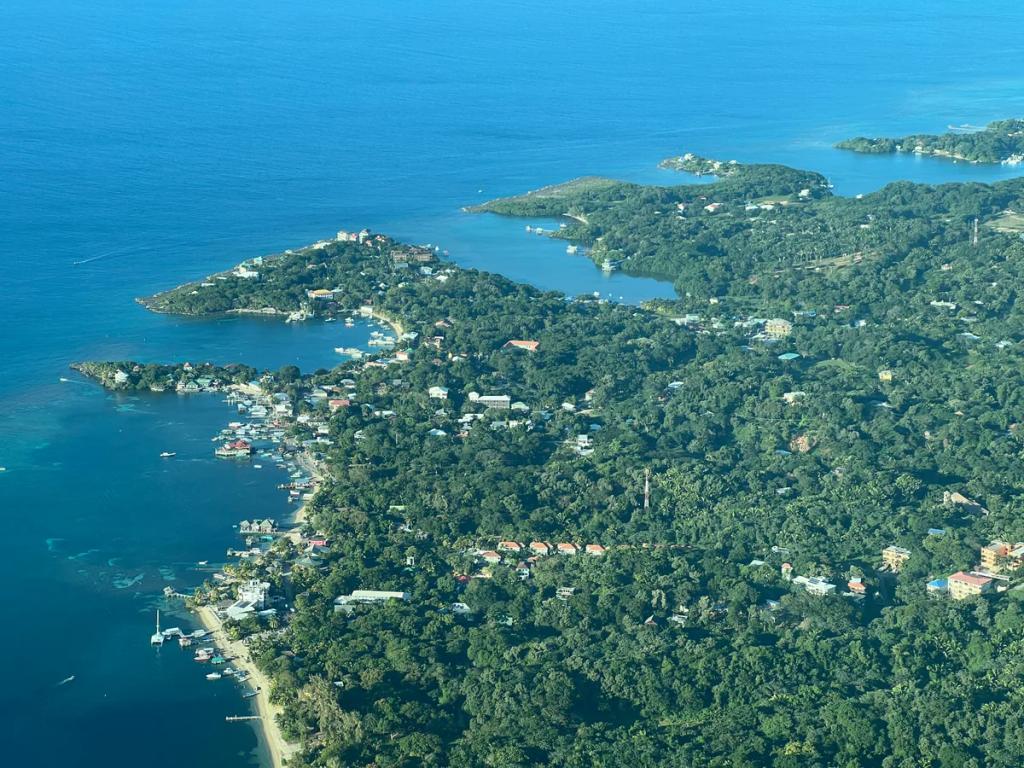
Roatan runs on Claro and Tigo, and your eSIM rides one of them as its host. Coverage is good along the developed west end of the island - West Bay, West End, Sandy Bay, Coxen Hole and French Harbour all have solid 4G. The east end is thinner and the water, obviously, has nothing. Which matters more here than almost anywhere, because most visitors spend a large part of their week underwater.
Roatan is one of the cheapest and best places in the world to learn to dive, and a very large share of visitors do exactly that. So the single most important piece of planning advice on this page is about your flight home rather than your phone.
Do not dive immediately before flying. Standard guidance is a minimum surface interval of 18 hours after multiple dives or multi-day diving, and at least 12 hours after a single no-decompression dive - many operators and agencies advise 24 hours to be safe. Flying too soon after diving risks decompression sickness, and the island's hyperbaric chamber exists because it happens.
Practically, this shapes the whole trip:
- Plan your last dive day to end at least a full day before you fly.
- Build the itinerary backwards from the flight, not forwards from arrival.
- Use that last day for the island above water - it is a good day, not a wasted one.
Your dive operator will enforce this and will tell you the same thing. It is here because people book the flight before they book the diving.
This comes up constantly and deserves a straight answer.
Roatan is one of the Bay Islands, roughly 60 km off the Honduran coast, and it is culturally and practically distinct from the mainland. The islands were British until 1861, and that history is still audible: English and an English-based Creole are widely spoken, alongside Spanish, and many island families identify strongly as Islanders rather than mainland Honduran.
It is also, by every measure and by the consistent account of visitors, considerably safer than mainland Honduras, whose reputation is what most people have heard. Ordinary sensible precautions apply - do not leave valuables on a beach, take care at night in Coxen Hole - but the security picture that dominates coverage of Honduras is not Roatan's.
The practical upshot for a visitor is that English gets you a long way here, which is unusual for Central America.
Underwater, comprehensively. The Mesoamerican Barrier Reef is the second largest in the world and runs immediately offshore - a short boat ride, sometimes a swim, from most of the west end.
On dive boats, coverage holds close to shore and drops on the further sites.
The east end. Camp Bay, Port Royal and the road east of Punta Gorda are much less developed, and both the road and the coverage deteriorate together. This is the quiet, beautiful part of the island and it is quiet in every sense.
Utila and Guanaja, the other Bay Islands, are separate trips with their own patchy coverage.
The interior ridge road, which runs the spine of the island, has gaps between settlements.
Cruise ship days are a congestion rather than a coverage issue: when two ships are in at Mahogany Bay and Coxen Hole, the island's population jumps by thousands and the networks in those areas feel it.
- Your dive operator's WhatsApp. As across Latin America, this is the channel for everything - pickup times, conditions, cancellations.
- A weather app with wind and sea state, which decides whether the north-side dive sites are diveable.
- Maps, offline. There is essentially one main road; the difficulty is the unmarked turnings off it.
- A currency converter. The lempira is the currency, though US dollars are widely accepted across the island, often at a rounded and unfavourable rate. Carry both.
- There is no meaningful ride-hailing. Transport is taxis - agree the fare first, and know that a colectivo shared taxi costs a fraction of a private one - or a rented scooter or car.
Juan Manuel Galvez International (RTB) is just outside Coxen Hole, and the island is small enough that nowhere is more than about 45 minutes away. Flights come from mainland Honduras, and direct from several US cities, plus regional connections.
The ferry from La Ceiba on the mainland takes around two hours. It has a considerable reputation for roughness - the crossing can be genuinely unpleasant, and the crew hand out bags. If you are prone to seasickness, fly.
Bring cash. Card acceptance is decent in West End and West Bay resorts and dive shops, and patchy elsewhere.
Very little. You will be in the water, on a boat, or asleep for most of it, and resort and dive-shop wifi covers the rest.
For a week, 1GB per 3 days is more than enough. Plans top up from your dashboard.
Reef-safe sunscreen, and take this seriously. You are snorkelling and diving on a living reef, oxybenzone and octinoxate damage coral, and the island's conservation bodies are vocal about it. A rash vest is better than more sunscreen.
Something long-sleeved for dusk. This is the practical one: sandflies on the beaches at dawn and dusk are Roatan's most consistent complaint, and they are worse than mosquitoes. Repellent, and locals swear by coconut oil.
Water shoes. Entries are often over rock and coral rubble.
Light, quick-drying everything. It is humid year-round.
A light rain layer from October to January.
West Bay beach early, before the cruise crowds arrive - white sand, palms, and reef close enough to swim to from the shore.
Underwater on the reef, which is why people come. Bring a housing rather than trusting a phone case at depth.
The Roatan Institute for Marine Sciences at Anthony's Key, and the wreck dives - the Odyssey and the El Aguila are the famous ones.
Sunset from West End, which faces the right way and is the island's evening ritual.
The iguanas at Arch's Iguana Farm in French Harbour, in genuinely absurd numbers.
The view from the ridge road, with both coasts visible at once - the island is only a few kilometres wide.
Roatan sits on the Mesoamerican Barrier Reef, the second-largest reef system in the world after Australia's, and it starts a few hundred metres from the beach.
The Bay Islands were British until 1861, when they were ceded to Honduras - which is why English and Creole are spoken and why the architecture and surnames do not look mainland.
The islands were a base for English and Dutch pirates in the seventeenth century, Port Royal on the east end among the more notorious anchorages.
And Roatan is one of the cheapest places in the world to get PADI certified, which is why so much of the island's economy is dive shops and why West End is full of people on day three of an Open Water course.
There is not much of a festival calendar, and that is part of the appeal.
Carnival in French Harbour in the spring is the main local celebration.
The dry season, February to August, is the best time - calmer seas, better visibility.
Whale shark season around Utila, the neighbouring island, runs roughly March to April and again August to October.
Hurricane season is June to November, with the real risk concentrated August to October - travel insurance that covers weather disruption is sensible in those months.
The love: world-class diving at a fraction of what it costs elsewhere, warm clear water, a reef you can reach by swimming out, and a relaxed island culture with English spoken. It is genuinely inexpensive once you are there, the dive community is welcoming, and West End manages to be lively without being a resort strip.
The complaints are consistent. The sandflies are the top of every list and they are worse than visitors expect. Cruise ship days transform West Bay from idyllic to packed, and it is worth checking the schedule. Infrastructure is patchy - power cuts, water issues and roads that deteriorate quickly off the main route. The east end is hard to reach without your own transport. Development has been rapid and some of it is unlovely. And Honduras's reputation, though not Roatan's reality, still worries people and their families.
Stay in West End rather than a West Bay resort, dive every day, keep the last day dry, and bring proper repellent.
At least 18 hours after multiple or multi-day dives, and at least 12 after a single no-decompression dive - many operators advise a full 24 hours. Plan the last dive day to finish a clear day before your flight. Roatan has a hyperbaric chamber because people get this wrong.
Much less than on the west. Camp Bay, Port Royal and the road east of Punta Gorda are far less developed and both the road surface and the coverage fall away together. West Bay, West End, Sandy Bay, Coxen Hole and French Harbour all have solid 4G.
Considerably safer than mainland Honduras, which is what most people have heard about. The Bay Islands are culturally and practically distinct - British until 1861, English and Creole speaking - and ordinary precautions are enough. Take normal care with valuables and at night in Coxen Hole.
Less than anywhere else in Central America. English and an English-based Creole are widely spoken across the island alongside Spanish, a legacy of British rule. US dollars are also widely accepted, though usually at a rounded rate - carry lempira too.