Kaliningrad runs on Russia's national operators - MTS, MegaFon, Beeline and Tele2 - and your eSIM rides one of them as its host. The oblast is small, flat and densely populated by Russian standards, so 4G across the city and out to the Curonian Spit is solid. MTS generally has the strongest reach once you leave the urban area, which matters on the coast road.
Kaliningrad is Russian territory with no land connection to the rest of Russia - it sits between Poland and Lithuania on the Baltic. That geography drives almost everything a visitor needs to know, and none of it is about scenery.
You need a Russian visa or the Kaliningrad e-visa. The e-visa allows stays of up to 30 days and is accepted at Khrabrovo airport and at the land borders, but not every nationality qualifies and processing typically takes around four days. Check your own passport's eligibility well before booking.
Your bank cards will not work. This is the single biggest practical shock for visitors. Since 2022, Visa, Mastercard, Maestro, JCB and American Express cards issued outside Russia do not function inside the country - not in shops, not in restaurants, not in ATMs. There is no workaround at the terminal.
What people actually do:
- Bring cash and exchange it at a bank. Rubles in hand are the reliable baseline.
- Or arrange a Mir card, Russia's domestic payment network. Some services issue a virtual Mir card to foreigners before travel; bank branches inside Russia can issue physical ones. Availability and rules for foreigners change, so verify current terms rather than trusting a blog post - including this one.
Your phone matters more than usual because of the above. When cards do not work, you rely on maps, translation and messaging constantly, and you cannot fall back on tapping a card for a taxi.
The Curonian Spit. The 98 km sand bar running north toward Lithuania is the region's great landscape and its thinnest coverage - long stretches of dune and pine forest with few masts, and a national park where you should assume patchy data. Download offline maps before you drive out to Zelenogradsk and beyond.
The border zones. Near the Polish and Lithuanian frontiers phones sometimes latch onto a network across the border. That is worth knowing for two reasons: your data plan may behave unexpectedly, and cross-border roaming here is not the routine matter it is elsewhere in Europe.
Soviet-era concrete. The mass housing that replaced the destroyed old city is thick and reinforced, and lower floors and stairwells go quiet in the usual way.
The Cathedral and the museum bunkers - including the German command bunker - are underground or heavy-walled and offer nothing.
- Yandex rather than Google, for maps and for taxis. Yandex Maps is materially better in Russia than the alternatives, and Yandex Go is the ride-hailing standard. Note the payment problem above applies inside the app too.
- Translation, heavily. Signage is Cyrillic and English is far less common than in Moscow or St Petersburg. A camera-translate function pays for itself on the first menu.
- Messaging. Telegram and WhatsApp are both widely used; VK is the local social layer.
- An offline map of the Spit, specifically, before you leave the city.
Khrabrovo (KGD) is about 24 km north of the city and small enough to clear quickly. It is the normal way in - flights come from Russian cities rather than from the EU.
Overland from Poland or Lithuania is possible with the right visa, but border formalities are slow and the situation at these crossings has changed repeatedly in recent years. Confirm current conditions close to your travel date rather than relying on anything written months earlier.
Either way, arrive with your data already working. This is not a place where you want to be hunting for airport wifi to look up your hotel while your cards do not work.
More than the city's size suggests, because you will lean on maps and translation constantly.
For a week, budget around 1GB per 2 days. If the Curonian Spit or the coast towns are on the plan, size up - you will be pre-downloading maps and re-loading them. Plans top up from your dashboard if the trip outruns the estimate.
Baltic, not Siberian. Winters here hover near freezing and are damp and grey rather than brutally cold, which means waterproofs matter more than heavy insulation. Summers are mild and often breezy - 22C with a sea wind is not beach weather most days.
Wind is the constant. On the Spit and at Zelenogradsk it comes straight off the Baltic, and a windproof layer is worth more than an extra jumper. Sturdy shoes for the dunes and the cobbles of the surviving German-era districts.
The Curonian Spit. The Dancing Forest, with its inexplicably contorted pines, and the Efa Height dune boardwalk looking out over sand, forest and two seas at once. This is a UNESCO World Heritage site shared with Lithuania, and it is the reason most visitors come.
Amber. The region holds the overwhelming majority of the world's amber, and the open-cast mine at Yantarny plus the Amber Museum in the city are the local subject nobody else has.
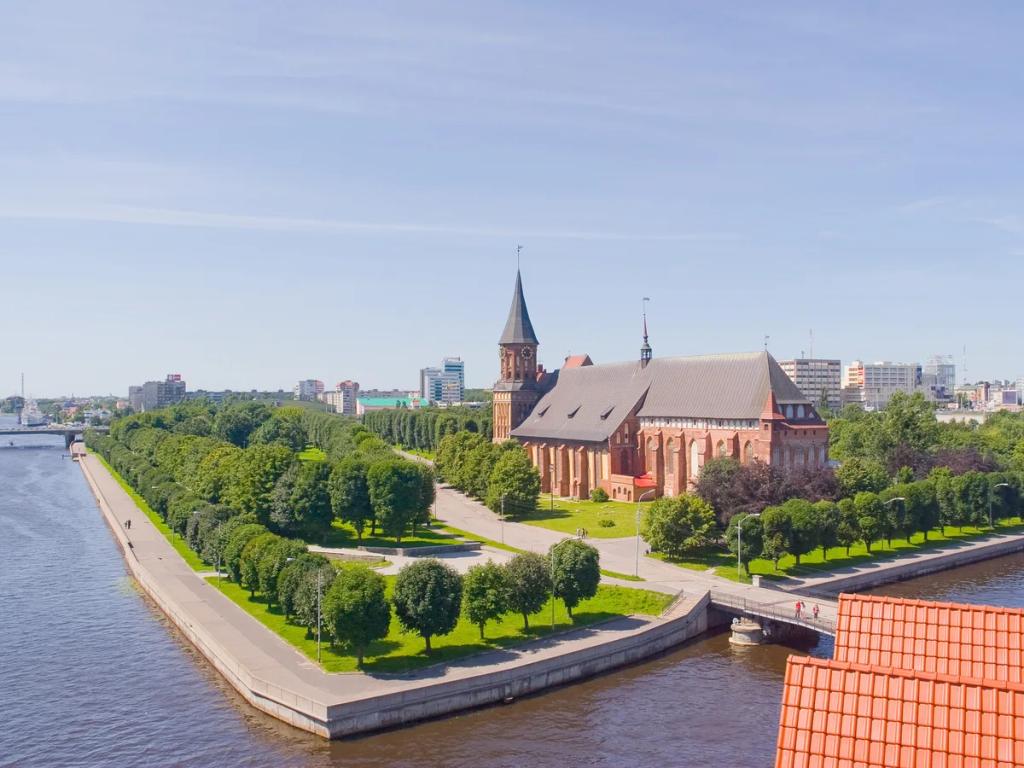
Konigsberg Cathedral on Kneiphof island, rebuilt after the war, with Immanuel Kant's tomb against its north wall - Kant was born, taught and died in this city and never really left it.
Amalienau and Maraunenhof, the surviving German villa districts, for a sense of the Konigsberg that the 1944 bombing and the 1945 assault erased almost everywhere else.
Fishing Village on the riverfront is the modern pastiche version of that lost city - photogenic, and honest about being a reconstruction.
Kaliningrad was Konigsberg, capital of East Prussia, for seven centuries before 1945 - which makes it a Russian city where the medieval cathedral is German and the street plan is Prussian.
It is the westernmost point of Russia and its only Baltic port that stays ice-free all year, which is precisely why it was retained.
Around 90% of the world's known amber sits in this small oblast, formed from the resin of forests that stood here some 40 million years ago.
And Kant's Critique of Pure Reason was written here, in a city he barely left in eighty years.
Amber Fest in Yantarny and the amber-themed events through summer are the local speciality.
City Day in early July fills the centre.
The White Nights effect is real but mild at this latitude - long Baltic evenings from June, without the full midnight sun of St Petersburg.
Winter is quiet, dark and damp, and much of the coast closes down. Zelenogradsk and Svetlogorsk are summer towns that hibernate.
The love: nowhere else layers German Prussia, Soviet reconstruction and modern Russia in quite this way, the Curonian Spit is genuinely world-class landscape, the amber story is unique, and the seaside towns of Svetlogorsk and Zelenogradsk are charming in a faded Baltic-resort way. It is also compact - you can see the region properly in four or five days.
The complaints are substantial and worth stating plainly. The card problem is a real constraint, not a minor inconvenience, and travellers who arrive without cash or a Mir arrangement have a difficult first day. Visa formalities are non-trivial and nationality-dependent. The centre is dominated by Soviet reconstruction that many visitors find bleak, and the House of Soviets - the notorious unfinished hulk on the old castle site - was demolished rather than rescued. English is limited. And the wider situation means flight routing, border rules and payment options all change more often than in an ordinary destination.
Go with cash, a downloaded map and realistic expectations of the city centre, and the Spit alone justifies the trip.
No. Cards issued outside Russia have not worked inside the country since 2022 - not for payment and not for ATM withdrawals. Bring cash to exchange, or arrange a Mir card, Russia's domestic network. Verify current Mir availability for foreigners close to your travel date, because the terms change.
Yes. Kaliningrad is Russia, so a Russian visa or the Kaliningrad e-visa is required. The e-visa covers stays up to 30 days and is accepted at Khrabrovo airport and the land borders, with roughly four days' processing - but eligibility depends on nationality.
Patchy. The spit is 98 km of dune and pine with few masts. Download offline maps before you leave the city, and do not plan on live navigation the whole way.
MTS generally has the strongest reach beyond urban areas, which is what matters on the coast road and toward the Spit. In the city itself all four national operators are comfortable.