Dushanbe runs on MegaFon Tajikistan, Tcell, ZET Mobile and Babilon Mobile, and your eSIM rides one of them as its host. The capital is comfortably covered - 4G throughout, and three of the four operators have launched 5G. Data is cheap. For most visitors, though, Dushanbe is a staging post rather than a destination, and what matters is what happens when you leave it.
Tajikistan has more administrative gates than most countries, and two of them are not negotiable.
The GBAO permit. Gorno-Badakhshan - the autonomous region containing the Pamir Highway, the Wakhan Valley and essentially every reason anyone comes to Tajikistan - requires a separate permit on top of your visa. The section of the Pamir road between Qalai Khumb and Kyzyl-Art is inside it.
The critical detail: you cannot buy it at the checkpoint. There is a strictly enforced post on the road into GBAO, and travellers without a valid permit are turned back. No exceptions, no negotiation, and a very long drive back.
How to get one:
- Online, with your e-visa at the official portal - tick the GBAO box and pay roughly USD 20 extra, and it arrives attached to the visa. This is the simple route.
- At a Tajik embassy when applying for the visa.
- At OVIR in Dushanbe, on Mirzo Tursunzoda Street near the Opera and Ballet Theatre - the fallback if you arrived without one.
OVIR registration. Staying more than 10 days means registering with OVIR within 10 working days of arrival. The Dushanbe office closes Sundays and shuts at noon on Saturdays. Many hotels handle this for you; confirm rather than assume, because the penalty lands on you at departure.
Both are worth sorting before you fly. Neither is difficult; both are absolute.
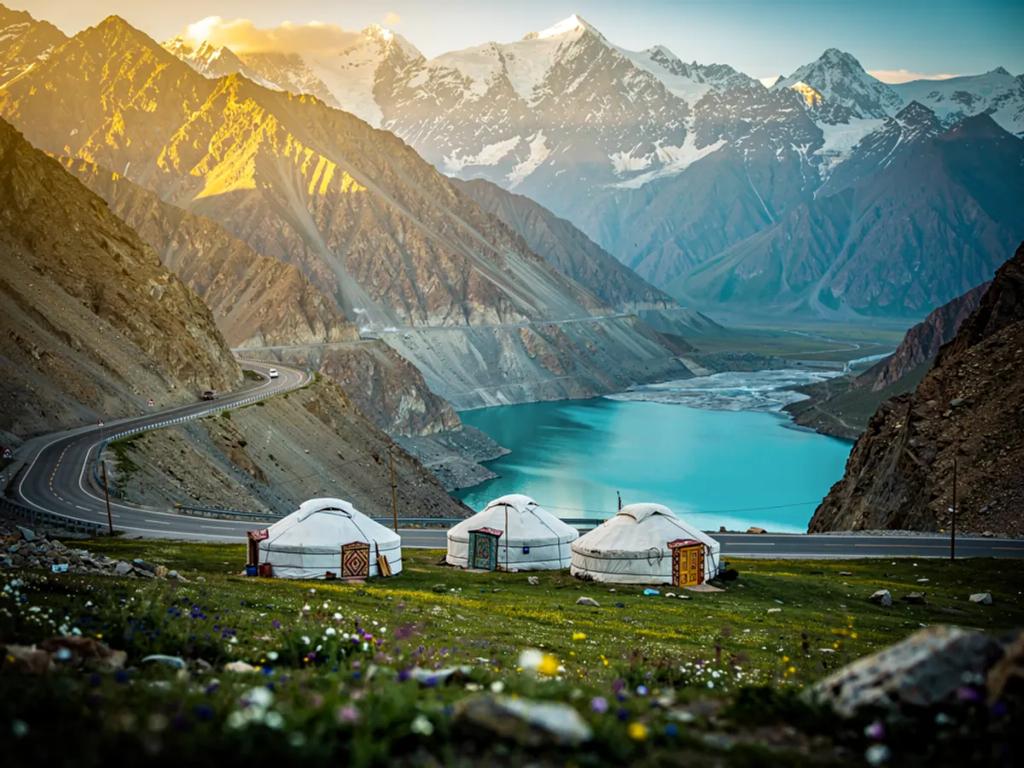
If you are here for the M41, understand what you are driving into. The Pamir Highway is among the most remote major roads on earth - a route across a high-altitude desert plateau, much of it above 3,500 m, with settlements hours apart.
- Coverage follows the villages, and the villages are sparse. Khorog has service. Murghab has some. The passes and the long empty stretches between them have nothing.
- Tcell and MegaFon are the two worth having for this route; they are the ones with any presence in the Pamirs at all, and even then it is patchy.
- Download everything. Maps, permits, accommodation contacts, the lot. Then download it again somewhere else.
- Satellite communicators are standard kit for cyclists and independent drivers on this route, and that tells you what you need to know.
This is not a road where a data plan saves you. It is a road where preparation does.
Tajikistan annulled licences for IP telephony back in 2018, and operators have been required to block voice and video calling over foreign messengers since. That restriction remains in force.
Practically: WhatsApp, Telegram and similar messaging works, but the calls through them may not connect. It is inconsistent - people report varying experiences at different times and on different networks - which is its own kind of frustrating.
Internet access in Tajikistan is also periodically restricted more broadly, particularly around sensitive dates. Plan on messaging rather than calling, and do not make a video call the linchpin of anything.
The Fann Mountains, four to five hours north and the country's most accessible trekking, are a lake-and-ridge landscape with very little coverage once you leave the road.
Iskanderkul, the alpine lake named for Alexander the Great, has patchy service.
The Anzob tunnel on the road north - once notorious enough to be nicknamed the Tunnel of Death before its refurbishment - is a long, dark, unlit hole in a mountain.
Dushanbe itself is the easy part: flat, laid out on a Soviet grid, and well covered.
- Offline maps, comprehensively. The single most important preparation for Tajikistan.
- Ride-hailing is limited. Taxis are cheap and are hailed or arranged; shared taxis and marshrutkas do the intercity work. There is no reliable Uber-equivalent to fall back on.
- A translation app. Tajik is a Persian language written in Cyrillic - an unusual combination that defeats guessing. Russian is very widely spoken and is often more useful than English.
- A currency app. The somoni is not a currency you will have intuition for, and Tajikistan is heavily cash-based - cards work in Dushanbe hotels and little else. Bring clean, new US dollars to change.
Dushanbe International (DYU) is close to the centre, about 5 km, and small. Flights come mainly from Istanbul, Dubai, Moscow, Almaty and Urumqi.
Overland entries from Uzbekistan and Kyrgyzstan are common and straightforward; the Kyrgyz route over the Pamirs is the classic approach and needs the GBAO permit before you start.
Arrive with data working. Between confirming the hotel, the OVIR question and arranging onward transport, the first hours want connectivity.
Little in the city, and almost none in the mountains - because there is nothing to use it on.
For a week based in Dushanbe, 1GB per 3 days is generous. For a Pamir trip, the data is spent before you leave: downloading maps, routes and offline copies of everything. Plans top up from your dashboard.
Summer in Dushanbe is genuinely hot - 35-40C in July, dry rather than humid.
The mountains are a different country. The Pamirs are cold at altitude in any season, and the plateau drops below freezing at night even in summer. If your itinerary includes both, you are packing for two climates.
Dress modestly. Tajikistan is a secular state but a conservative society, and covered shoulders and knees is the norm for both men and women outside the capital's most modern spots. Note that in some contexts local women avoid certain garments and visitors are simply expected to be neat and covered.
Sturdy shoes, and sun protection at altitude, where the UV is severe.
Rudaki Avenue and the Palace of Nations, with Dushanbe's enormous flagpole - for years the tallest in the world - and the ceremonial architecture of a capital built to impress.
The National Museum of Tajikistan for the reclining Buddha of Ajina-Teppa, 13 metres of it, the largest in Central Asia.
Iskanderkul, the turquoise mountain lake a few hours north - the classic day trip out of the city.
But the photographs people actually come for are on the road:
The Wakhan Valley, with the Panj river separating Tajikistan from Afghanistan and the Hindu Kush rising on the far bank - one of the great frontier landscapes anywhere.
Karakul lake on the high plateau, and the Ak-Baital pass at over 4,600 m.
Bulunkul, reputedly the coldest inhabited place in Central Asia.
Tajikistan is over 90% mountain, and more than half the country sits above 3,000 m.
Ismoil Somoni Peak, at 7,495 m, is the highest in the former Soviet Union - it was called Communism Peak until 1998.
The Pamir Highway is the second-highest international highway in the world and was built by Soviet engineers in the 1930s to supply the frontier.
And Tajik is essentially Persian - closely related to the Farsi of Iran and the Dari of Afghanistan - but written in Cyrillic, a legacy of the Soviet period.
Navruz, 21 March, is the Persian new year and the biggest celebration of the year across the country.
Independence Day, 9 September, fills Dushanbe with ceremony.
The travel season is June to September for the Pamirs - outside it the passes are snowbound and the high route is closed.
Roof of the World Festival in Khorog brings Pamiri music and culture together in July.
The love: Tajikistan offers a scale of landscape that very few places can match, and it is still genuinely uncrowded. The Pamir Highway is one of the great overland journeys on earth, the Wakhan is extraordinary, and Pamiri hospitality is famous for good reason. Costs are low. And Dushanbe is a pleasant, green, surprisingly relaxed capital with excellent bread and a good bazaar.
The complaints are structural rather than aesthetic. The permits and registration are real administrative friction and catch unprepared travellers hard. Infrastructure is thin - roads are rough, breakdowns are normal, and altitude sickness on the plateau is common. VoIP restrictions and periodic internet limits frustrate people who expect to stay in touch easily. Dushanbe itself is short on sights: it was a small town before the Soviets built it, so there is little that is old. And this is a country where you should read current travel advice properly, particularly regarding the Afghan border areas.
Sort the permit first, budget more days than you think, and treat the road as the destination.
Yes, for the Pamir Highway, the Wakhan and anywhere in Gorno-Badakhshan - and you cannot buy it at the checkpoint. Get it online with your e-visa by ticking the GBAO box for around USD 20 extra, at a Tajik embassy, or at OVIR in Dushanbe. Travellers without one are turned back at the enforced post on the road in.
Only in the villages, and they are hours apart. Khorog and Murghab have some service; the passes and the plateau between them have none. Tcell and MegaFon are the two with any Pamir presence. Download everything before you leave, and note that satellite communicators are standard kit for independent travellers on this route.
Often not. Tajikistan annulled IP telephony licences in 2018 and operators are required to block voice and video calls over foreign messengers; the restriction is still in force and its enforcement is inconsistent. Messaging generally works. Do not build plans around a video call.
If you are staying more than 10 days, yes - within 10 working days of arrival. The Dushanbe office is on Mirzo Tursunzoda Street, closed Sundays and open only until noon on Saturdays. Many hotels will do it for you, but confirm rather than assume.