Yerevan runs on Viva, Ucom and Team, and your eSIM rides one of them as its host. Coverage across the city is good and inexpensive, and Armenia has better connectivity than its geography would suggest. That geography is the thing worth understanding before you come: this is a landlocked country with two of its four borders closed, which shapes how you get here, how you leave, and what you can see from the city.
Armenia's situation is unusual and it is not obvious from a map.
The Turkish border has been closed since 1993. It runs along Armenia's entire western edge and there is no crossing.
The Azerbaijani border is closed too, and has been for far longer in practical terms.
So overland access is through Georgia or Iran, and that is the whole list. The Georgian route via Tbilisi is the one nearly everyone uses.
Which means flying, for most visitors. Zvartnots is well connected to Europe, the Gulf and Russia.
Things are moving. Normalisation between Armenia and Turkey has accelerated - scheduled Istanbul to Yerevan flights resumed in 2026, visa procedures have been simplified and there has been talk of land trade reopening. This is a live situation, so check the current position rather than trusting anything undated, including this.
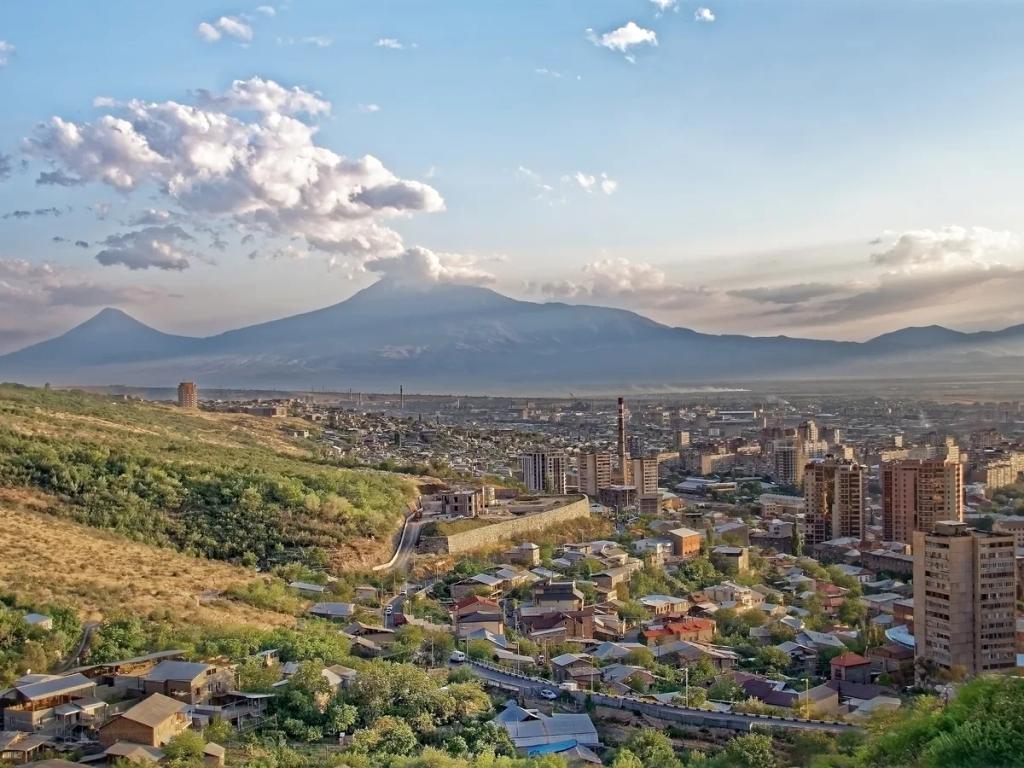
And then there is Ararat. The mountain on Armenia's coat of arms, visible from half the windows in Yerevan, floating over the city on a clear morning - is in Turkey, behind that closed border. Armenians look at their national symbol every day and cannot go to it. Nothing explains this country faster.
Brief, because it is simple: Armenia is not in the EU or the EEA, so Roam Like at Home does not apply and an EU SIM will bill at out-of-zone rates.
Local data is cheap and the networks are good, so a travel eSIM is straightforward and there is no reason to suffer the roaming bill.
Cards work well here, which is worth saying because it is not true of every country in the region - contactless is normal in Yerevan's cafes, shops and taxis. Carry some dram for markets and rural trips.
Worth knowing because it explains what you are looking at.
Large numbers of Russians relocated to Armenia after February 2022, many of them young and working in technology, and Yerevan absorbed a substantial wave in a matter of months.
It changed the city visibly - rents rose sharply, new cafes and co-working spaces opened, and Russian became even more audible on the street than it already was.
Some have since moved on, but a good deal of it has stayed and settled.
For a visitor this mostly means Yerevan is more cosmopolitan, better caffeinated and more expensive than it was a few years ago, and that the cafe you are working from may be full of people doing the same thing.
Yerevan is well covered, including the metro, which is a single short line and easy to use.
The mountain monasteries - Geghard, Haghartsin, Noravank - have coverage at the car parks and less in the gorges.
Tatev, in the far south, is reached by the world's longest reversible cableway and the ride itself is spectacular and largely disconnected.
Lake Sevan is fine around the resorts and thins on the eastern shore.
The mountain roads generally, and especially the passes in winter, drop out.
Near the closed borders, your phone may try to register on a Turkish or Azerbaijani network. Given the roaming rates, turn data roaming off if you are driving anywhere near the frontier.
- GG and Yandex Go, the ride-hailing apps that work here. Taxis are extremely cheap by European standards.
- Maps with offline copies for the monastery circuits and the south.
- A translation app. Armenian uses its own alphabet, which you cannot transliterate by guessing. Russian is widely understood, English increasingly so among the young.
- A weather app in winter, when mountain roads close.
- Telegram, which is more widely used here than in western Europe.
Zvartnots International (EVN) is about 12 km west of the centre, modern and quick, and 20 minutes from town.
Taxis and the ride apps both work from the terminal; agree a fare or use the app.
Overland from Tbilisi is a common and pleasant route - marshrutka, shared taxi or the slow overnight train - and takes most of a day.
Many nationalities enter visa-free; check your own before travelling.
In the city, Yerevan is compact and walkable in its centre, taxis are cheap, and the single metro line covers a useful north-south axis.
Not much for the city, where wifi is good and cafes are everywhere - Yerevan is a genuinely comfortable place to work remotely. Budget more for the monastery days and the drive south, where offline maps matter and the gorges swallow signal.
Summer is hot and very dry, above 30C and often well above. Light clothes, and the city moves outdoors in the evening.
Winter is properly cold with snow, and needs a real coat.
Spring and autumn are short and lovely, and need layers.
Modest dress for monasteries - shoulders covered, and a scarf for women's heads at some sites. Wraps are usually available at the door.
Comfortable shoes. Yerevan is walkable but hilly in places, and the monastery sites involve uneven stone.
Yerevan dresses well, particularly in the evening on Northern Avenue, and it is a city that goes out.
Ararat over the city, from the top of the Cascade, early on a clear morning before the summer haze. This is the shot.
The Cascade complex itself, a giant limestone stairway of terraces and sculpture, with the Cafesjian art collection on the way up.
Republic Square at night, when the fountains dance to music.
Khor Virap monastery, with Ararat directly behind it - the most photographed view in Armenia, and about 40 minutes from the city.
Geghard, a monastery partly carved into the rock, UNESCO-listed, with extraordinary acoustics when someone sings.
Garni, the only Greco-Roman colonnaded temple in the former Soviet Union, on a gorge edge with basalt organ-pipe cliffs below.
The Vernissage market at the weekend, for carpets, silver and Soviet cameras.
Tatev by cableway, in the south, for the ride as much as the monastery.
Yerevan is older than Rome. The fortress of Erebuni was founded in 782 BC, and the city celebrates its birthday from that date.
Armenia was the first state to adopt Christianity, in 301 AD, which is why the churches here are older than almost anywhere.
The Armenian alphabet was invented in 405 AD by Mesrop Mashtots and is used for nothing else. There is a monument to it, with the letters carved as standing stones.
The oldest known winery was found in Armenia, in the Areni-1 cave, dating back around 6,100 years, along with the oldest known leather shoe.
Yerevan is built of pink tuff, a volcanic stone, which is why the whole city changes colour with the light and is nicknamed the Pink City.
Armenian brandy has a Churchill story attached - that he was so taken with it at Yalta that Stalin sent him a supply annually. It is repeated everywhere and is at least half true.
And lavash, the flatbread baked on the wall of a clay oven, is on the UNESCO intangible heritage list.
Vardavar, in July, when the entire country throws water at each other for a day. Nobody is exempt, tourists least of all, and buckets are launched from balconies. Put your phone in a sealed bag or leave it in the hotel - this is not a suggestion.
Independence Day, 21 September, with fireworks over the city.
Genocide Remembrance Day, 24 April, when hundreds of thousands walk to the Tsitsernakaberd memorial with flowers. It is solemn and enormous, and visitors are welcome to join respectfully.
Yerevan Wine Days, in May, when a whole district is closed to traffic and given over to Armenian wine.
The Areni Wine Festival, in October, in the valley where the winemaking started.
May, June, September and October are the best months. July and August are very hot.
The love: Armenia offers a genuinely ancient culture in a small, cheap, welcoming country that very few people visit. The monasteries are spectacular and set in dramatic landscape; the food and wine are excellent and improving fast; Yerevan is a sociable, cafe-filled, late-night city with a serious arts scene; and Armenians are hospitable in a way that visitors find almost overwhelming. It is also very good value and extremely safe.
The complaints are consistent. Getting here is not casual - two closed borders and a landlocked position. Yerevan's architecture is largely Soviet, and though the pink stone softens it, people expecting an ancient-looking city are surprised that the old parts are outside it. Winter air quality in the city is poor. The region is tense, and while Yerevan itself is safe and normal, travel advice for border areas is restrictive and worth reading. English is limited among older people. And the country's history is heavy, and engaging with it honestly is part of being here rather than something to skip.
Come in late May or September, base yourself in the centre, hire a driver for a monastery day, and get up early for Ararat before the haze.
No. Armenia is in neither the EU nor the EEA, so an EU SIM roams at out-of-zone rates. Local data is cheap and the networks are good, so a travel eSIM makes obvious sense. Unlike some neighbours, cards work well here and contactless is normal in the city.
No. Both borders are closed - Turkey's since 1993. Overland access to Armenia is via Georgia or Iran only, and most visitors fly. Normalisation with Turkey has been moving, with scheduled Istanbul-Yerevan flights and simplified visas, so check the current position before assuming anything.
Because the closed border is still a border, and cells on the other side of it reach across. Near the western or eastern frontiers your handset may register on a Turkish or Azerbaijani network at full roaming rates. Turn data roaming off if you are driving in those areas.
Only in a waterproof bag. Vardavar in July is a nationwide water fight with no exemptions for visitors, and water arrives from balconies, cars and passing strangers. Locals seal their phones or leave them at home for the day.