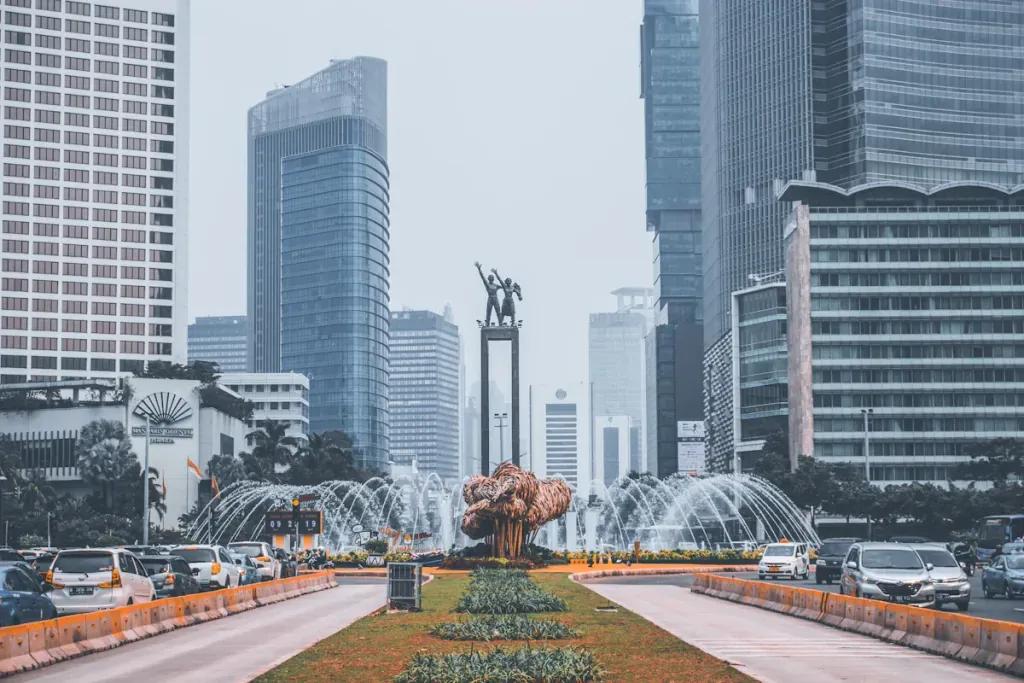
Jakarta is served by Telkomsel, Indosat and XL Axiata, and your eSIM will sit on whichever performs best in your district. Coverage is dense, 5G is widespread in the centre, and Indonesian data is cheap - our Bali and Batam guides cover the country's networks and the Nyepi shutdown that catches people further east. What makes Jakarta unlike any other capital in this series is that the city is sinking, and the government has legally moved the capital somewhere else because of it.
This is genuinely happening, it is not a metaphor, and it explains a great deal about what you will see.
North Jakarta has dropped around two and a half metres in a decade, and parts of it continue to subside by more than twenty centimetres a year. That is among the fastest rates of urban subsidence measured anywhere.
The cause is groundwater. Piped supply never reached much of the city, so households and businesses pump from the aquifer beneath it, and the ground compacts as the water leaves. The city sits on a delta, so there was not much margin to begin with.
Roughly the northern fifth of the city is already below sea level, held back by sea walls that have to be raised repeatedly. You can stand on a dyke in Muara Baru and look down at the neighbourhood behind you.
So Indonesia is moving its capital. Nusantara, in East Kalimantan on Borneo, was announced in 2019 and legislated as the new capital, and construction is underway.
But do not expect a ghost town. The transition has been slow, expensive and politically contested, ministries have moved only partially, and Jakarta remains overwhelmingly the country's economic, financial and cultural centre. What you visit is still the real city; what has changed is its constitutional title.
Flooding is the practical consequence. Between November and March, serious floods are routine - not a freak event but an annual feature, closing roads and sometimes districts. Check conditions before travelling in those months and do not schedule tightly.
Jakarta's congestion is legendary, and the local solution is not a road or a train. It is two wheels.
The ojek is a motorbike taxi, and Jakarta is where the app version was invented. Gojek began here as a call centre dispatching motorbike couriers and grew into one of Southeast Asia's largest technology companies.
Gojek and Grab both operate, and both do rides, food, parcels and payments in one app.
Take the motorbike option, not the car. A journey that takes an hour in a taxi takes twenty minutes on a bike threading between stationary vehicles. Helmets are provided. It is the single most useful thing a visitor learns here.
The MRT opened in 2019 and is clean, air-conditioned and covered by signal, running north to south through the centre with extensions underway.
TransJakarta, the bus rapid transit network, has dedicated lanes and is the largest BRT system in the world by route length - it goes far more places than the MRT.
A car in Jakarta traffic is a decision to spend your day in one. There is also an odd-even licence plate scheme on major roads at peak times, which affects hired cars.
The city is comprehensively covered, MRT included.
Congestion rather than absence is the failure mode, as in any megacity of thirty million people - full bars and nothing moving, particularly at peak hours and during events.
The Thousand Islands (Kepulauan Seribu), the archipelago in the bay, is covered on the developed islands and patchy between them.
Bogor and Puncak, up in the hills south of the city, thin in the valleys and the tea plantations.
During floods, power cuts affect local infrastructure and mobile service degrades in affected districts. Hotel wifi in the business areas generally survives.
Inside the older kampung districts, dense low-rise housing gives weaker indoor signal than the coverage map suggests.
The currency is the rupiah and the numbers are enormous - a modest meal runs into the tens of thousands. Count the zeroes carefully.
QRIS is the national QR standard, and it is on every counter from mall to warung. Local e-wallets - GoPay, OVO, Dana - dominate daily spending.
Most need an Indonesian number to register, so visitors generally fall back on cards and cash.
Cards work in malls, hotels and chain restaurants and much less elsewhere. Cash for street food, warungs and small vendors.
Jakarta's malls are civic infrastructure, not just shopping - air-conditioned, enormous, and where a great deal of the city's social life happens because the streets are hot, congested and often unwalkable.
- Gojek and Grab, and specifically their motorbike options.
- A transit app or the MRT's own, plus TransJakarta route information.
- Maps with offline copies, useful during floods and in the kampung lanes.
- A translation app. Indonesian is relatively approachable and English is common in business and hotels, thinner on the street.
- A flood information account or app in the wet season - the city publishes water-level and inundation data.
Soekarno-Hatta International (CGK) is about 30 km northwest, and the transfer is the first lesson in Jakarta traffic - anything from 45 minutes to well over two hours.
The Airport Rail Link runs to Sudirman and BNI City stations in around 45 minutes and is immune to the traffic. It is the reliable option and most visitors do not know it exists.
Grab and Gojek work from the airport, as do official taxis - Bluebird is the reputable metered operator and using their app avoids the fare conversation.
Halim (HLP) handles some domestic flights and is closer in.
Most nationalities get visa-free entry or visa on arrival for tourism; check the current position for your passport.
A good amount, and it is inexpensive here. Ride apps run continuously, maps are in constant use, and the city rewards being able to reroute. Hotel and mall wifi is good. In the wet season, having data while stuck somewhere unexpected is worth the extra.
Light, breathable clothing, and accept that you will be damp. The humidity is constant.
A layer for indoors. Malls, offices and cinemas are air-conditioned to a degree that feels punitive after the street.
Modest dress. Indonesia is the world's largest Muslim-majority country and Jakarta, while cosmopolitan, is not a place for very short shorts or vests away from hotel pools. Shoulders and knees covered is the easy default, and a scarf for mosque visits.
Shoes you can walk and get wet in. Pavements are inconsistent and flooding is seasonal.
Something smarter for the evening. Jakarta's bar and restaurant scene in the south of the city is genuinely good and people dress for it.
Kota Tua, the old Dutch Batavia square, with its colonial buildings and rented bicycles, in late afternoon.
Istiqlal Mosque, the largest in Southeast Asia - and the Jakarta Cathedral directly across the road from it, with an underground "tunnel of friendship" now connecting the two. That pairing is the single most Indonesian thing in the city.
Monas, the National Monument, from the surrounding park, with the flame at the top.
The skyline from a rooftop bar in the Sudirman corridor at dusk, with the traffic rivers below.
Glodok, the Chinatown, for the temples and the market lanes.
A warung meal, photographed honestly - the food here is the real reason to come.
The Thousand Islands, a couple of hours by boat, for the version of Java that is not concrete.
Sunda Kelapa, the old harbour where wooden pinisi schooners still load cargo by hand.
Greater Jakarta is one of the largest metropolitan areas on earth, with something over thirty million people in it - larger than many countries.
Gojek started with twenty motorbike drivers and a phone line, and became one of the region's defining technology companies. It is a genuinely Jakartan story.
Istiqlal Mosque was designed by a Christian architect, Frederich Silaban, who won the open competition - and it faces the Catholic cathedral across the street deliberately.
TransJakarta operates the longest BRT network in the world by total route length.
The city has had many names - Sunda Kelapa, Jayakarta, Batavia, Jakarta - and each one marks who was in charge.
And Jakarta is legally no longer the capital, which makes it one of very few cities in the world to have been the seat of government and then formally handed the title to a place still being built.
Idul Fitri, at the end of Ramadan, when millions leave for their home towns in the mudik exodus and Jakarta becomes briefly, eerily empty. Transport is impossible in the days either side and much closes.
Jakarta Fair, from June into July, an enormous month-long fair marking the city's anniversary.
Independence Day, 17 August, with neighbourhood games and competitions across the city.
Chinese New Year, marked substantially in Glodok.
April to October is the drier season and the sensible time to visit. November to March brings the rain and the floods.
The love: Jakarta is where Indonesia actually happens, and visitors who give it more than a transit night usually find far more than they expected. The food is superb and spans the whole archipelago, the bar and music scene in the south is excellent, the museums and old town are improving fast, and the sheer energy of a thirty-million-person city building itself in real time is compelling. It is also very cheap and the people are exceptionally friendly.
The complaints are serious. The traffic genuinely eats days. The air quality is poor and sometimes very poor. It is not a walking city - pavements stop, crossings are scarce and the heat is relentless. Flooding disrupts the wet season. There are few conventional sights, and visitors wanting a tidy itinerary struggle. And most people treat it as an airport with a city attached on the way to Bali, which is understandable and a loss.
Come in the dry season, take the Airport Rail Link in, use motorbike taxis for everything, and give the city two days rather than one night.
Legally, no - Nusantara in East Kalimantan was designated the new capital and construction is underway. In practice the move has been slow and contested, ministries have relocated only partially, and Jakarta remains the country's economic and cultural centre. What you visit is unchanged; the title is what moved.
A motorbike taxi through Gojek or Grab. A trip that takes an hour by car takes twenty minutes on a bike, because bikes pass stationary traffic. The MRT is excellent along its line and has signal throughout, and TransJakarta's bus lanes cover far more of the city.
It can. Serious flooding is an annual feature between November and March rather than a rare event, closing roads and occasionally districts, and it degrades mobile service locally through power cuts. Business-district hotels generally stay dry and connected. Do not schedule tightly in those months.
Take the Airport Rail Link to Sudirman or BNI City, which takes about 45 minutes regardless of the roads. Most visitors do not realise it exists and sit in a taxi for two hours instead.