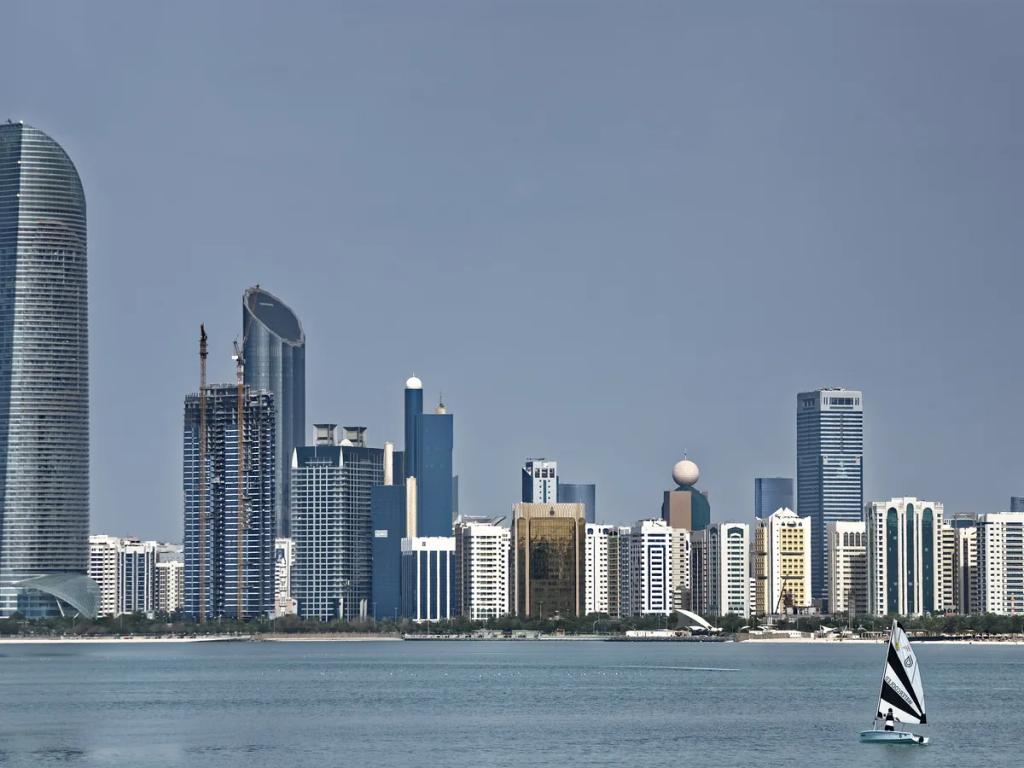
Etisalat and du cover Abu Dhabi, and your eSIM will use one of them. The UAE's restriction on VoIP calling over consumer apps is dealt with properly in our Dubai guide, and it applies identically here - that is a federal matter rather than an emirate one. What our Dubai guide cannot tell you is that Abu Dhabi is not Dubai's quieter suburb. It is the capital, it is most of the country, and several things work differently ninety minutes down the road.
Worth understanding, because the relationship is the opposite of what most visitors assume.
Abu Dhabi is around 87% of the UAE's land area. Dubai is a small emirate on the coast; Abu Dhabi extends from the city across the desert to the Saudi and Omani borders.
It holds the great majority of the country's oil, which is why it funds federal spending and why the president of the UAE is traditionally the ruler of Abu Dhabi.
It is the capital, and the seat of federal government and the diplomatic corps.
And it is more conservative than Dubai. Not dramatically, but noticeably: dress standards in malls and public buildings are taken more seriously, public behaviour rules are enforced more consistently, and the city has less of the anything-goes tourist bubble.
The emirates set their own rules on some matters. Alcohol licensing, entertainment permissions and enforcement practices differ across the seven, and what is unremarkable in a Dubai hotel may not be in an Abu Dhabi public space. When in doubt, behave as you would in the more conservative of the two.
Which means the day trip runs the wrong way. Most visitors base themselves in Dubai and come here for a day, see the mosque and the Louvre, and leave. Abu Dhabi rewards being based in rather than sampled.
Sheikh Zayed Grand Mosque is the reason most people come, and it is genuinely one of the great buildings of the last century.
Entry is free, and non-Muslims are welcome - which is not true everywhere in the region.
The dress code is enforced at the door, properly, and people are turned away every day.
Women need everything covered except face and hands: ankles, wrists, and hair. Loose clothing, nothing sheer, nothing tight. Abayas are lent free of charge at the entrance if you arrive unprepared, though the queue for them is long at peak times.
Men need long trousers and sleeves - no shorts, no vests.
Book a timed slot. Entry is by advance registration and it fills, particularly at sunset, which is when the building looks best.
It is a working mosque. It closes to visitors during Friday prayers and at other prayer times, and the behaviour expected inside is that of a place of worship rather than a monument.
Louvre Abu Dhabi opened in 2017 on Saadiyat Island, in a Jean Nouvel building whose perforated dome creates a shifting "rain of light" on the plaza beneath it. The building alone justifies the visit.
The collection is genuinely good and deliberately universal - objects from different civilisations displayed together by period rather than by culture, which is the whole curatorial argument.
Zayed National Museum and further institutions have followed on the same island, with more still under construction.
This is the emirate's long bet: that a cultural district can outlast the oil, and that Abu Dhabi rather than Dubai becomes the region's serious cultural capital.
Whether that works is an open question, but as a visitor you get a world-class museum with a fraction of the crowding of its Paris namesake.
The city and the islands are comprehensively covered. UAE networks are fast and dense, and 5G is everywhere.
Inside the Grand Mosque, coverage is fine in the courtyards and weaker in the prayer halls - where you should not be on your phone anyway.
The desert is the gap. Once you are off the highway into the dunes towards Liwa and the edge of the Empty Quarter, coverage stops. Desert driving here needs a guide, deflated tyres and a convoy, and people get stuck regularly.
Sir Bani Yas Island, the wildlife island a few hours west, is covered around the resorts and thin across the reserve.
The Al Ain road and the oases inland are well served along the route.
On the Corniche and Yas Island, everything works, including during the Grand Prix - the networks reinforce heavily for it.
Summer here is humid. Abu Dhabi sits on the Gulf, so 45C comes with humidity that inland desert cities do not have, and the combination is genuinely oppressive.
Dew point in August can make the outdoors feel unbearable at any hour, including the middle of the night.
Everything is built around avoiding it - covered walkways, malls, car-to-lobby transitions. The city is not designed for walking in summer and does not pretend to be.
November to March is superb and is when the whole calendar happens.
Rain is rare and disruptive. When it does fall, drainage struggles and roads flood quickly.
Sandstorms occasionally reduce visibility and delay flights.
- Careem and Uber, both of which operate; taxis are also metered, plentiful and cheap here in a way they are not everywhere in the region.
- The Louvre Abu Dhabi and Grand Mosque booking sites, both of which use timed entry.
- Maps with offline copies for any desert trip.
- A translation app is rarely needed. English is effectively the working language of the city, and signage is bilingual.
- Darb, for the road tolls, if you are driving a hire car.
Zayed International (AUH) is about 30 km from the centre, and its Terminal A - opened in 2023 - is among the more impressive airport buildings anywhere.
Taxis and ride apps work from the terminal; the drive into the city takes 30 to 40 minutes.
From Dubai, the road is about 90 minutes and there are frequent intercity buses. Many visitors do this as a day trip, which is the wrong way round.
Etihad is the home carrier and connects widely, which makes Abu Dhabi a straightforward stopover point.
Many nationalities enter visa-free or on arrival; check your own before flying.
Moderate. Wifi is universal, distances are long so ride apps run constantly, and the networks are excellent. The one thing worth preparing is offline mapping for the desert, where coverage genuinely stops.
Modest in public, everywhere. Shoulders and knees covered in malls, souqs and public buildings - this is signposted and it is taken more seriously here than in Dubai.
For the Grand Mosque, as above: everything but face and hands for women including hair, long sleeves and trousers for men.
Swimwear at hotel pools and private beaches only.
Light natural fabrics in summer, and a layer for the ferocious air conditioning indoors.
Something smart for the evening. Abu Dhabi's hotel restaurants and the Grand Prix week dress up considerably.
Sunglasses and sun protection all year - the glare off the water and the sand is strong even in winter.
Sheikh Zayed Grand Mosque at dusk, when the lighting shifts through the phases of the moon across the domes - book the last slot of the day.
Louvre Abu Dhabi's dome from beneath, with the light falling through it onto the plaza and the sea beyond.
Qasr Al Watan, the presidential palace, which is open to visitors and is astonishing inside.
The Corniche at sunset, with the skyline behind and the beach in front.
Emirates Palace, for the scale of it.
Liwa's dunes, on the edge of the Empty Quarter, three hours south - Moreeb Dune is one of the largest in the world.
Al Ain oasis, a UNESCO site inland, with its falaj irrigation channels under the palms.
Yas Marina Circuit during Grand Prix week, or the Ferrari World rollercoaster if that is your thing.
Abu Dhabi is about 87% of the UAE by land area, and holds the large majority of its oil reserves - which is why the federal capital is here rather than in the better-known emirate.
Louvre Abu Dhabi's dome is made of nearly eight thousand metal stars in overlapping layers, engineered so that sunlight through them creates a dappled effect the architect called a rain of light.
The Grand Mosque holds the world's largest hand-knotted carpet, made by around a thousand weavers, and among the largest chandeliers ever built.
Al Ain's falaj irrigation channels are UNESCO-listed and have been moving water through the oasis for thousands of years - the same system found across Oman.
Ferrari World has one of the fastest rollercoasters in the world, which accelerates hard enough that riders wear goggles.
And the Empty Quarter starts here. The Rub' al Khali, the largest continuous sand desert on earth, begins in Abu Dhabi's southern desert at Liwa.
The Abu Dhabi Grand Prix, in late November or December, which closes the Formula 1 season at Yas Marina under floodlights and fills every hotel in the emirate.
Ramadan, when eating, drinking and smoking in public during daylight are not done, hours shift dramatically and the city comes alive after sunset.
Eid al-Fitr and Eid al-Adha, both major.
UAE National Day, 2 December, marked substantially.
November to March is the season - everything outdoors happens in this window and the weather is close to perfect.
The love: Abu Dhabi is the calmer, more considered version of the Emirates, and visitors who give it more than a day trip usually prefer it to Dubai. The Grand Mosque and the Louvre are both genuinely world-class, Qasr Al Watan is extraordinary, the Corniche is a proper city beach, and the desert at Liwa is real desert rather than a dune-bashing excursion. It is also less crowded, less frantic and rather more grown-up.
The complaints are consistent. The summer heat and humidity rule out half the year completely. It is spread out and you will use taxis constantly. It can feel quiet - visitors wanting Dubai's density of things to do find it sedate. It is expensive, particularly hotels in season. And the conservatism catches out people who arrived expecting Dubai's tourist bubble to extend down the road.
Come between November and March, stay here rather than commuting from Dubai, book the mosque for the last slot of the day, and give Saadiyat a full morning.
No - the UAE restricts VoIP calling on consumer apps, and that is a federal rule applying in Abu Dhabi exactly as in Dubai. Our Dubai guide covers the detail and the licensed alternatives. Messaging works normally; it is voice and video calling that is blocked.
Not quite. The federal rules are shared, but Abu Dhabi is the capital and noticeably more conservative in practice - dress standards in public places are enforced more consistently and there is less of a tourist bubble. Behave as you would in the stricter of the two and you will have no difficulty.
Women: everything covered except face and hands, including hair, in loose non-sheer clothing. Men: long trousers and sleeves. It is enforced at the door and people are turned away daily. Abayas are lent free at the entrance, and entry itself is free but requires a timed booking, which fills at sunset.
Along the highways, yes. Once you leave them for the dunes towards Liwa and the Empty Quarter, no. Desert driving here requires a guide, deflated tyres and preferably a second vehicle - download offline maps and do not go alone.