Belgrade runs on three networks - mts (Telekom Srbija), A1 Serbia and Yettel - and your eSIM rides one of them as its host. Coverage across the city is dense 4G, and 5G has been rolling out with Telekom Srbija leading the national build. In practice the centre, New Belgrade and the main corridors are well served; you will not think about coverage inside the city at all.
This is the single most important connectivity fact about Belgrade, and it is not about signal quality at all.
Serbia is not in the European Union, and EU "Roam Like at Home" stops at its border. Drive down from Budapest or across from Zagreb with a European SIM and your allowance simply ends - what was included becomes billed, often at rates that make a week of ordinary map use genuinely expensive. Travellers arrive expecting the seamless behaviour they get everywhere else in Europe and discover the bill afterwards.
Two things soften it, neither of which helps a visitor from the EU or UK:
- Since July 2021 a Western Balkans roaming agreement lets residents of Serbia, Albania, Bosnia and Herzegovina, Kosovo, North Macedonia and Montenegro use their home plans across all six without surcharge. Excellent if you live in the region; irrelevant if you flew in from Munich.
- In February 2026 the European Commission said it wants to open negotiations to bring the Western Balkans into the EU roaming-free area. That is a direction of travel, not a date - nothing has changed for your phone yet.
Until it does, this is one of the clearest cases in Europe for arriving with a data plan already installed rather than finding out what your operator charges outside the zone.
Belgrade is built on a ridge above the confluence of two big rivers, and the topography is the story.
Kalemegdan's lower fortress and the casemates cut signal the way any thick-walled stonework does - the upper terrace above the Sava-Danube junction is fine, the tunnels below are not.
The splavovi - the barge clubs moored along the Sava and Danube - sit on water, below the bank, surrounded by steel and a great many phones all doing the same thing at 2am. Expect congestion rather than absence. If you are meeting people, agree the barge by name before you go down the embankment.
Underpasses and the Terazije tunnel do what underpasses do.
Otherwise the city is easy. New Belgrade's open blocks and the Zemun waterfront are both strong.
- CarGo is the local ride-hailing app and the one to install - Belgrade's answer to Uber, paying by card, PayPal or in-app credit, which spares you the cash-and-argument routine with street taxis. A short hop like Savamala to the Savski Kej clubs runs a few hundred dinars.
- Public transport is free. Since 1 January 2025 Belgrade's buses, trams and trolleybuses carry no fare at all on regular city and suburban lines - no ticket, no app, no validator. It is one of the more startling things about the city and it removes an entire category of tourist admin.
- Maps, constantly. Belgrade's street grid is not a grid, addresses run oddly, and the Cyrillic-Latin switch on signage means the name you are looking for may not be the name that is written.
- A translation app for menus outside the centre, where Cyrillic is the default.
Nikola Tesla (BEG) is about 18 km west of the centre. The A1 Airport Express minibus runs into town for around 400 dinars and is the simple, fixed-price option. Official airport taxis work on a voucher system - take the voucher from the desk inside rather than accepting an offer in the hall, which is the standard Belgrade arrival advice and still worth repeating.
Your data matters here mostly because of the taxi question: with CarGo running on your phone, the voucher desk becomes optional rather than necessary.
Moderate. You are navigating a walkable centre, hailing the occasional CarGo and not paying for transit at all.
For a long weekend, 1GB per 2-3 days is comfortable; a week of ordinary sightseeing sits around 3-4GB. Size up if the splav season has you posting video at 3am. Plans top up from your dashboard if the trip outruns the estimate.
Belgrade takes appearance seriously - it is a well-dressed city and the nightlife is not casual. Trainers and shorts will get you into a kafana; they will not always get you onto a barge.
Weather-wise the swing is wide. July and August are properly hot and often humid, and the city empties toward the rivers. Winter is cold with real snow, and the Kosava - the dry southeasterly that funnels down the Danube - can blow for days and takes several degrees off whatever the thermometer says. Layers in spring and autumn; a windproof outer layer earns its place any time between November and March.
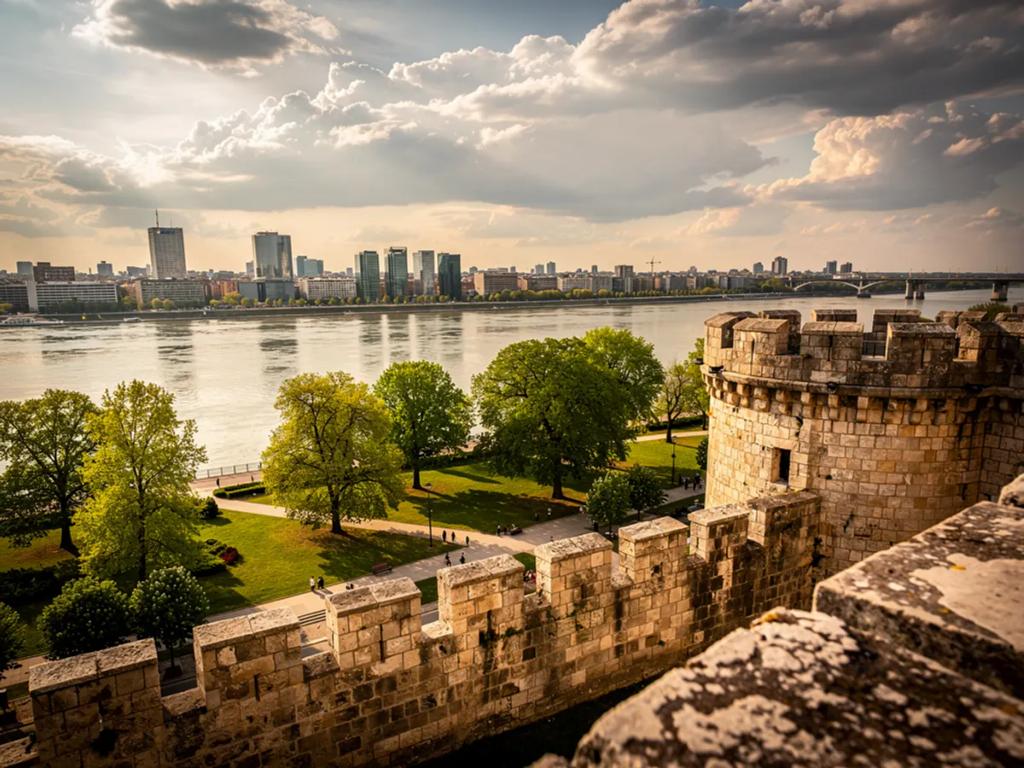
Kalemegdan at sunset, from the upper fortress looking out over the point where the Sava meets the Danube. It is the postcard for a reason, and the light in the last hour is worth timing your day around. The Pobednik statue is the classic foreground.
Skadarlija, the cobbled bohemian street of kafanas and lanterns - best in the early evening as the lamps come on and before the tables fill.
Zemun and the Gardos Tower, a short ride from the centre and a completely different city - Austro-Hungarian streets, a fishing quarter and the best elevated view over the Danube.
Beton Hala and the Sava waterfront for the modern city, and the contrast with Kalemegdan directly above it.
Belgrade sits where the Sava joins the Danube and has been fought over accordingly - the city has been destroyed and rebuilt more times than almost any capital in Europe, which is why the "old town" is younger than the fortress guarding it.
Its full free-transit policy makes it one of very few European capitals where a visitor can cross the city all week without buying a ticket.
And the splav is a genuinely local invention: a nightclub that floats, moored to the bank, moved or rebuilt between seasons, with the river doing the job that a soundproofed basement does elsewhere.
EXIT Festival in July is not in Belgrade - it is in Novi Sad, an hour north inside the Petrovaradin Fortress - but it reshapes Belgrade's summer, its trains and its hotel prices all the same.
Belgrade Beer Fest in August fills Usce Park by the confluence.
BITEF and BEMUS in the autumn are the serious theatre and classical-music festivals.
And splav season, roughly May to September, is when the river clubs open and the city's nightlife moves onto the water. Out of season, the same nightlife retreats indoors and the barges sit dark.
The love: Belgrade is unpolished in a way that increasingly few European capitals are, the nightlife is genuinely exceptional rather than merely marketed, the food is heavy and excellent and cheap, and free public transport plus low prices make it one of the best-value city breaks in Europe. People are direct and, once past the first exchange, extremely hospitable.
The complaints are fair. It is not a pretty city in the Prague sense - the architecture is a hard-edged mix of Austro-Hungarian, socialist-modernist and unfinished, and visitors expecting a chocolate-box old town are disappointed. Air quality in winter is poor. Street taxi overcharging is a real and persistent problem, which is exactly why the app matters. Smoking indoors is still common. And the roaming cliff above catches people who never thought about it.
Come for the rivers, the nightlife and the value rather than the architecture, and Belgrade rewards you.
No. Serbia is outside the EU and outside the Roam Like at Home zone, so an EU or UK SIM roams at out-of-zone rates that can be expensive. The European Commission said in February 2026 that it wants to negotiate bringing the Western Balkans into the roaming-free area, but nothing has changed yet. Arrive with a data plan already in place.
Yes. Since 1 January 2025 regular city and suburban buses, trams and trolleybuses carry no fare - no ticket to buy and no app needed.
CarGo. It is the local ride-hailing service, takes card and PayPal, and removes the pricing argument that street taxis are known for. From the airport, the official voucher desk or the A1 Airport Express minibus are the fixed-price alternatives.
Yes, with Telekom Srbija leading the national rollout and coverage focused on the city and main corridors. Everywhere a visitor goes has solid 4G at minimum.