MEO, NOS and Vodafone cover Lisbon, and your eSIM will use whichever is strongest. Portugal is in the EU and the eurozone, so an EU or EEA SIM works on its home allowance with no surcharge, coverage across the city is comprehensive, and Portuguese networks are quick. Note the clocks: Portugal runs an hour behind Spain, France and most of the continent, which catches out anyone arriving overland or booking a connection.
The thing your phone will get wrong here is not the signal. It is the walk.
This is the most practical piece of advice for Lisbon and it applies from your first morning.
Lisbon is built on hills - traditionally seven, in practice more - and the gradients are severe. Streets rise at angles that would be stepped in most cities.
Your maps app shows distance, not gradient. A route described as a nine-minute walk can be a sixty-metre vertical climb on worn limestone, and the app will cheerfully suggest it in August at two in the afternoon.
Check the contours before accepting a route. Switching to the terrain or satellite view, or simply looking at which way the street tilts, will save you a great deal.
The pavements are the other half of it. Traditional calçada portuguesa - hand-laid limestone cobbles - is beautiful and becomes genuinely slippery when wet, and worn smooth on the busiest streets. People fall.
Shoes with grip, not fashion soles. This is the single most common visitor complaint and it is entirely avoidable.
The lifts and funiculars exist for this reason. The Elevador da Glória, the Bica and the Lavra funiculars, and the Santa Justa lift are public transport, not attractions - they are covered by a normal transport pass, and they exist because the alternative is a climb.
Plan routes downhill. Take the metro or a funicular up and walk down. Locals do.
Lisbon's centre looks the way it does because of a single morning.
On 1 November 1755 an enormous earthquake struck, followed by a tsunami up the Tagus and a fire that burned for days. Tens of thousands died and most of the lower city was destroyed.
It happened on All Saints' Day, with churches full and candles lit, which is part of why the fire was so severe - and why the disaster shook European philosophy as much as it did the city. Voltaire wrote about it; the modern discipline of seismology traces its origins to the survey ordered afterwards.
The Marquis of Pombal rebuilt the Baixa on a grid, in about a decade - wide straight streets, uniform facades, standardised buildings, in a city that had been medieval lanes.
And he made it earthquake-resistant. The gaiola pombalina is a wooden cage frame built inside the masonry, designed to flex and hold the structure together under shaking. Models were reportedly tested by having troops march around them to simulate a quake.
It is among the first systematic anti-seismic construction anywhere, and it is why the Baixa's regular blocks look nothing like the tangled Alfama above them - Alfama largely survived because it sits on rock, which is also why it is the oldest part of the city.
Look for it as you walk. The Baixa's uniformity, the Alfama's chaos, and the line between them is 1755.
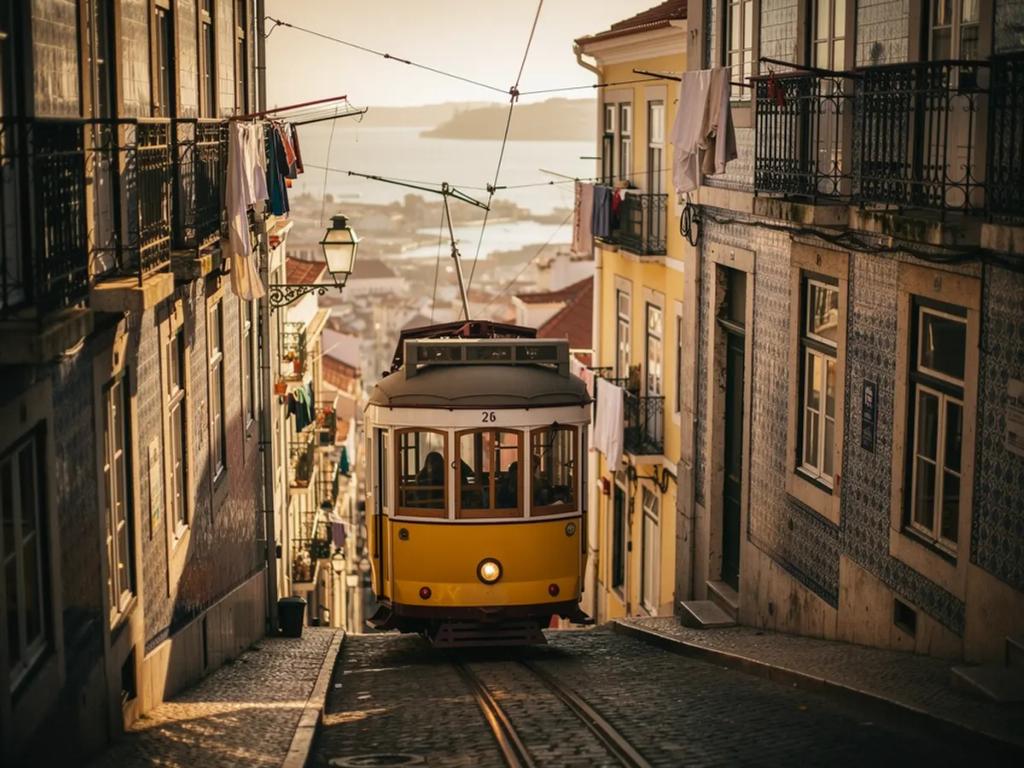
Tram 28 runs through Graça, Alfama, Baixa and Estrela on the original narrow-gauge network, in the small yellow remodelado cars, and it is genuinely lovely.
It is also a normal public tram on which people go to work, and in season the queue at Martim Moniz can be an hour.
Board at the far ends - Campo Ourique or Martim Moniz early in the morning - or accept standing.
Pickpocketing on 28 is well known. It is crowded, tourists are distracted by the view, and phones in back pockets go missing. Front pocket, bag closed, and do not stand at the doors with a phone out.
Tram 12 covers a shorter loop of the same hill with a fraction of the crowd, and the 24 was restored to Campolide.
Or take it at eight in the morning, when it is full of people going to work and you will get a seat.
The city is comprehensively covered, metro included.
Inside the Alfama's lanes, GPS drifts badly. The streets are narrow, the buildings are tall and stone, and your blue dot will wander across three alleys. Download the area offline and expect to navigate by eye.
The Tagus ferries to Cacilhas and Almada hold signal across the river, and the ride back at sunset is one of the cheapest good things in Lisbon.
Sintra, forty minutes by train, is covered in the town and thins in the wooded hills around Pena and the Moorish castle - and the roads up are narrow and jammed in season.
Cabo da Roca, the westernmost point of mainland Europe, is fine at the viewpoint and patchy along the cliff paths.
The Arrábida hills south of the river have gaps.
Worth saying plainly, because it is visible.
Lisbon's visitor numbers have grown enormously in about fifteen years, and short-term rentals have taken a substantial share of the housing stock in the central neighbourhoods.
Rents have risen far faster than Portuguese wages, and residents have been displaced from Alfama, Bairro Alto and Graça in significant numbers.
Policy has swung repeatedly - licensing freezes, then partial reversals - and it remains a live political argument.
What this means for a visitor: nothing that will inconvenience you, and something worth being conscious of. Stay in licensed accommodation, spend in neighbourhood businesses rather than only on the main drags, and be a quiet neighbour in a residential building at two in the morning.
Portuguese hospitality is genuine and undiminished, which makes it easier to forget that the person serving you may be commuting an hour because they cannot afford to live where they work.
- The Carris and Metro apps, or a general transit app - one Navegante card covers metro, trams, buses, funiculars and the ferries.
- Bolt, Uber and FREE NOW, all of which operate and are inexpensive.
- Maps with Alfama downloaded offline, for the GPS drift.
- CP for trains to Sintra, Cascais and Porto.
- A translation app is optional. English is very widely spoken in Lisbon, to a high standard - Portuguese television is subtitled rather than dubbed, which is the usual explanation.
Humberto Delgado Airport (LIS) is unusually close - about 7 km from the centre, inside the city, and connected directly by the red metro line.
The metro is the obvious way in, twenty minutes to the centre with one change. Bolt and Uber also work, and taxis are metered.
The airport is congested, being hemmed in by the city, and a replacement has been debated for decades. Allow time on departure, particularly in summer.
By train, Santa Apolónia and Oriente connect to Porto in under three hours and to Spain.
In the city, the metro is clean and cheap, the trams and funiculars are transport rather than tours, and the ferries across the Tagus are on the same ticket.
Not much. Wifi is everywhere, the city is compact, and EU visitors are on their home allowance anyway. The one thing worth doing is downloading Alfama offline, because that is where navigation actually fails.
Shoes with grip. Repeating it because it matters more here than anywhere else in this series: worn limestone cobbles on a steep hill in the rain are genuinely treacherous.
Layers. The Atlantic means a warm afternoon turns cool as soon as the sun drops, and the wind off the estuary is constant.
Summer is hot and dry but rarely oppressive, thanks to the sea breeze that comes up in the afternoon.
A rain jacket in winter, which is mild but properly wet.
Lisbon dresses casually but neatly. Nothing formal is needed; scruffy is noticed.
Miradouro da Senhora do Monte at sunset, the highest viewpoint, looking over the whole city to the river.
Miradouro de Santa Luzia, with the tiled panels and the bougainvillea over Alfama.
Tram 28 on a steep Alfama corner, which is the postcard - stand on Rua das Escolas Gerais and wait.
Belém Tower and the Jerónimos Monastery, both UNESCO-listed Manueline masterpieces, early before the queues.
The 25 de Abril bridge from Cais do Sodré, with Cristo Rei on the far bank.
LX Factory under the bridge, a converted industrial complex of bookshops and restaurants.
Sintra's Pena Palace, forty minutes out, and go at opening or not at all.
A pastel de nata at Belém, from the shop that has been making them since 1837 to a recipe it does not share.
The 1755 earthquake changed European thought. Its scale prompted Voltaire's Candide and Rousseau's response, and the systematic questionnaire sent to parishes afterwards is considered a founding document of seismology.
The gaiola pombalina - the flexible wooden cage inside Baixa's buildings - is among the earliest deliberate anti-seismic engineering in the world.
Bertrand, on Rua Garrett, is the oldest operating bookshop in the world, trading since 1732 and holding a Guinness record for it.
Fado is on the UNESCO intangible heritage list, and Alfama and Mouraria are where it comes from - the small houses with a guitarist and a singer are the real thing, the large dinner shows less so.
Lisbon is older than Rome by most reckonings, with Phoenician origins - a claim the city makes frequently and which is broadly defensible.
And the pastéis de Belém recipe is a genuine secret, made in a locked room by a handful of people who have signed confidentiality agreements. Every other custard tart in Portugal is a pastel de nata; only that shop's are pastéis de Belém.
Santo António, 12 and 13 June, the city's great festival - grilled sardines on every corner, marches down the Avenida da Liberdade, and Alfama, Graça and Mouraria turned into street parties all night. It is the best time to be here and the busiest.
Web Summit, in November, one of the largest technology conferences in the world, which fills every hotel in the city.
Carnival, in February.
The Lisbon Half Marathon, in March, run across the 25 de Abril bridge.
March to June and September to October are the best months. August is hot and the city partly empties for the coast.
The love: Lisbon has extraordinary light, a river the size of a sea, tiled facades, viewpoints on every hill, and a food culture that runs from a two-euro coffee and custard tart to serious restaurants. It is one of the sunniest capitals in Europe, it is safe, it is still cheaper than most of western Europe, and it is unusually welcoming in English. The Atlantic beaches at Cascais and Costa da Caparica are half an hour away and Sintra is forty minutes.
The complaints are consistent. The hills exhaust people who did not expect them. The cobbles are slippery and hard on feet. Tram 28 and Sintra are both severely overcrowded in season. Prices have risen sharply and the city is no longer the bargain it was a decade ago. The tourism pressure is visible in emptied residential streets. And the airport is small for the traffic it now takes.
Come in April, May or October, take the funicular up and walk down, ride tram 28 at eight in the morning, and take the ferry across the Tagus at sunset.
Yes, fully. Portugal is in the EU and the eurozone, so an EU or EEA SIM uses its domestic allowance with no surcharge. Note the time zone: Portugal runs an hour behind Spain and most of western Europe, which trips up overland arrivals and connection bookings.
Because your maps app optimises for distance and knows nothing about gradient. Lisbon's hills are steep enough that a short route can be a serious climb on slippery limestone. Check the terrain view, plan routes downhill, and use the funiculars and lifts - they are public transport on a normal ticket, not attractions.
In Alfama. The lanes are narrow and the buildings tall and stone, so GPS drifts across several alleys at once. Download the area offline and navigate by eye and by the sound of the trams. Coverage itself is fine everywhere in the city.
It is worth riding, not queueing for. It is a working commuter tram, so take it at around eight in the morning and you will get a seat, or board at Campo Ourique rather than Martim Moniz. Watch your phone: it is crowded, tourists are distracted by the view, and it is the city's best-known spot for pickpocketing.