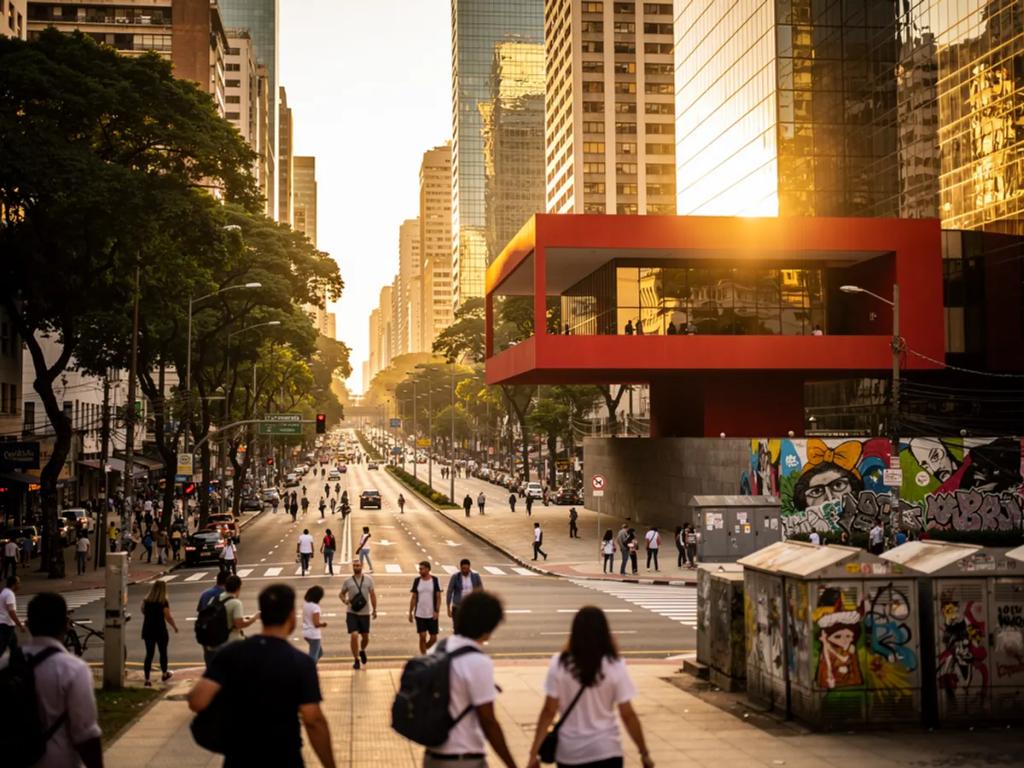
Sao Paulo runs on Vivo, Claro and TIM, and your eSIM rides one of them as its host. This is one of the best-connected cities in the southern hemisphere - dense 4G everywhere, extensive 5G across the central and western districts, and free wifi in a great many public spaces. The connectivity question in Sao Paulo is not whether you will have signal. It is whether you can pay for anything without a Brazilian tax number.
Brazil's instant payment system, Pix, has become the default way the country moves money. Market stalls, bars, taxi drivers, hairdressers and street vendors all take it, often in preference to cash, and increasingly a small business will look faintly surprised if you offer anything else.
Registering for Pix requires a CPF - the Brazilian individual taxpayer number - and a Brazilian bank account. A visitor on a two-week trip has neither, and the workarounds involve more bureaucracy than the trip is worth.
What this means practically:
- Bring a contactless card and expect to use it constantly. Card acceptance in Sao Paulo is excellent - far better than in most of Latin America - and this is the visitor's substitute for Pix.
- Carry some cash for the few places that are cash-or-Pix only, typically small food stalls and street markets.
- Some international fintech cards now offer Pix to non-residents; if you already hold one, check before you fly rather than at the counter.
It is not a crisis - Sao Paulo is a card city and you will be fine. But it is the one moment where being a visitor is visibly different from being local, and it comes up several times a day.
For a city of this density, remarkably rarely - but there are places.
The Metro. Sao Paulo's is clean, fast and the best way across the city, and coverage in the tunnels is inconsistent between lines. Platforms are generally fine; the running tunnels less so. Download your route.
The high-rises themselves. Sao Paulo is a vertical city on a scale that has to be seen, and deep inside the older concrete towers of the Centro - the Copan, the Martinelli - signal drops the way it does in any thick 1950s slab.
Serra da Cantareira, the enormous urban rainforest on the northern edge, has real gaps once you are on the trails. It is one of the largest urban forests in the world and it behaves like forest, not like park.
The road to the coast. The Serra do Mar descent to Santos and the beaches - the Rodovia dos Imigrantes or the Anchieta - drops through mountain and tunnel, and the cloud forest on that escarpment eats signal. If you are heading to Guaruja or Ubatuba for the weekend, load the route first.
- 99 and Uber both operate and both are heavily used - 99 is the Brazilian one and often cheaper. Sao Paulo is enormous and taxis are not hailed the way they are elsewhere.
- The Metro and bus apps. The Metro is genuinely excellent and the integrated network covers far more ground than a visitor expects.
- A translation app. English is much less widely spoken than the city's size suggests, including in restaurants and shops. Brazilian Portuguese is also different enough from European Portuguese that a phrasebook aimed at Lisbon will mislead you.
- iFood. Food delivery is culturally enormous in Brazil, and it is how a lot of the city eats.
- Maps. Sao Paulo is not walkable end to end and the districts are far apart - Vila Madalena to Paulista to Liberdade is a real journey, not a stroll.
Guarulhos (GRU) is the main international airport, about 25 km northeast, and the transfer takes anywhere from 40 minutes to two hours depending entirely on traffic. This is the number that catches people. Do not plan a tight onward connection on the assumption of 40 minutes.
Congonhas (CGH) is the domestic airport and sits inside the city, close to the south-western districts.
The airport bus service into Paulista and the centre is comfortable and much cheaper than a car, and in bad traffic it is not slower.
Arrive with data working. Between ordering a car, finding your accommodation in a city with no obvious centre, and the fact that addresses here run on district rather than landmark, the first hour wants connectivity.
More than a compact European city - this is a place where you will use maps and ride-hailing constantly, and where the distances mean a lot of time in transit with a phone in hand.
For a week, 1GB per 2 days is a realistic baseline. Size up if you are working from here, though the wifi in cafes and co-working spaces is genuinely good. Plans top up from your dashboard.
Layers, and a jacket even in summer. Sao Paulo sits at around 760 m and the temperature drops sharply in the evening in a way that Rio does not. Winter nights are properly cold.
An umbrella or a shell from December to March. Summer afternoon storms arrive fast, dump an enormous amount of water in half an hour, and stop. They flood streets briefly and reliably.
Walking shoes. The pavements are uneven and you will cover ground.
Something smarter than you would pack for a beach city. Sao Paulo is Brazil's business capital and dresses like it - the bar and restaurant scene in Jardins and Vila Madalena is stylish, and shorts and flip-flops read as tourist.
The skyline from the Edificio Copan or the Farol Santander, which is the shot that explains the city - buildings to the horizon in every direction, with no obvious edge.
Avenida Paulista on a Sunday, when it closes to cars and fills with cyclists, skaters, musicians and families.
Beco do Batman in Vila Madalena - an alley given over entirely to street art, repainted constantly, and the densest concentration of it in Brazil.
The Municipal Market (Mercadao) for the stained glass and the mortadella sandwich that is the size of your head.
Liberdade, the largest Japanese diaspora neighbourhood in the world, with its red arches and Saturday market.
Ibirapuera Park at golden hour, with Niemeyer's white curves against the trees.
Sao Paulo's metropolitan region holds over 20 million people, making it the largest city in the southern hemisphere and the Americas.
It is home to the largest Japanese population outside Japan, centred on Liberdade, and to enormous Italian, Lebanese and Syrian communities - which is why the food here is the best in Brazil by a distance.
The city was founded in 1554 by Jesuit missionaries as a mission school, and stayed small for centuries before coffee money and then industry made it what it is.
And Oscar Niemeyer designed the Ibirapuera Park buildings and the Copan - the latter a serpentine apartment block with its own postcode and around 5,000 residents.
Carnival is famously Rio's, but Sao Paulo's is enormous in its own right - the Anhembi Sambadrome hosts a full parade, and the street blocos have grown vast.
Sao Paulo Fashion Week is the largest in Latin America.
The Brazilian Grand Prix at Interlagos in November, one of the best-loved races on the calendar.
The Sao Paulo Art Biennial, in even-numbered years, in the Niemeyer pavilion at Ibirapuera - the second-oldest art biennial in the world after Venice.
LGBTQ+ Pride in June, which is among the largest parades anywhere.
The love: Sao Paulo is the cultural and culinary capital of South America and it is not close. The restaurant scene is world-class across every price point, the museums are serious - MASP, Pinacoteca, the Instituto Tomie Ohtake - the nightlife runs until morning, and the immigrant history has produced something genuinely singular. People who live here are evangelical about it.
The complaints are real and most visitors hit them. It is not a beautiful city - there is no beach, little colonial charm, and a great deal of grey concrete under grey cloud. The traffic is punishing and the distances mean you spend real time getting anywhere. Inequality is highly visible, and there are areas where ordinary urban caution is genuinely warranted, particularly around Centro after dark. The weather is changeable in a way that surprises people expecting tropical Brazil. And it is a city that rewards knowing someone - the good things are not on the main street where you can trip over them.
Give it more days than a checklist suggests, eat constantly, and treat it as a city to live in for a week rather than to see.
Almost certainly not. Pix requires a CPF - the Brazilian taxpayer number - and a local bank account, which a short-stay visitor will not have. Use a contactless card, which is very widely accepted in Sao Paulo, and carry some cash for small stalls. A few international fintech cards now support Pix for non-residents; check yours before you travel.
Vivo, Claro and TIM all have strong coverage across the city, with extensive 5G in the central and western districts. Any of the three works well as a host - this is one of the best-connected cities in the southern hemisphere.
Between 40 minutes and two hours, depending on traffic, for roughly 25 km. Plan for the upper end. The airport bus into Paulista is comfortable and no slower when the roads are bad.
On platforms generally yes; in the running tunnels it varies by line. The Metro is the fastest way across the city, so download your route rather than relying on live directions underground.