Monastir is served by Ooredoo, Orange and Tunisie Telecom, and this eSIM uses Ooredoo or Orange, on 4G/5G. Tunisia sits outside the EU, so an EU SIM roams at out-of-zone rates and a travel eSIM is the sensible answer - our Tunis and Djerba guides cover the country's networks, its closed currency and the absence of ride-hailing apps in detail. The good news specific to Monastir is that it is the one part of Tunisia where you do not need a taxi at all.
This is the practical thing that distinguishes Monastir from everywhere else in the country.
The Metro du Sahel is a light rail line running along the coast from Sousse through Monastir to Mahdia. It is not a metro in the underground sense - it is a suburban railway - and it is genuinely useful.
It stops at Monastir airport. The station is at the terminal, which makes this one of very few places in Tunisia where you can land and take a train to your hotel without negotiating anything.
It links the Sahel's resorts. Sousse, Port El Kantaoui's approaches, Monastir, Skanes and Mahdia are all on or near the line, so a week here does not require a car or a driver.
It is extremely cheap and runs frequently, though slowly - Sousse to Monastir takes around 40 minutes for a distance you would drive in 25.
Buy at the window, in cash, and note that first and second class are separated for very little difference in price.
Elsewhere you still negotiate. Yellow taxis are plentiful and cheap; check the meter or agree the fare first. The ride-hailing apps that work in greater Tunis do not operate here, and our Djerba guide explains that landscape.
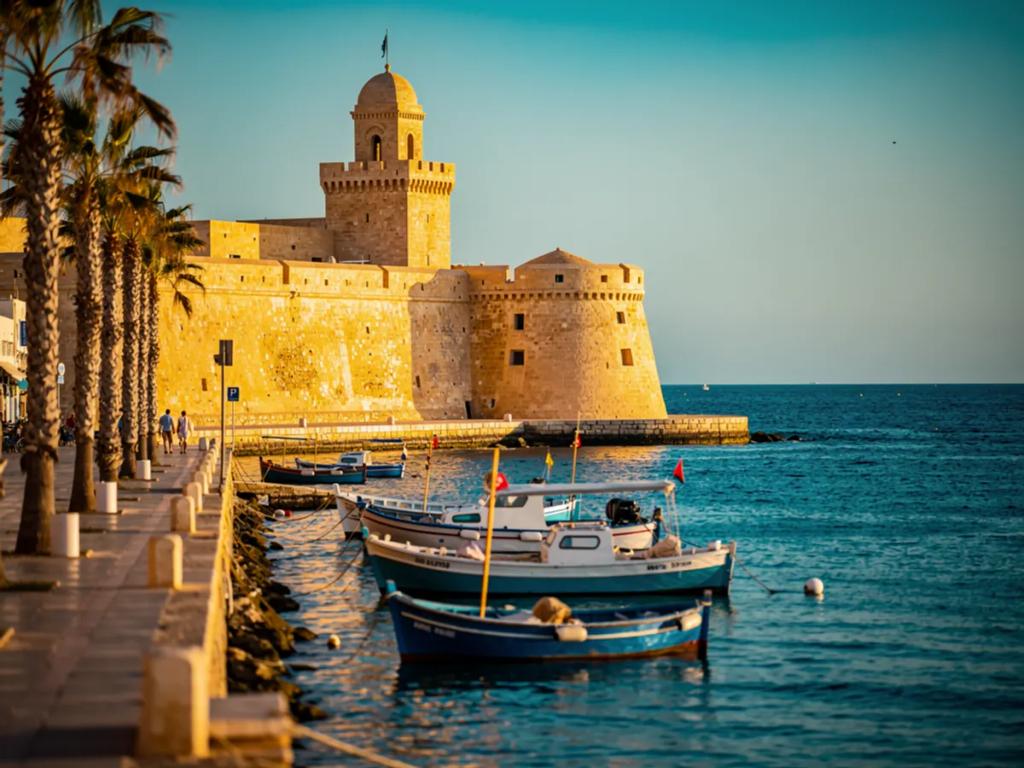
The Ribat of Monastir is one of the oldest Islamic fortifications anywhere, founded in the eighth century as a fortified monastery guarding the coast against Byzantine raids.
It is remarkably intact, and you can climb the watchtower for a view along the whole coastline.
And you have probably seen it. Its courtyards and walls stood in for Jerusalem in Zeffirelli's Jesus of Nazareth, and then - to the enduring amusement of everyone involved - for the same city in Monty Python's Life of Brian. Some of the film's best-known scenes were shot inside these walls.
Tunisia has a long film history beyond this, and locations across the country have been used repeatedly by productions needing somewhere that looks like the ancient Mediterranean or another planet entirely.
Go early or late. The stone is pale and the midday light flattens it; the tower is best in the last hour before sunset.
Useful context, because Monastir is unusual among Tunisian towns in feeling deliberately composed.
Habib Bourguiba was born here in 1903 and led Tunisia to independence in 1956, serving as its first president for three decades.
He directed a great deal of investment to his home town, which is why Monastir has boulevards, a grand mosque, an international airport and a monumental cemetery on a scale its size does not otherwise explain.
The Bourguiba Mausoleum is the centrepiece - gold dome, twin minarets, marble courtyards - and he is buried there along with members of his family.
It sits in the Sidi el Mezeri cemetery, which is worth walking through in its own right.
Opinions about Bourguiba are complicated in Tunisia and have shifted repeatedly since 2011. As a visitor, the mausoleum is simply one of the more striking pieces of twentieth-century architecture in the country.
Monastir, Sousse and the coastal strip are well covered, and the rail line has service along its length.
The Ribat's interior is thick stone and drops out in the lower chambers.
Inland towards Kairouan, an hour west, coverage follows the road and thins between settlements.
The salt flats and the interior generally are sparse.
On boat trips out of the marina, service holds close inshore and fades beyond.
Coverage is not the problem in Tunisia; the network is decent and 4G is widespread. Download offline maps anyway, because as in Djerba the useful thing is having the map already open when you are agreeing something in French.
The dinar is a closed currency - you cannot obtain it before you travel or take it out afterwards. Change on arrival and spend what you change. Our Djerba guide covers this properly.
Cash dominates. Cards work in hotels, larger restaurants and supermarkets, and not much else.
ATMs are plentiful in Monastir and Sousse and can run dry over long weekends.
Keep small notes. Taxis, cafes and the medina stalls will not thank you for a fifty.
- Maps with offline copies, for the reason above.
- A translation app. Arabic is the language; French is very widely spoken and is the practical second language for a visitor. English is common in hotels and thinner outside them.
- A currency converter, because the dinar's three decimal places surprise people.
- The Metro du Sahel timetable, which is easier to find online than at the station.
- No ride-hailing app is worth installing here - see above.
Monastir Habib Bourguiba International (MIR) is about 8 km from the town centre and is the Sahel's main charter gateway - a large share of visitors to Sousse, Port El Kantaoui and Mahdia land here rather than in Tunis.
The airport has its own rail station, which is the cheap and painless way in.
Taxis are available and short; agree the fare.
Tunis-Carthage (TUN) is the alternative, about two and a half hours north, with more scheduled flights.
Many nationalities enter visa-free for short tourist stays; check your own before booking.
Not much. Hotel wifi across the Sahel resorts is adequate, the town is small and walkable, and you will use data mainly for maps and translation. A modest plan is plenty - the argument for having one at all is avoiding EU roaming charges rather than heavy use.
Modest by beach-resort standards. Tunisia is relaxed and Monastir is used to visitors, but swimwear belongs at the hotel and the beach, not in town.
Shoulders and knees covered for the medina, the mausoleum and any mosque, and a scarf for women at religious sites.
Light clothing in summer, which is hot and dry with a reliable sea breeze.
A jacket for winter evenings, which are mild but cool once the sun goes.
Comfortable shoes for the Ribat's stairs, which are steep, worn and without handrails in places.
The Ribat from the seaward side, late in the day, with the tower catching the last light.
The view from the Ribat's watchtower, along the coast and over the cemetery.
The Bourguiba Mausoleum, gold dome against a blue sky, from the cemetery approach.
The marina at Cap Monastir, in the evening.
Sousse's medina, half an hour up the line and UNESCO-listed, which is the bigger and more atmospheric of the two.
El Jem, an hour inland - one of the largest and best-preserved Roman amphitheatres anywhere, and a World Heritage Site that most visitors to this coast never bother with.
Kairouan's Great Mosque, an hour west, in the fourth holiest city in Islam.
Mahdia's cape, at the end of the rail line, which is quieter than anywhere else on this coast.
The Ribat appears in Life of Brian. Monty Python filmed in and around Monastir in 1978, using the fortress that Zeffirelli had used for Jesus of Nazareth the year before - the sets were still standing, which is precisely why the Pythons could afford to shoot there.
El Jem's amphitheatre held around 35,000 people and stands in a small inland town, which makes coming over the rise and seeing it genuinely startling.
Kairouan is regarded as the fourth holiest city in Islam, after Mecca, Medina and Jerusalem, and its Great Mosque is among the oldest in the world still in use.
Tunisia does not observe daylight saving, so the offset from Europe shifts by an hour twice a year and catches people out on flight times.
The dinar is divided into a thousand millimes, which is why prices carry three decimal places.
And Monastir's cemetery is on the seafront, which is unusual and rather beautiful - white tombs, blue water, and the Ribat at the end of it.
Ramadan, when daytime hours change completely and the evenings come alive. Resort hotels carry on largely as normal.
Eid al-Fitr and Eid al-Adha, both major and both moving through the calendar.
The El Jem International Symphonic Music Festival, in July and August, held inside the Roman amphitheatre - which is as good a setting as it sounds.
Summer, June to September, is the beach season and the busiest.
April, May, September and October are the best months here: warm, quiet and comfortable for the inland trips that are the real reason to come.
The love: Monastir is a comfortable, inexpensive and genuinely easy base for a part of Tunisia that is unusually rich in things to see. The Ribat is one of the most impressive early Islamic buildings in North Africa, El Jem and Kairouan are both extraordinary and both under an hour away, Sousse's medina is a UNESCO site up the rail line, and the coast is warm from May to October. The rail link makes all of it accessible without hiring anything.
The complaints are consistent. The resort strip at Skanes is dated in places and the package-holiday infrastructure shows its age. The town itself is small and a day covers it. Cash-only friction is constant for visitors used to tapping a card. Hassle in the medinas wears some people down, though it is milder here than in Tunis. And Monastir is a base rather than a destination - the case for coming is what is within an hour of it.
Come in May or September, take the train rather than a taxi, do El Jem and Kairouan on separate days, and climb the Ribat tower an hour before sunset.
No. Tunisia is outside the EU and the EEA, so an EU SIM bills at out-of-zone rates. Local data is inexpensive and coverage across the Sahel is good, so a travel eSIM is the straightforward answer.
Yes, and it is the reason this is the easiest arrival in Tunisia. The Metro du Sahel light rail has a station at the terminal and runs along the coast between Sousse, Monastir and Mahdia. It is cheap, frequent and slow, and it removes the taxi negotiation entirely.
No. The ride-hailing apps do not operate in this part of Tunisia - Bolt withdrew from the country and the local app works only in greater Tunis. Taxis are yellow, cheap and plentiful; check the meter or agree the fare first. Our Djerba guide covers the wider picture.
Yes, for most things. The dinar is a closed currency that cannot be bought before you travel or taken out afterwards, so change on arrival. Cards work in hotels and larger restaurants and very little else, and ATMs can empty over long weekends.