Swisscom, Sunrise and Salt cover Geneva, and this eSIM uses Salt or Sunrise, on 4G/5G. Our Zurich guide sets out the fundamental Swiss fact - the country is in neither the EU nor the EEA, so Roam Like at Home does not apply and an EU SIM bills at out-of-zone rates. That is true here too. But Geneva adds a complication Zurich does not have, and it is one that produces genuinely surprising bills: the canton is almost entirely surrounded by France, and your phone does not always notice which country it is in.
Geneva's canton borders France on three sides. It is joined to the rest of Switzerland by a narrow neck of land along the lake, and in every other direction the frontier is minutes away.
French masts reach well into the Swiss side. You can be standing in Geneva - in the city, not the countryside - and find your handset registered on Orange or SFR.
And the two are different roaming zones. For an EU SIM, France is free and Switzerland is expensive. For a Swiss SIM, the reverse. Either way, crossing without moving costs money.
This catches people constantly. A hotel near the border, a walk in the Jura, lunch in Ferney-Voltaire, a run along the Rhône - any of these can move you onto a foreign network while you believe you are at home.
Check what you are registered on rather than assuming, particularly if you have a country-specific plan.
Lock your network manually if you are staying near the frontier. Selecting a Swiss network by hand in your phone's network settings prevents the drift, and it is the single most useful setting change for this city.
Carry a plan for each side if you will genuinely be in both countries. Our Europe eSIM covers France but not Switzerland, so pair it with a Switzerland eSIM on the same phone and switch the data line when you cross.
The airport has a French sector. Geneva Airport sits on the border, and it has a French exit with direct road access to France - you can land in Switzerland and leave into France without clearing Swiss customs, which is a genuinely unusual arrangement and useful if you are heading to Chamonix or the Alps.
Geneva proper has about 200,000 people. The canton has around half a million.
But roughly 100,000 people cross the border to work here every day from Haute-Savoie and Ain, which is why the roads and trains behave the way they do at peak.
The Léman Express is the regional rail network built for exactly this, running across the border to Annemasse, Evian, Annecy and beyond on a single integrated system. It is excellent and underused by visitors.
Prices differ enormously across the frontier. Groceries, petrol, restaurants and haircuts are substantially cheaper in France, and Genevans shop there routinely - the supermarkets in Ferney and Annemasse exist largely for that traffic.
Which is worth knowing as a visitor too. Staying on the French side, ten minutes out, can halve your accommodation cost, and the Léman Express brings you in.
Public transport is free for hotel guests. Geneva hotels issue a transport card covering buses, trams and the lake shuttles for the length of your stay - ask for it at check-in, because they do not always volunteer it.
The institutional presence is out of all proportion to the city's size.
The United Nations Office at Geneva occupies the Palais des Nations, and it is open to visitors on guided tours with a passport.
The WHO, the ILO, the WTO, the ICRC and a very long list of others are headquartered here. The Red Cross was founded in Geneva, and its museum is one of the better and more affecting in the city.
CERN is on the edge of town, straddling the French border, and runs free visits - the Science Gateway is open without booking, and tours of the accelerator sites need reserving well ahead.
The Broken Chair, a twelve-metre wooden chair with one leg blown off, stands opposite the Palais des Nations as a monument against landmines. It is the most photographed object in the city after the fountain.
This all makes Geneva expensive and slightly serious. It is a working diplomatic city rather than a tourist one, and the visitor infrastructure reflects that.
The city and the lake shore are comprehensively covered.
Near the border, as above, coverage is not the problem - which country's coverage is.
CERN's underground facilities obviously have no service, and that is by design.
The Jura, immediately northwest, thins on the ridge and in the valleys.
The Salève, the mountain immediately south that dominates the skyline, is in France - and taking the cable car up it moves you into another country and another roaming zone in about five minutes.
Around the lake towards Montreux and Lausanne, coverage follows the shore and is fine.
In the Alps proper, an hour or two east, this becomes a mountain-coverage question rather than a border one.
Switzerland is among the most expensive countries in the world, and Geneva is among its most expensive cities.
Restaurant meals, drinks and hotels are the sharpest of it.
Tap water is excellent and free, and the city has drinking fountains throughout.
Supermarket picnics by the lake are entirely normal and what a great many residents do.
Museums are often free on the first Sunday of the month, and several are free permanently.
The free transport card from your hotel is worth real money over a few days.
Crossing into France for a meal is a common and unembarrassing strategy.
- TPG, for Geneva's buses, trams and the yellow Mouettes shuttle boats across the lake.
- SBB/CFF, for Swiss rail, and Léman Express for the cross-border network.
- Your phone's manual network selection, which is not an app but is the most useful setting in this guide.
- Maps, with offline copies for the Jura or the Alps.
- A translation app is largely unnecessary. French is the language, English is widely spoken in a city this international.
Geneva Airport (GVA) is about 4 km from the centre - one of the closest major airports to a city centre anywhere.
The train takes six minutes to Cornavin station, and the airport issues a free public transport ticket from a machine in the baggage hall, valid for eighty minutes. Take one; a great many arrivals do not know it exists.
The French sector allows exit directly into France, which is how most Chamonix and ski traffic leaves.
By rail, Geneva connects to Paris in about three hours by TGV and along the lake to Lausanne, Montreux and beyond.
In the city, trams and buses are excellent, the centre is walkable, and the little yellow lake shuttles are part of the transport network rather than tourist boats.
Not much for the city itself. The consideration here is not volume but which network you are on - a Swiss plan plus a France-covering plan side by side, or a manually locked Swiss network, matters far more than the size of your allowance.
Layers, and a proper coat in winter. The bise makes Geneva feel considerably colder than the temperature.
Smart-casual as standard. Geneva is a formal, well-dressed city and scruffiness is noticed more than in most of Europe.
Comfortable shoes for the old town, which is steep and cobbled.
Something warm for the lake, where the wind cuts across the water year-round.
Swimwear in summer - the lake baths at Bains des Pâquis and Genève-Plage are a genuine local institution.
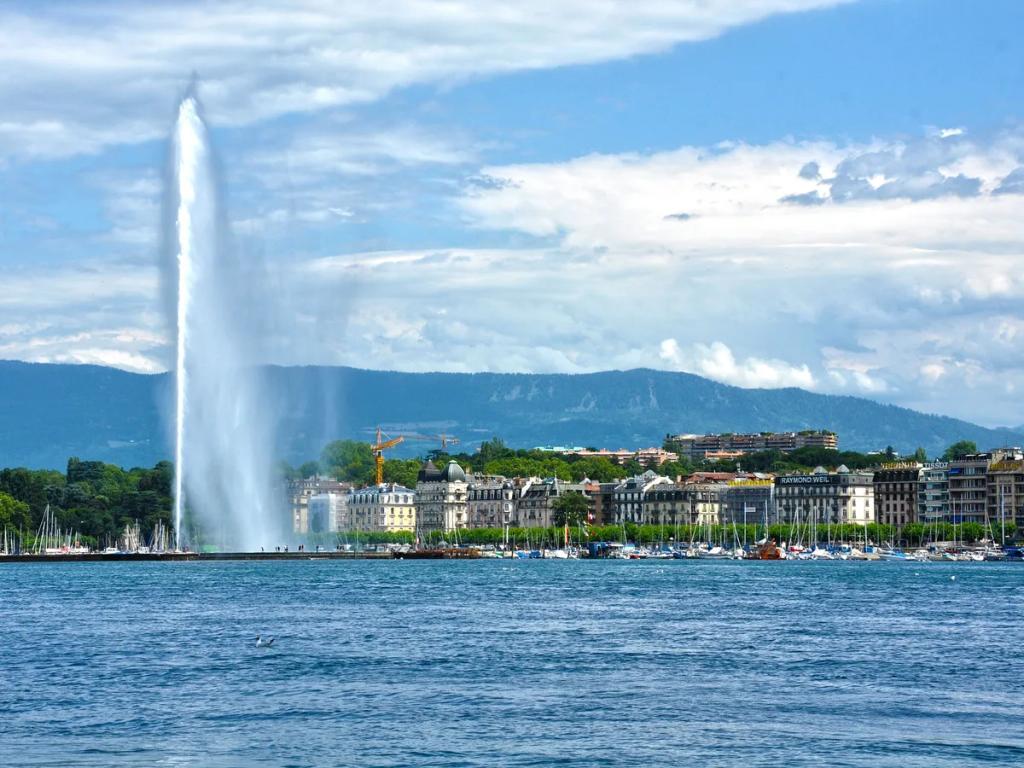
The Jet d'Eau throwing 140 metres of water over the lake, from the Pâquis pier - and go out along the jetty to stand under the spray.
Mont Blanc from the lake shore on a clear morning, which is a surprisingly rare event and worth waiting for.
The Broken Chair outside the Palais des Nations.
Bains des Pâquis at sunrise, with swimmers going in year-round.
The old town's Place du Bourg-de-Four, the oldest square in the city.
St Pierre Cathedral's tower, for the view over the lake and the rooftops.
CERN's Science Gateway, whose Renzo Piano building is worth the trip alone.
The Salève by cable car, looking back down over the whole city - and remember you are in France when you get there.
The Jet d'Eau began as a safety valve. It was a pressure release for the city's hydraulic power network, and it was so popular that Geneva kept it and made it a monument.
Geneva's canton is joined to Switzerland by a narrow corridor and is otherwise surrounded by France, which is the root of every border oddity in this guide.
CERN straddles the border. The Large Hadron Collider's 27-kilometre ring runs under both Switzerland and France, and staff cross the frontier daily inside the site.
The Red Cross was founded here in 1863 after Henry Dunant witnessed the aftermath of the battle of Solferino, and the Geneva Conventions are named for the city.
The World Wide Web was invented at CERN by Tim Berners-Lee in 1989, which makes Geneva an odd place to be writing a connectivity guide.
And the Reformation ran from here under Calvin, which is why a city this international has such austere churches.
The Fêtes de Genève, in summer, with concerts and a large fireworks display over the lake.
L'Escalade, in December, commemorating the failed 1602 assault on the city - a torchlit procession in period costume, and chocolate cauldrons smashed with a specific ritual phrase.
Geneva's museums' free Sundays, on the first of each month.
The Christmas markets, from late November.
May, June and September are the best months. Winter brings fog into the lake basin for long spells, and the mountains above it are in sun while the city is grey - which is why locals go up.
The love: Geneva has one of the great settings - a lake, the Jura behind and Mont Blanc in front - and an institutional density that makes it feel far larger than it is. The old town is genuinely handsome, the lake swimming is excellent and free, CERN and the Red Cross museum are both outstanding, and the Alps and Chamonix are an hour away. Public transport is superb and free with your hotel.
The complaints are consistent. It is extremely expensive, and there is no getting around that for accommodation. It is small - two days covers the sights. It can feel corporate and buttoned-up, a city of institutions and private banks rather than street life. Winter fog sits in the basin for weeks. And the roaming trap described above genuinely catches people, which is the one thing in this guide that costs money if ignored.
Come in June or September, take the free transport ticket at the airport, lock your network manually, swim at Bains des Pâquis, and go up the Salève on a clear afternoon.
No - Switzerland is in neither the EU nor the EEA, so Roam Like at Home does not apply and an EU SIM bills at out-of-zone rates. Our Zurich guide covers the national picture. Geneva adds a twist the rest of the country does not have.
Because Geneva's canton is almost surrounded by France and French masts reach well into the Swiss side. You can change country without moving. Since Switzerland and France are separate roaming zones, that can be expensive in either direction. Lock your network manually to a Swiss operator in your phone's settings, and if you are spending time on the French side too, keep a France-covering plan such as the Europe eSIM installed alongside your Switzerland eSIM.
For hotel guests, yes - Geneva hotels issue a card covering buses, trams and the lake shuttles for your stay, and you often have to ask for it. Separately, the airport baggage hall has a machine dispensing a free 80-minute ticket into the city. Both are widely missed by visitors.
Yes. The Science Gateway is free and open without booking, and it is an excellent building in its own right. Tours of the accelerator facilities need reserving a long way ahead. Note that the site straddles the French border, with the roaming implications above.