Siem Reap runs on Smart, Metfone and Cellcard, and your eSIM rides one of them as its host. Cambodian mobile data is fast, cheap and better than most visitors expect, and coverage across the town and the main Angkor circuit is solid. What you actually need to plan here is not the signal. It is a ticket that cannot be bought where you are going, and a currency situation that is stranger than it first appears.
Get this wrong and the day is gone, so it is the first thing to sort out.
Passes are sold only at the Angkor Enterprise ticket centre, on Road 60 about four kilometres from the middle of town. Not at the temples. Not online through third parties you should trust. Not at your hotel.
They photograph you on the spot and print your face on the pass. It is non-transferable and it is checked, repeatedly, at the entrance to each temple group.
The three options are one day, three days and seven days. The three-day pass is usable across ten days and the seven-day across a month, so they do not have to be consecutive - which makes the three-day far better value than it looks if you want a rest day in the middle.
For a sunrise start, buy the evening before. The office sells from 5am to 5:30pm, and a pass bought after 5pm carries over to the following day - so you can use the last of the light that evening and still have the full next day. Collect it the night before and go straight to the temple in the dark, without a detour.
Bring your passport and enough for the fee. Card payment works at the centre.
Sunrise at Angkor Wat means leaving town around 4:30am. The queue at the ticket centre at 5am on a January morning is not where you want to discover any of the above.
Cambodia is officially riel, practically dollars, and in daily use both at the same time.
Prices are quoted in US dollars and ATMs dispense them. Hotels, tours, restaurants and the Angkor pass are all priced that way.
Riel is the small change. Anything under a dollar comes back in riel at a fixed working rate of about 4,000 to the dollar. You will hand over a five-dollar note and get dollars and riel back together, and that is entirely normal.
Damaged dollars are refused. This is the one that catches people. A note with a tear, a scribble, heavy creasing or a missing corner will be politely handed back, and this applies at banks too. Inspect what you are given, and reject anything torn when it is offered to you rather than discovering it later.
Bring clean, newer notes if you are carrying dollars in. Small denominations are far more useful than large.
Cards work in hotels, larger restaurants and the ticket centre, and not at markets, tuk-tuks or most street food. ABA is the dominant local bank and its app is everywhere, but a local account is needed.
The main Angkor circuits are covered. Angkor Wat, Bayon, Ta Prohm and the small circuit generally hold a usable signal, which surprises people expecting a jungle blackout.
The outlying temples are the drop. Beng Mealea, Koh Ker and the long road to Preah Vihear thin out badly. Banteay Srei, 35 km out, is patchy.
Phnom Kulen, the sacred mountain, loses it on the climb and in the forest.
The Tonle Sap floating villages are inconsistent. The lake is enormous and the villages move with the water level between seasons, and coverage does not follow them closely.
Inside the temple interiors, unsurprisingly, thick stone corridors and the Bayon's inner galleries block it.
Download the temple maps before you go. The Angkor complex is around 400 square kilometres and the roads between temples are not intuitive.
Siem Reap sits beside real poverty and the tourism economy is the main thing standing between many families and worse, so how you spend matters more here than in most places.
Do not visit or volunteer at orphanages. This is the important one. The great majority of children in Cambodian residential care institutions have at least one living parent, and the demand from well-meaning visitors has been shown to drive family separation rather than relieve it. The Cambodian government and every serious child protection organisation ask travellers not to participate. Orphanage tours, day visits and short volunteer placements all feed the same system.
Do not give money to begging children, for the same structural reason: it keeps them out of school and on the street.
Do buy from local businesses, eat outside the hotel, tip your guide properly and use the shops and restaurants that train and employ local staff. Several in town are explicitly set up to do that and say so.
Guides are licensed, knowledgeable and inexpensive relative to what they add. Hiring one for a temple day is the single best-value thing most visitors do here.
- PassApp, the local ride-hailing app, which is the standard way to get a tuk-tuk at a fixed fare.
- Grab, which also operates in Cambodia and is worth having as the alternative.
- Maps with offline coverage of the Angkor park, which is large and confusingly laid out.
- A translation app. English is widely spoken in tourism and much less so elsewhere.
- A torch app for the pre-dawn walk to the reflecting pool, which is genuinely dark.
Siem Reap-Angkor International (SAI) opened in October 2023 and replaced the old airport entirely. It sits about 50 km east of town, so the transfer is now 45 minutes to an hour rather than the fifteen minutes it used to be. Budget for that; a great deal of older advice online still assumes the closed airport.
Hotel transfers are standard and worth arranging in advance. Taxis and PassApp both work from the terminal.
Overland from Phnom Penh takes about six hours by road, and the boat across Tonle Sap runs in the wet season only and is slow, scenic and weather-dependent.
Around town, tuk-tuks are the default and the town itself is small enough to walk.
Modest. Hotel and cafe wifi is widespread and good, the town is compact, and much of your day is spent at temples where you should be looking up rather than down. A small to middling plan is plenty. The one thing worth having is enough headroom to run maps continuously across a full temple day.
Shoulders and knees covered at the temples. This is enforced rather than suggested, and the upper level of Angkor Wat, the Bakan, turns people away for it.
Light, loose, quick-drying clothes. It is hot at every hour and humid for most of the year.
Proper shoes with grip. Temple stairs are steep, worn smooth and often wet. Sandals are a poor idea at Ta Keo or the Bakan.
A hat, sunglasses and serious sun protection. There is very little shade on the causeways.
A light layer for sunrise, which is cool by local standards and involves standing still for an hour.
A rain shell from May to October, for a downpour that arrives in the afternoon and is brief and total.
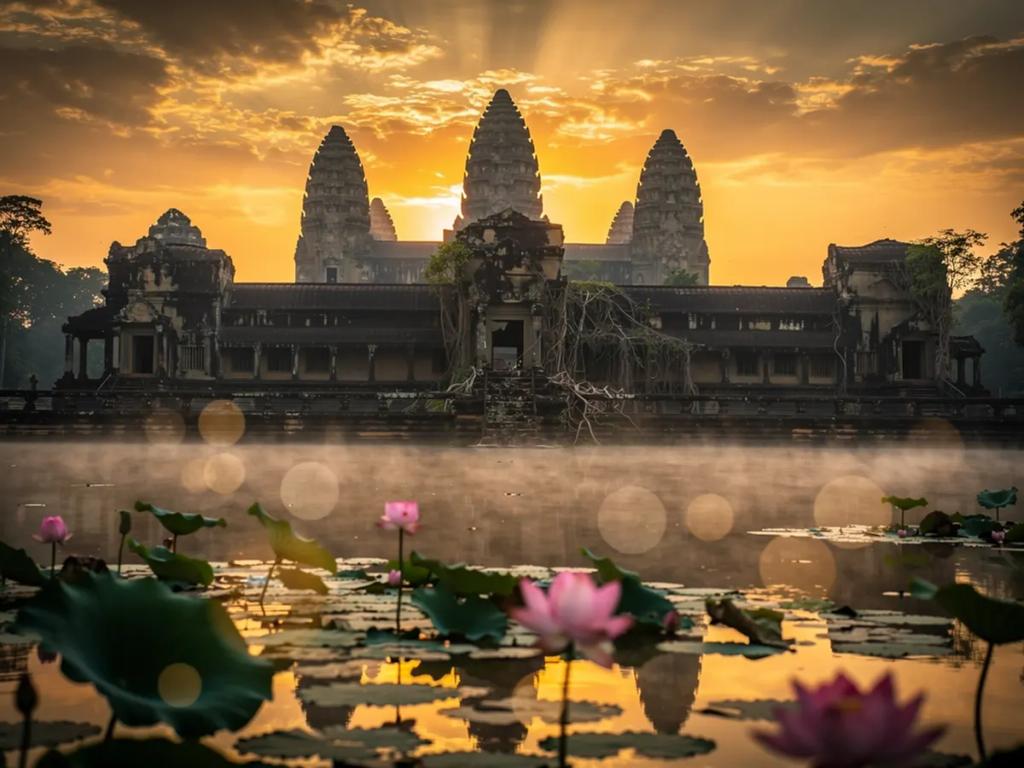
Angkor Wat at sunrise, reflected in the northern pond. The left-hand pond is the classic angle and gets crowded from about 5am; the right-hand one is quieter and nearly as good.
Ta Prohm's strangler figs, the roots pouring over the stonework, best in early morning light before the tour groups.
The faces of the Bayon, 216 of them, at mid-morning when the sun reaches into the upper terrace.
Banteay Srei, the small pink sandstone temple 35 km out, whose carving is the finest in the complex and photographs beautifully in late afternoon.
Preah Khan's corridors, a receding line of doorways that frames itself.
Tonle Sap at sunset, from a boat, in the wet season when the lake is at its largest.
Pub Street after dark, if only for the contrast with everything above.
Angkor was the largest pre-industrial city in the world. Recent lidar surveys put the greater urban area at around a thousand square kilometres, supporting perhaps three quarters of a million people at a time when London had around twenty thousand.
Angkor Wat is the largest religious monument on Earth, by land area, and it has never been fully abandoned - Buddhist monks have maintained a presence for centuries.
Cambodia's flag is the only national flag that depicts a building, and the building is Angkor Wat.
Ta Prohm is the Tomb Raider temple, deliberately left partly unrestored so the trees remain.
Angkor Wat faces west, unusually for a Khmer temple, which is one of the reasons some scholars read it as funerary.
And the temples were built for a Hindu god and later rededicated to Buddhism, which is why you find both iconographies layered in the same stone.
Khmer New Year, mid-April, which is the biggest holiday of the year. Siem Reap hosts Angkor Sankranta, the town fills with Cambodians rather than foreigners, and it is a genuinely joyful and very wet few days. Much closes; plan around it either way.
Water Festival, Bon Om Touk, in November, marking the reversal of the Tonle Sap's flow. Phnom Penh has the boat races, but the whole country celebrates.
Pchum Ben, in September or October, a fifteen-day ancestor festival when Cambodians return to their home pagodas.
The dry season, November to February, is the comfortable time to visit and the busy one. March to May is brutally hot. The wet season brings green landscapes, full moats, dramatic skies and far fewer people, at the cost of an afternoon soaking.
The love: Angkor is one of the few places that is straightforwardly worth the journey, and three days there rearranges your sense of what the medieval world was capable of. Beyond the temples, Siem Reap is a friendly, cheap, easy town with genuinely good food, warm people and a tourism industry that has had thirty years to get competent. The countryside starts immediately and the lake is extraordinary.
The complaints are consistent. The heat is punishing for anyone attempting a full day on foot. Temple fatigue is real and sets in around day three. The hawking at the temple gates wears people down, particularly the children selling, which is uncomfortable for the reasons above. Pub Street is tacky and unavoidable if you are staying centrally. The new airport is far away. And a few visitors find the gap between the resorts and the villages around them hard to sit with, which is a fair response rather than a complaint about the destination.
Go in November, buy the three-day pass and use it across a week, hire a guide for at least one day, and see Bayon in the morning rather than at noon.
No. The only official seller is the Angkor Enterprise ticket centre on Road 60, about four kilometres from town, and they photograph you for the pass on the spot. Nothing is sold at the temple entrances. For a sunrise start, buy it after 5pm the previous evening - it will be dated for the next day.
On the main circuits, generally yes: Angkor Wat, Bayon and Ta Prohm all hold a usable signal. The outlying sites are where it fails - Beng Mealea, Koh Ker, Phnom Kulen and the road to Preah Vihear. Download offline maps of the park before you set out.
Dollars are the working currency and ATMs dispense them, with riel used as change below a dollar at about 4,000 to the dollar. Bring clean notes: torn, scribbled or badly creased dollars are routinely refused, including by banks.
No, and please do not. Most children in Cambodian residential care have a living parent, and visitor demand has been shown to drive family separation. The government and child protection organisations ask travellers to stay away from orphanage tourism entirely. Support local businesses and hire local guides instead.