Santiago runs on Entel, Movistar, Claro and WOM, and this eSIM uses CLARO CL or Movistar, on 3G. Chilean networks are the best in South America by most measures - fast, extensively built out, and reaching a long way down a very long country. Coverage is a solved problem here. What is worth your attention instead is a tax rule that will save you nineteen percent on your hotel bill if you know about it, and a mountain range that changes what the city is.
This is real, official and routinely missed by visitors, and it is the most valuable paragraph in this guide.
Chile exempts foreign tourists from IVA, the 19% value added tax, on hotel accommodation.
The condition is that you pay in foreign currency. US dollars, or a foreign-issued credit card. Pay in Chilean pesos and the exemption is lost.
You must show your passport and your tourist card - the migration slip issued when you enter the country. Keep it; it is the document the hotel needs to file the exemption, and its issue date has to precede your check-in.
The hotel must be registered with the tax service, which most established ones are. Ask when booking rather than at checkout.
It applies to stays under 59 days, which covers any normal visit.
Confirm it at check-in, not after. Say you are a foreign tourist and want the IVA exemption. Reception will know exactly what you mean; the rule is decades old.
Nineteen percent on a week of hotel nights is a substantial number, and the whole cost of claiming it is one sentence at the front desk.
Santiago's setting is the thing photographs undersell, and it shapes the practicalities.
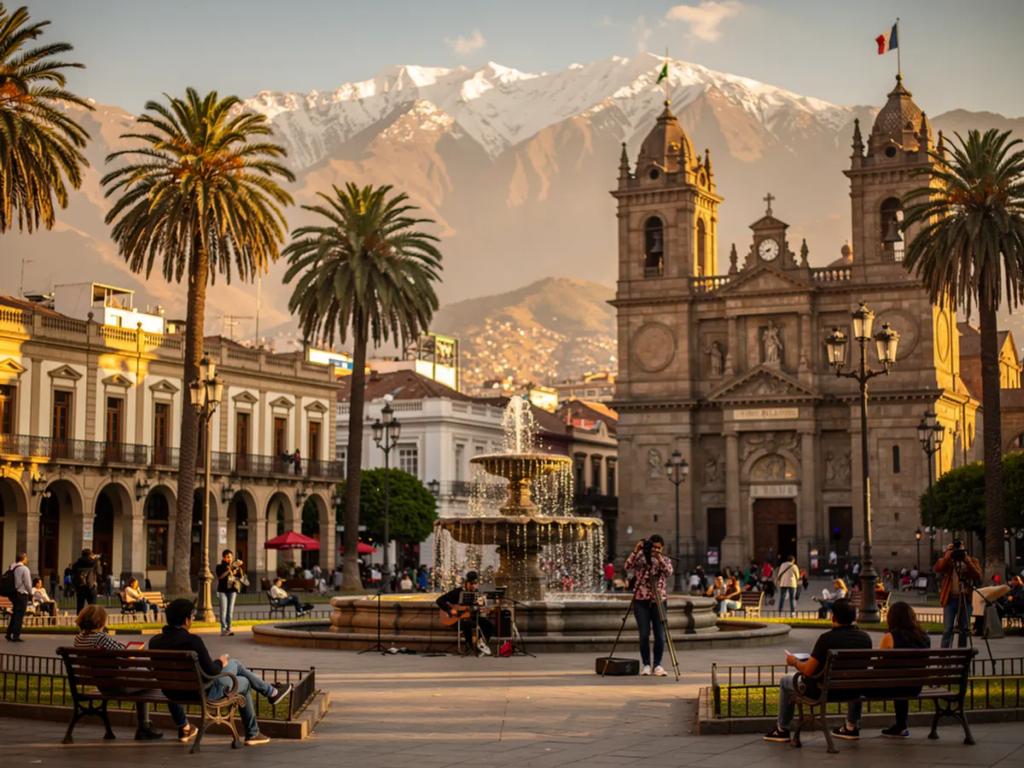
The mountains rise abruptly from the city's eastern edge, and on a clear morning after rain they are startling - a wall of snow at the end of an ordinary avenue.
Skiing is roughly 90 minutes away. Valle Nevado, La Parva and Farellones sit above 3,000 m, and the season runs June to September. Very few capital cities can do this.
The coast is 90 minutes the other way, at Valparaiso and Vina del Mar, which means you can genuinely ski and stand in the Pacific on the same day if you plan it badly enough to want to.
The wine valleys start half an hour out - Maipo, Casablanca, Colchagua - and are among the most accessible serious wine regions anywhere.
Altitude matters if you go up. The ski areas are high enough that arriving from sea level and skiing hard on day one is a poor idea.
Not a connectivity issue, but the thing that most shapes a winter visit.
Santiago sits in a basin, hemmed in by the Andes and the coastal range, and in winter a thermal inversion traps the air.
The city responds with restriccion vehicular - rotating driving bans by number plate, announced daily, tightening to preemergencia and emergencia levels when readings get bad.
On the worst days, outdoor school sport is cancelled and wood burning is prohibited.
As a visitor this rarely affects you directly unless you have hired a car, in which case check the day's restricted digits. What you will notice is the haze eating the mountain view.
Summer is clear and dry and the air problem essentially disappears. It is a winter phenomenon.
The city and the metro are comprehensively covered.
The ski areas have coverage at the resorts and lose it on the road up, which is a series of switchbacks with a great deal of rock in the way.
The Cajon del Maipo, the mountain valley southeast of the city, thins quickly past the last villages.
The Atacama, far to the north, is covered in San Pedro and around the main routes and nowhere else - and it is a genuinely dangerous place to be lost without water.
Patagonia, far to the south, is patchy to absent across most of the interesting parts.
Torres del Paine has service around the refugios and administration and very little on the circuits.
Chile is 4,300 km long, so "coverage in Chile" means very little as a single statement.
- Metro de Santiago or a transit app, for a system that is clean, fast and one of the best on the continent.
- Uber, Cabify and DiDi, all of which operate widely and cheaply.
- The Bip! card is the physical transport card for metro and buses - buy and load it at any station.
- Maps with offline copies for anything in the mountains.
- A translation app. Chilean Spanish is famously fast, elided and full of local idiom, and even fluent Spanish speakers from elsewhere find it hard work. English is limited outside hotels and business.
Arturo Merino Benitez International (SCL) is about 15 km northwest, a modern airport with a recently expanded international terminal.
Official taxis and transfer desks are inside arrivals; Uber and DiDi work from designated pickup areas; and the Centropuerto and Turbus airport buses run to the centre cheaply.
A metro extension towards the airport has been in planning for years - check whether it is actually running rather than trusting a map.
In the city, the metro is the way to move, supplemented by ride apps. Santiago is large and spread out but its central neighbourhoods - Lastarria, Bellas Artes, Providencia, Bellavista - are walkable and pleasant.
Moderate. Wifi is good and widespread, the metro covers the centre, and the city is easy. Budget more if you are heading north to the Atacama or south to Patagonia, where offline maps stop being optional and become the plan.
Remember the seasons are inverted. July is winter here.
Summer is hot and extremely dry, above 30C, with strong sun and cool evenings. Layers for the temperature drop after dark.
Winter is cool and damp rather than freezing, 3-15C, and buildings are poorly heated - the indoor cold catches people out.
Sun protection all year. The combination of altitude, latitude and thin dry air is stronger than it feels.
Walking shoes, and something smarter for dinner - Santiago dresses neatly.
Ski or hiking kit is rentable and not worth flying with.
The Andes behind the skyline, from Cerro San Cristobal or the Sky Costanera observation deck, on a clear morning after winter rain.
Cerro Santa Lucia, the ornamental hill in the middle of the city, all terraces and stairways.
Barrio Lastarria and Bellas Artes, for the cafes, the bookshops and the street life.
La Chascona, Pablo Neruda's Santiago house, built for a mistress and full of his eccentric collections.
Plaza de Armas and the cathedral.
Valparaiso, 90 minutes away, for the funiculars, the murals and the hillside chaos - a completely different city and a UNESCO site.
The Maipo or Casablanca valleys, vines against mountains.
Valle Nevado from the road up, if you can find somewhere safe to stop on the switchbacks.
Chile is around 4,300 km long and averages under 200 km wide - if laid over Europe it would run from Scotland to the Sahara.
The Atacama is the driest desert in the world, and some weather stations there have never recorded rain.
Chile produces a substantial share of the world's copper, and the industry is visible in the economy, the politics and the landscape.
Easter Island is Chilean, five hours by air from Santiago and one of the most remote inhabited places on the planet.
The country is among the most seismically active on earth, and the 1960 Valdivia earthquake, at magnitude 9.5, remains the largest ever instrumentally recorded. Chilean building codes are correspondingly serious.
And Chileans speak Spanish faster than almost anyone, drop final consonants, and use cachai roughly the way an English speaker uses "you know?"
Fiestas Patrias, 18 September, the national holiday and by far the biggest event of the year - fondas, cueca dancing, empanadas and terremotos, with the whole country off work for several days.
Lollapalooza Chile, in March or April, in Parque O'Higgins.
The vendimia, the grape harvest festivals, through March and April in the wine valleys.
Ski season, June to September, in the resorts above the city.
Spring, September to November, and autumn, March to May, are the best times to be here - clear air, comfortable temperatures and the mountains visible.
The love: Santiago is a comfortable, safe, well-run base with genuinely spectacular geography attached. The metro works, the food and wine are excellent and well priced, the neighbourhoods are pleasant to walk, and within ninety minutes you can be on a ski slope, at the Pacific, or in a serious vineyard. It is also the natural hub for the Atacama, the Lake District, Patagonia and Easter Island, all of which are why most people come to Chile.
The complaints are consistent. It is not a beautiful city in its own right, and visitors expecting colonial charm find a modern business capital. Winter smog eats the view that is the city's best feature. It sprawls, and the interesting parts are scattered. It is expensive by South American standards. Petty theft is a real nuisance in crowded areas and around Plaza de Armas, and phones are the target. And some find it conservative and buttoned-up next to Buenos Aires or Rio.
Come in October or April, claim the IVA exemption, take the metro, and give a full day each to Valparaiso and a wine valley.
Tell reception at check-in that you are a foreign tourist claiming the IVA exemption, pay in US dollars or with a foreign-issued card rather than in pesos, and show your passport and the tourist card you were given on entry. The hotel must be registered with the tax service, and the exemption applies to stays under 59 days.
In the cities and along the main routes, yes - Chilean networks are the strongest in the region. But the country is 4,300 km long, and the Atacama, Patagonia and Torres del Paine all have long stretches with nothing. Download offline maps for any trip beyond the central valley.
Only if you have hired a car. Santiago runs rotating number-plate bans in winter when air quality drops, announced daily and tightened on bad days. On foot or on the metro it makes no difference to you.
Notoriously so, even for fluent speakers from other Spanish-speaking countries. It is fast, drops final consonants and carries a lot of local idiom. English is limited outside hotels and business districts, so a translation app is worth having here in a way it is not in every capital.