Mexico City runs on three networks - Telcel, AT&T Mexico and Movistar - and Telcel is the honest answer to "which is best": the deepest coverage in the country, blanketing the capital in solid 4G with 5G spreading through the central boroughs. This eSIM uses Movistar or Telcel, on 4G/5G, and everywhere visitors actually spend time - Centro Histórico, Roma, Condesa, Polanco, Coyoacán, Chapultepec - fast data is the norm.
This is a city of 9 million people at 2,240 meters, spread across a valley that takes real time to cross. Above ground, coverage is strong almost everywhere tourists go. Underground is the exception: long stretches of the Metro's tunnels have little or no mobile signal. Many stations have free public Wi-Fi - CDMX runs one of the world's largest free hotspot networks - but treat it as a backup: load your route before you tap in and it becomes irrelevant.
- Uber and DiDi are how visitors move. Both are well established, cheap by international standards, and the standard safety advice here - use the app rather than hailing a cab on the street - has been true for years. Every ride needs live data: pinning your pickup, tracking the car, sharing the trip.
- The Metro costs 5 pesos - one of the cheapest big-city rides on Earth - but you pay with the rechargeable Movilidad Integrada card bought at station machines, not by tapping a foreign bank card at the gate.
- Timed tickets sell out. The Frida Kahlo Museum in Coyoacán is online-only and routinely sells out weeks ahead - book before you fly, not from the queue.
- WhatsApp is the default. Restaurants, tour guides, Airbnb hosts and even market vendors confirm everything over WhatsApp, so your data connection is effectively your phone line here.
- Cash still matters. Tap-to-pay is normal in Roma, Condesa and Polanco cafés and restaurants, but street food, markets and many taquerías are cash-only - budget an ATM stop.
Most international flights land at Benito Juárez (AICM), inside the city itself - Roma or Condesa is typically 30-45 minutes by car. Authorized taxi counters operate inside the terminal, and Uber and DiDi both serve the airport, though pickup points shift, so follow the app's walking directions. That first ride is exactly when your "just landed" messages, hotel pin and driver chat hit your data plan, which is why installing the eSIM before you fly beats hunting terminal Wi-Fi.
More maps than most cities. The sprawl means you navigate constantly - between neighborhoods, across Chapultepec, through Centro's one-way grid - and translation apps earn their keep if your Spanish is thin. Add Uber/DiDi and most travelers land around 1GB per 2 days; Roma and Condesa's laptop-friendly cafés soak up heavier work like photo backups and video calls over Wi-Fi. Plans top up from your dashboard if the trip runs long, and our Mexico eSIM guide compares the costs against roaming and airport SIMs.
One local reality worth knowing: Mexico City's earthquake early-warning system (SASMEX) sounds citywide loudspeakers up to a minute before strong shaking arrives. It works without your phone, but apps like 911 CDMX and SkyAlert push the same alerts - and having data means family can confirm you are fine within minutes, as everyone here does after every alert.
Layers, always. At 2,240 meters the day has seasons of its own: mornings start at 6-12C, afternoons warm to the mid-20s, and it cools fast again at sunset - a jacket that stuffs into a daypack is the local uniform. The altitude sun burns harder than the temperature suggests, so sunscreen and a hat matter even in "cool" weather. In rainy season (May-Oct), carry a compact umbrella for the almost-scheduled late-afternoon downpour. And Polanco dinners run smart-casual - chilangos dress up for restaurants more than most visitors expect.
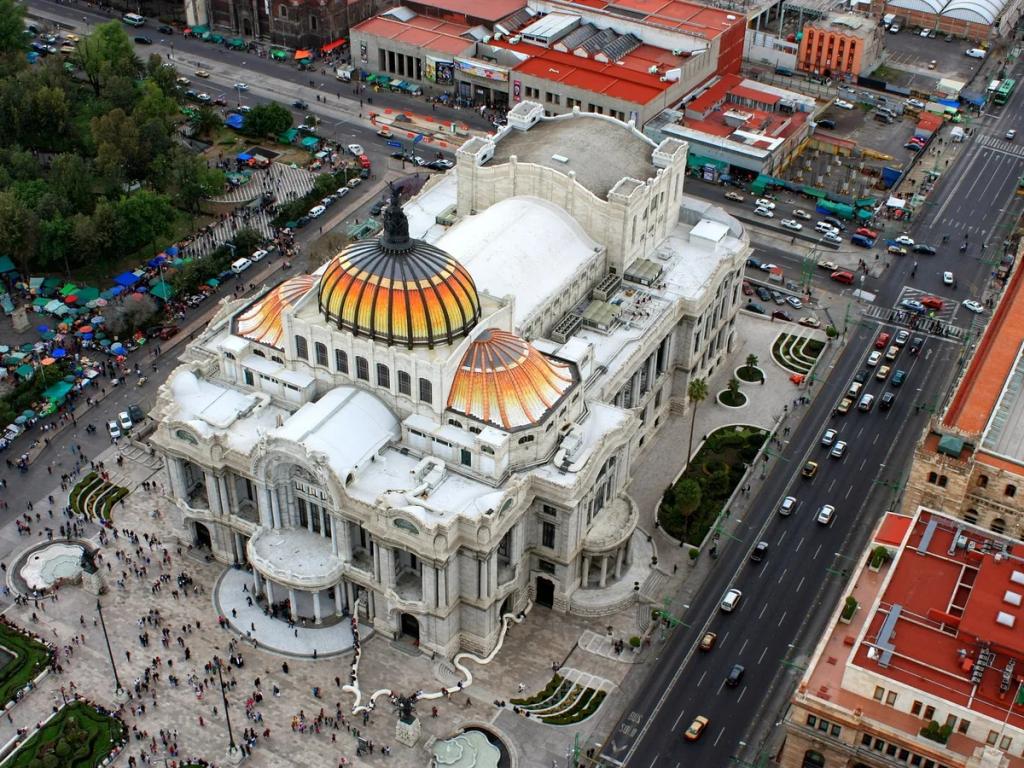
That famous straight-down view of the Palacio de Bellas Artes dome is shot from Finca Don Porfirio, the cafe on the 8th floor of the Sears building across Avenida Juarez - still open, still busy, with timed turns at the window, so go on a weekday and order a coffee for the mirador slot. Casa Azul's cobalt courtyard needs those prebooked tickets; the emptiest frames are in the first entry slot. Coyoacan's colored facades are at their best in golden-hour side light. And the shot of a lifetime is outside the city: a dawn hot-air balloon over Teotihuacan's pyramids, with hotel pickups around 5am.
Mexico City sits on the drained bed of Lake Texcoco, and it is still sinking measurably every year - by tens of centimeters in the worst-affected areas - which is why the Palacio de Bellas Artes has visibly settled since it was built. The city counts more museums than almost anywhere on Earth, roughly 150 and counting. And Chapultepec, its great urban forest, is more than twice the size of New York's Central Park.
Dia de Muertos (November 1-2) is the marquee moment, with the Gran Desfile parade down Reforma on a Saturday around those dates - the exact date is confirmed a few weeks out. Independence Day peaks with El Grito in the Zocalo on the night of September 15, followed by the September 16 military parade. The F1 Mexico City Grand Prix fills the Autodromo Hermanos Rodriguez each fall (in 2026, October 30 - November 1). And during Semana Santa, Iztapalapa stages its UNESCO-listed Passion Play, running since 1843 and drawing crowds in the millions.
The rave reviews are earned: a food scene that is world-class at every price point from street tacos to tasting menus, museum depth few cities can match, neighborhood life in Roma, Condesa and Coyoacan that rewards aimless walking, and prices that feel gentle for a global capital. The complaints are real too: the altitude takes a day or two of feeling winded, traffic is genuinely among the world's worst (budget double the map estimate at rush hour), tap water is not for drinking and hotel water pressure can disappoint, and the earthquake alerts - covered above - take some getting used to.
Mostly no in the tunnels - expect long dead stretches between stations, especially on the older central lines. Station Wi-Fi exists but is registration-gated and crowded. Load your route before descending; above ground on the Metrobús, signal is normal.
For Mexico as a whole, yes - Telcel's network is the country's most extensive, which makes it the safe default. Inside the capital the gap narrows: AT&T Mexico and Movistar both perform well in the central boroughs, so any of the three keeps a visitor comfortably online.
No - both apps work on any data connection and your existing accounts carry over. What you do need is reliable data at pickup time, since drivers often message through the app to confirm the exact corner. A data eSIM covers that; a Mexican number is only needed for local services that insist on SMS verification, which the major ride apps do not.