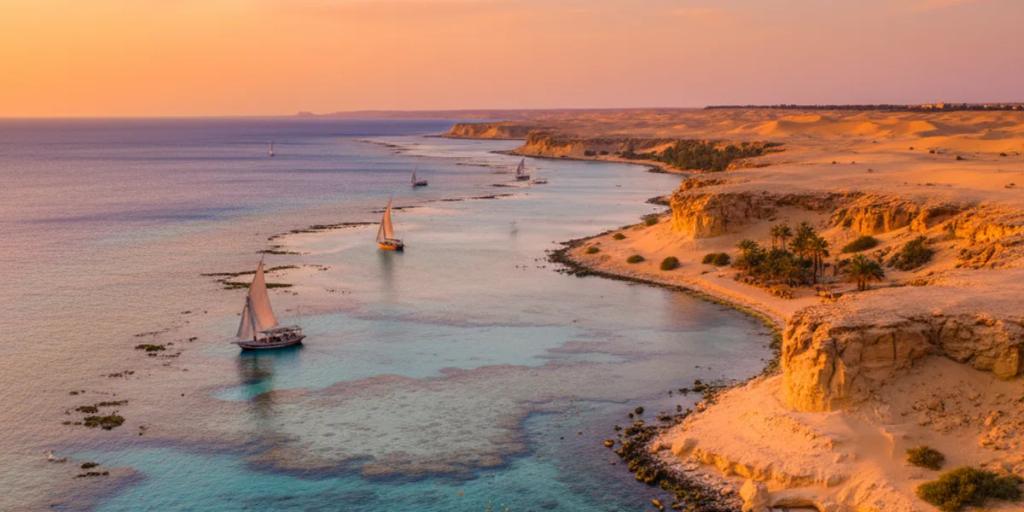
Marsa Alam is the Red Sea's frontier. Where Hurghada is a packed 40 km of hotels, down here the map stretches out: roughly 60 km separate the airport from Marsa Alam town, and the resorts sit in pockets along more than 100 km of coast road, from Port Ghalib down to Hamata in the deep south. Vodafone Egypt, Orange, WE and Etisalat by e& all serve the area, and this eSIM uses Orange, on 4G/5G, but the mobile grid follows the same logic - a string of islands, not a blanket.
Around anything built, you are fine: Port Ghalib's marina quarter, the resort pockets at Abu Dabbab and Marsa Mubarak, Marsa Alam town, and the hotel clusters further south all have workable 4G. Between those pockets is the part first-timers do not expect - long runs of empty desert highway where bars drop to one or vanish, so on transfers treat the connection as intermittent: messages send at the next cluster. The four networks also thin out unevenly this far south, so a companion on a different host network may have signal when you do not.
The excursions that justify coming here are precisely the ones that leave coverage behind. The Sataya "Dolphin House" day means an early pickup, around 111 km of road to Hamata port, then some 2 to 2.5 hours of sailing - for most of that day your phone is a camera, nothing more. Wadi el Gemal National Park swallows signal once you turn inland, and liveaboards are offline by definition. This is not a problem to solve; it is the deal. The night before any boat or desert day, download offline maps, screenshot confirmations and pickup points, warn anyone expecting instant replies, and enjoy being unreachable somewhere genuinely wild.
Egyptian carriers restrict VoIP, so voice and video calls through WhatsApp, FaceTime and similar apps regularly fail on mobile data anywhere in the country, whatever SIM or eSIM you use. Text, photos and voice notes all go through untouched - and swapping voice notes is how everyone here communicates anyway.
- WhatsApp text is the operating system of the deep south. Dive centers confirm house-reef slots by message, excursion desks send pickup times the evening before, and your transfer driver will message rather than ring.
- There is no Uber or Careem in Marsa Alam. Ride-hailing stops far north of here, so movement is pre-booked transfers, hotel taxis and negotiated fares - agree the price before the door closes, and check the distance first, because "nearby" can mean 40 km here.
- Book excursions ahead. Sataya and Samadai dolphin trips run on limited daily permits; reserve a day or two out.
- Cash still rules outside the lobby. Resorts and Port Ghalib restaurants take cards; taxis, the town souk and beach kiosks want Egyptian pounds.
Marsa Alam International sits by itself in the desert - Port Ghalib is 10 minutes away, but many resorts are an hour or more down the coast, and Hamata-area hotels closer to two. Nearly everyone is met by a pre-arranged transfer, and the driver's WhatsApp message is waiting before you reach baggage claim - which is why the eSIM is worth setting up before you leave home instead of queueing for a passport-registered local SIM.
Less than a city trip, honestly - the boat and desert days are forced savings. What eats data is everything around the water: dive-center coordination, backing up a week of reef photos, and evening streaming when the resort Wi-Fi sags under a full house. A modest plan covers most visitors for a week; size up if you work remotely or hotspot a tablet. Confirm your phone is on the eSIM-ready list, and if you are pairing the coast with Luxor or Cairo, one Egypt eSIM handles the entire itinerary.
Resortwear rules the hotel zones, but the sun this far south is serious: high-SPF reef-safe sunscreen, a hat and a long-sleeve rash guard are the real essentials, because the seagrass bays keep you floating face-down far longer than planned. From roughly November to March the water is cool enough that a shorty wetsuit turns a 20-minute dip back into an hour, and the near-constant breeze means a windproof layer for boat decks and winter evenings. In Marsa Alam town and El Quseir's old streets, cover shoulders and knees; these are conservative working towns, not resort promenades.
At Sataya, the shot is spinner dolphins arcing past the boat - keep the phone ready at the rail, because the pods decide when to approach, not you; enforced conduct rules (30 m vessel distance, protected resting zones, capped daily visitors) mean the patient boats get the passes. At Abu Dabbab and Marsa Mubarak, a waterproof pouch earns the trip's best frame: a green turtle grazing seagrass, shot slightly from above - and if a dugong appears, stay still and wide rather than chasing close. Port Ghalib's marina rewards a dusk walk, and after dinner look up: with almost nothing but desert to the south, these are the darkest skies most visitors have ever seen. No drone - Egypt requires military authorization private users cannot get.
Wadi el Gemal means "valley of the camels", and the national park (established 2003) hides Mons Smaragdus - the Roman Empire's only emerald mines, popularly called Cleopatra's mines. The dugongs grazing at Abu Dabbab belong to the order Sirenia, named for the sirens - sailors who glimpsed them helped birth the mermaid myth. And the Tropic of Cancer crosses the coast about 200 km south, close enough that the midsummer sun stands almost directly overhead.
Nobody flies here for a festival - Marsa Alam's calendar is written by nature. European winter-sun demand peaks October to April, summer brings heat and steadier wind for the kite spots toward Hamata, and pelagic seasons set the divers' rhythm. Ramadan moves earlier by roughly 11 days annually; resorts run normally, but excursion timings and town restaurant hours flex, and the Eid weeks fill hotels with Egyptian families. For a culture fix, El Quseir - the Red Sea's oldest port, with a 1571 Ottoman fortress that guarded the pilgrim route to Mecca - is up the coast road.
The love: this is the Red Sea before the crowds got to it - turtles and dugongs a swim from the sand, reefs Hurghada divers ride buses south to reach, dark-sky nights and space to breathe. The gripes are the mirror image: transfers are genuinely long (an hour or two, not twenty minutes), most resorts stand alone in the desert so "popping out" for shops or nightlife is not a thing, and on windy days the sea decides - boat trips do get cancelled. Snorkelers and divers call it the best of Egypt; anyone wanting buzz should book further north.
At the resort, almost certainly - hotels cluster where the towers are, and 4G in Port Ghalib, the Abu Dabbab area and town is dependable. The gaps are between the clusters: transfer stretches, inland tracks and open water. Expect intermittent coverage on the move, steady coverage once you arrive.
Assume not on mobile data: Egypt restricts internet calling nationwide, so app calls fail no matter which SIM or eSIM you hold. Messages, photos and voice notes work perfectly; hotel Wi-Fi is sometimes the exception for calls, so try yours on the first evening.
Effectively no. Once the boat leaves Hamata for the 2-plus-hour crossing you are offline until the return, and stretches of the drive south are dead too. Save confirmations offline the night before and treat it as a screen-free day at one of the Red Sea's great sites.