Claro, Movistar, Entel and Bitel all cover Lima, and this eSIM uses Movistar, on 4G. The city is comprehensively served, data is cheap, and coverage is not something you will think about here. Our Cusco guide handles the Peruvian questions that genuinely bite - altitude, and the fact that everything at Machu Picchu is booked months ahead. Lima's own peculiarity is that it is one of the world's great food cities that most visitors treat as an airport, and that for half the year it sits under a fog that never rains.
Lima has repeatedly held two or three places in the World's 50 Best Restaurants, and has held the top position. Central and Maido are the names, and they are genuinely destination restaurants rather than list artefacts.
Book months ahead for those, and understand that they are tasting menus at international prices.
But the depth is the point, not the peaks. Lima's food is extraordinary at every level, and the cheap end is where the argument is won.
Ceviche is the national dish and it is a lunch food. Fish cured in lime with chilli and red onion, served at a cevichería, and traditionally eaten before about four in the afternoon because the fish came in that morning. Ordering it at dinner marks you out.
Two immigrant cuisines are fully Peruvian now. Nikkei is Japanese-Peruvian, born of a large Japanese community, and it is where a great deal of the modern cooking comes from. Chifa is Chinese-Peruvian, older and more everyday, and Lima's Chinatown is one of the oldest in the Americas.
Pisco sour, and the argument with Chile about whose drink it is, which you should not attempt to adjudicate.
Most visitors give Lima one night on the way to Cusco. Two or three days here, eaten properly, is one of the better decisions available in South America.
This catches out almost everyone who books between May and November.
Lima sits in a coastal desert. Annual rainfall is a few millimetres - it is among the driest capital cities on earth, and it essentially never rains.
And yet it is grey and damp for half the year. Cold water offshore produces a persistent marine layer, the garúa, which sits over the city from roughly May to November. It is not rain; it is a fine mist and a lid of low cloud that can hold for weeks.
Humidity stays high while the temperature sits in the mid-teens, which feels considerably colder than the number suggests, especially since buildings have no heating.
Winter here is not sunny. People arrive in July expecting a South American summer and find a fortnight of flat grey light. The beach districts look completely different under it.
December to April is the bright season - genuine sun, warm sea air, and the city at its best.
Photographers should know that the famous Miraflores clifftop views are frequently shot in the four bright months, and the July version does not look like that.
The whole metropolitan area is well covered, including the Metropolitano bus corridor and the metro line.
Congestion is the failure mode, as in any city of ten million - saturated cells at peak rather than absent ones.
Down at the beach clubs below the Miraflores cliffs, the 70-metre escarpment produces shadows.
The Pachacamac ruins and the desert south of the city are covered along the highway and thin off it.
Paracas and the Ballestas Islands, three hours south, have service in town and patchy coverage on the boat trips.
The Andes begin an hour east, and the road up to the mountains loses signal in the valleys quickly.
Miraflores is where most visitors base themselves: clifftop, walkable, safe, well served and with a great deal of the food.
Barranco, next door, is the bohemian district - bars, street art, small galleries, and the best evening in the city.
San Isidro is the business district and quieter.
The historic centre is UNESCO-listed and genuinely worth a day - the cathedral, San Francisco's catacombs, the balconies - but it is not where most people sleep.
Ordinary precautions apply. Lima has petty crime and phone snatching in busy areas, so keep your phone away when walking, use ride apps rather than street taxis, and be more careful after dark and away from the main districts. This is a normal big-city posture rather than a special warning.
Taxis should be booked through an app. Uber, Cabify, DiDi and inDrive all operate, they are inexpensive, and using them removes the fare negotiation that unmetered street taxis expect.
- Uber, Cabify, DiDi or inDrive, whichever you already have. All work.
- Maps, with offline copies for anything outside the city.
- Yape, Peru's dominant payment app, which is on every counter - though it needs a Peruvian account, so this is context rather than instruction.
- A restaurant booking app or the restaurants' own sites, if you are aiming for the famous ones.
- A translation app. Spanish is essential outside hotels and the tourist districts; English is limited.
Jorge Chávez International (LIM) is in Callao, about 10 to 12 km northwest of the centre and rather further from Miraflores in practice - budget 45 minutes to well over an hour depending on traffic. The airport has been substantially expanded in recent years, so check which terminal your airline uses.
Use an app or a pre-booked transfer. The arrivals area attracts informal drivers, and the official options - authorised taxi desks, a booked hotel transfer, or a ride app from the designated pickup area - are all straightforward.
Lima is the hub for the whole country, and most trips to Cusco, Arequipa or the Amazon route through here, which is why so many people see only the airport.
The Metropolitano bus corridor and the metro line cover useful axes but not the airport directly.
Moderate. Ride apps and maps run constantly, wifi is good in hotels and cafes, and Peruvian data is inexpensive. A middling plan is right, with more if you are heading south to Paracas or east into the mountains where offline maps matter.
Layers, and a jacket in winter. Fourteen degrees with high humidity and no indoor heating is colder than it sounds, and the fog does not lift to reward you.
Light clothes December to April, when it is genuinely warm.
Something for the evening. Lima dines late and dresses for it, particularly in Miraflores and Barranco.
Comfortable shoes. The malecón walk along the cliffs is several kilometres and worth all of it.
A windproof layer for the clifftop, where the sea breeze is constant.
Sun protection in summer - the cloud is gone and the UV at this latitude is strong.
The Miraflores malecón at sunset in the bright season, with paragliders launching off the cliff and the Pacific behind.
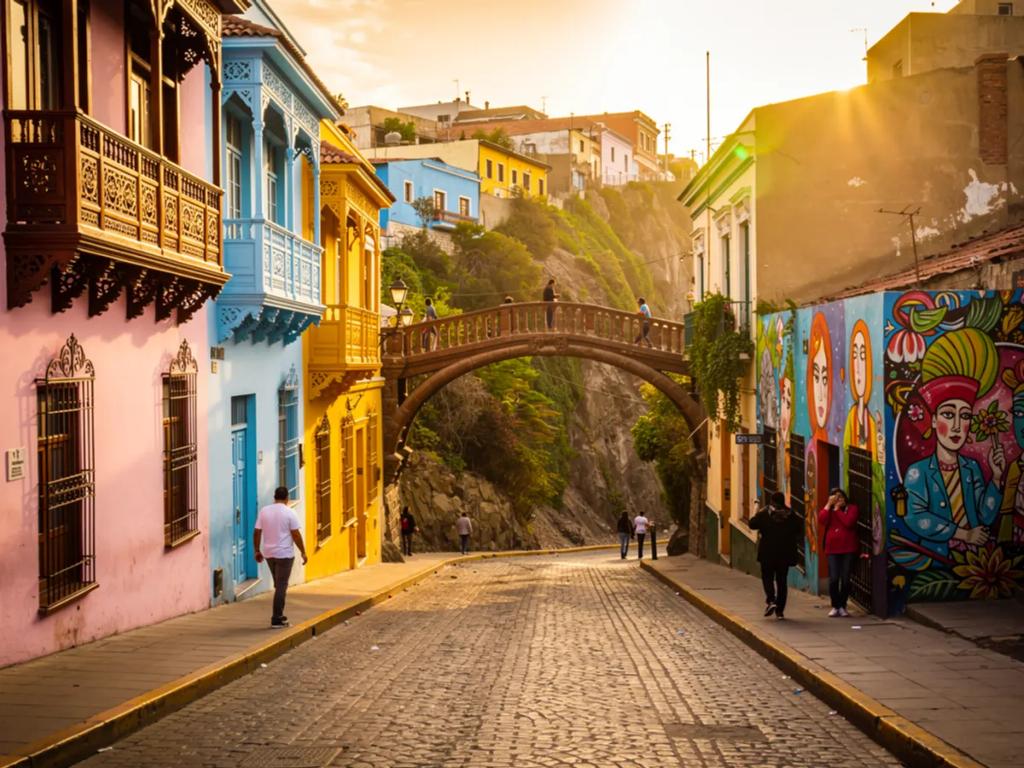
Barranco's Puente de los Suspiros, the Bridge of Sighs, and the street art in the lanes around it.
Huaca Pucllana, a pre-Inca adobe pyramid sitting in the middle of a residential Miraflores block, lit at night with a restaurant beside it.
Plaza Mayor in the historic centre, with the cathedral and the yellow Archbishop's Palace balconies.
The catacombs at San Francisco, where the bones are arranged in patterns.
The Circuito Mágico del Agua, a park of illuminated fountains, which is unashamedly kitsch and very popular.
Pachacamac, the pre-Inca sanctuary in the desert half an hour south.
A cevichería at lunchtime, which is the actual photograph you will want later.
Lima is one of the driest capitals on earth and simultaneously one of the greyest. It sits in a desert, receives almost no rain, and spends half the year under fog - a combination that surprises everyone.
Peru grows thousands of varieties of potato, and the crop originated in the Andes. The variety on a Lima menu is not a marketing claim.
Nikkei cuisine exists because of migration. Peru received one of the largest Japanese communities in the Americas from the late nineteenth century, and the cooking that resulted is now a defining strand of Peruvian food.
Lima's Chinatown is among the oldest in the Americas, and chifa - Chinese-Peruvian food - is so thoroughly naturalised that it is simply what Peruvians eat.
Huaca Pucllana is around 1,500 years old and stands in the middle of an affluent modern neighbourhood, which is a very Lima juxtaposition.
And the historic centre is a UNESCO World Heritage Site, largely for its colonial architecture and its extraordinarily carved wooden balconies.
Señor de los Milagros, in October, when Lima turns purple - one of the largest religious processions in the Americas, and the month is named for it.
Independence Day, 28 and 29 July, with military parades and a long weekend when the country travels.
Summer, December to April, is the sunny season and when the city uses its beaches.
The winter months, May to November, are grey but are also low season, cheaper, and perfectly good for eating - which is much of the reason to be here.
The love: Lima is one of the world's genuine food cities, and it rewards anyone who gives it more than a connection. The clifftop districts are handsome and walkable, Barranco is charming, the historic centre is a proper colonial capital, and the pre-Inca sites sit inside the modern city rather than out of reach. It is also good value once you are away from the famous restaurants, and it is the natural gateway to everything else in Peru.
The complaints are consistent. The garúa makes half the year visually dreary. The traffic is heavy and the city sprawls enormously. It is not a beautiful city overall - the interesting parts are pockets separated by a great deal of grey concrete. Petty crime requires an awareness that some visitors find tiring. And most people are here for one night before Cusco, which is a self-fulfilling reason not to explore it.
Come between December and April if you want the city to look like the photographs, stay in Miraflores or Barranco, eat ceviche at lunch, and give it two full days before you fly on.
Yes, for the food if nothing else - the city has held multiple places in the World's 50 Best Restaurants and the depth below that level is the real argument. Two or three days covers the clifftop districts, Barranco, the UNESCO historic centre and a pre-Inca site, all with excellent eating attached.
Lima is a coastal desert under a persistent marine fog called the garúa, produced by cold water offshore. From roughly May to November the city sits under low cloud and fine mist without meaningful rainfall, at 14-19C and high humidity. December to April is the bright season.
Use ordinary big-city sense. Phone snatching happens in busy areas, so keep it away while walking, use ride apps rather than hailing street taxis, and be more careful after dark and outside Miraflores, Barranco and San Isidro. Most visits are entirely uneventful.
No - an eSIM covers it, coverage across the metropolitan area is comprehensive and Peruvian data is cheap. The one thing worth downloading before you leave the city is offline maps, for Paracas, Pachacamac or any trip up into the Andes.