Helsinki runs on Elisa, Telia and DNA, and your eSIM rides one of them as its host. Finland has some of the best mobile infrastructure in the world and it is not close. Coverage is excellent across the country including in genuinely remote areas, 5G is ubiquitous in the capital, and the way Finns buy data is unlike almost anywhere else - which is worth understanding even as a visitor, because it explains the network you are using.
This is the most interesting thing about connectivity here and it is invisible unless someone points it out.
Finnish mobile plans are usually unlimited on data and priced by the maximum speed instead. You choose 50 Mbps or 300 Mbps or a gigabit, and you use as much as you like at that rate.
Around two thirds of Finns are on an unlimited plan, the highest proportion anywhere in the world.
So Finns use an extraordinary amount of data - on the order of 70 GB per SIM per month, comfortably the highest national figure on the planet and several times the European average.
The networks are built for that, which is why coverage and capacity here are so good. A country where everyone streams everything has to build differently.
What it means for you: whatever travel eSIM allowance you buy will feel small against local habits, but the network itself will never be the bottleneck. Finnish wifi is fast and genuinely everywhere, including on trains and buses.
Worth stating plainly, because Helsinki spent decades as the easy way into Russia and a great deal of published advice still assumes it.
The land border is closed. Finland shut its crossings and they have not reopened.
The Allegro train to St Petersburg stopped running in March 2022 and has not returned. Direct buses and ferries are also gone.
Do not plan a Russian leg from here. There is no ordinary route across, and for most visitors there is no route at all.
What Helsinki is still a gateway to is Tallinn, two hours by fast ferry and an extremely easy day trip, and Stockholm on the overnight boat.
Finland has something on the order of three million saunas for five and a half million people, which is roughly one for every two Finns.
It is not a spa treatment. It is where people go to be clean, to think, to conduct business, and to sit in silence. Nearly every apartment building has one.
Public saunas are the way in for a visitor. Loyly and Allas on the waterfront are the modern architectural ones; Kotiharjun Sauna in Kallio is the old wood-fired original, unchanged since 1928.
You are naked, in single-sex sections. Swimsuits are for the mixed outdoor pools and the sea.
Wash before you enter. Sit on your towel. Throwing water on the stones is loyly, the steam, and anyone can do it.
No phones. This is close to absolute and nobody will need to tell you. The heat would ruin the device anyway, and the point of the room is that you are not reachable.
The ice swim afterwards is normal, available at several public saunas through the winter, and considerably more pleasant than it sounds.
Essentially nowhere in the capital region. The metro is covered, the trains are covered, the ferries to Suomenlinna are covered.
Lapland, far to the north, is well covered in the towns and resorts and thins across the fells and wilderness areas.
The archipelago is the practical gap. There are tens of thousands of islands off the southern and western coasts, and coverage on the outer ones is patchy to absent.
Deep in the national parks - Nuuksio is only 40 minutes away - service drops in the valleys.
On the ferries to Tallinn and Stockholm, you will drift between Finnish, Estonian and Swedish networks in the middle of the Baltic. All are in the EU, so roaming costs nothing, but a plan tied to one country specifically may behave oddly.
- HSL, for Helsinki's trams, metro, buses, trains and the Suomenlinna ferry, all on one ticket and one app. It is very good.
- 112 Suomi, the official emergency app, which transmits your precise location to the responder when you call. Finns install it as a matter of course and there is no reason a visitor should not.
- Foreca or the FMI app for weather, which matters more here than in most cities.
- Maps, with offline copies if you are heading to the archipelago or Lapland.
- A translation app is essentially optional. English is spoken to an extremely high standard by almost everyone under sixty.
Helsinki-Vantaa (HEL) is about 20 km north, and the train from beneath the terminal reaches the central station in around 30 minutes on an ordinary transport ticket. The I and P ring-rail trains run in a loop, so either direction gets you there.
The airport is consistently rated among the best in Europe and is genuinely quick to move through.
Ferries from Tallinn and Stockholm dock within walking distance or a short tram ride of the centre.
In the city, the tram network is the pleasure, and a day or week ticket covers trams, metro, buses, local trains and the island ferry together.
Very little. Wifi is fast and universal, the city is compact, and EU visitors are on their home allowance anyway. A small plan is fine unless you are working. Save the headroom for a Lapland or archipelago trip, where offline maps matter.
Winter is serious but manageable. December to March sits below freezing with snow, and the city is completely set up for it - pavements cleared, buildings warm, everything connected.
Proper boots with grip. Ice underfoot is the actual hazard, not the temperature.
Layers with a windproof outer. The wind off the Baltic is what makes -5C feel much worse.
In summer, layers again. July can be 25C or 14C and wet.
Swimwear and a towel year-round, because the sauna opportunity arrives unannounced.
Helsinki dresses simply and well - understated, functional, good quality. Nobody dresses up much and nobody is scruffy.
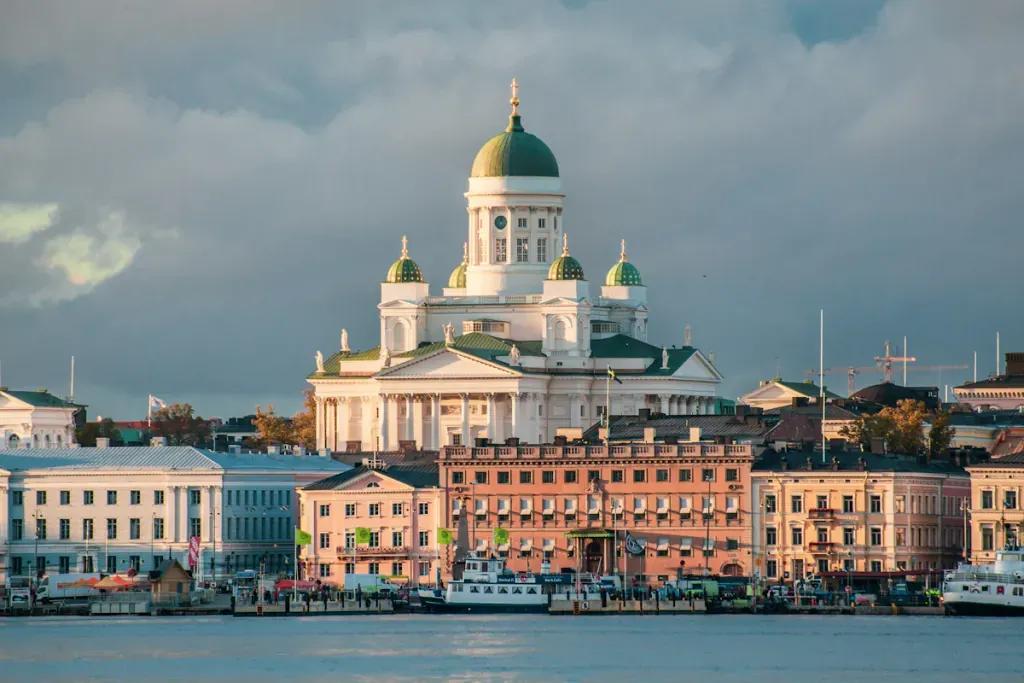
Helsinki Cathedral above the granite steps of Senate Square, best in low winter sun or at white-night dusk.
Uspenski Cathedral, the red-brick Orthodox cathedral on its rock above the harbour.
Temppeliaukio, the church quarried directly into bedrock with a copper-coil ceiling.
Oodi, the central library, which is a genuinely radical civic building and free to wander.
Suomenlinna, the UNESCO-listed sea fortress spread over six islands, reached by a ferry that runs on an ordinary transport ticket. Go even in winter, when it is empty and the sea steams.
The Market Square and Old Market Hall in the morning.
Loyly's terraced waterfront, all timber, at sunset.
Kallio, for the bars, the second-hand shops and a completely different register from the centre.
Finns drink more coffee per person than any other nation on earth, by a distance, and it is filter coffee rather than anything elaborate.
Finland has repeatedly been ranked the happiest country in the world, a result Finns find perplexing and slightly embarrassing given the winters.
Linux was written by a Finn. Linus Torvalds began it as a student in Helsinki.
The Moomins are Finnish, created by Tove Jansson, and written originally in Swedish - Finland's other official language.
There are more heavy metal bands per capita here than anywhere else, which sits oddly and pleasingly alongside the national reserve.
The Wife Carrying World Championships are held annually at Sonkajarvi, and the traditional prize is the wife's weight in beer.
And Finnish is not related to Swedish, Russian or any of its neighbours - it belongs to the Uralic family, alongside Estonian and, distantly, Hungarian.
Vappu, 1 May, the student and spring festival, when the whole city puts on white caps, drinks sparkling wine in the park and behaves entirely unlike itself.
Juhannus, midsummer, in late June, when Helsinki empties completely for the countryside and the light barely goes at all. Expect closed shops.
Flow Festival, in August, in a former power plant, and one of the better-curated festivals in Europe.
The Helsinki Festival, also August, across music, theatre and art.
Lux Helsinki, in January, a light festival that makes something of the darkest weeks.
Summer, June to August, is bright, warm and social. Winter is dark and beautiful, and the city handles it far better than most.
The love: Helsinki is calm, functional and quietly excellent. The design tradition is real and lived in rather than curated, the public transport and libraries and swimming halls suggest a city built for the people who live in it, and the sauna culture is worth the trip on its own. It is safe, clean, green and surrounded by water, the food scene has improved beyond recognition, and Tallinn is two hours away by boat.
The complaints are consistent. It is expensive, particularly eating and drinking out. The winters are dark, with about six hours of murky daylight in December. Finns are reserved, and visitors wanting spontaneous conversation find it slow going - though the reserve is politeness rather than coldness. It is small and quiet, and two or three days covers the centre. And a few people find it austere, which is fair in February and entirely wrong in June.
Go in June for the light or February for the ice swimming, buy a transport day ticket, take the Suomenlinna ferry, and book a public sauna for the first evening rather than the last.
Finnish plans are typically unlimited on volume and priced by maximum speed instead, and around two thirds of Finns are on one. The result is the highest data use per SIM in the world, roughly 70 GB a month, and networks built to carry it. Coverage and capacity here are exceptional, including outside the cities.
Yes, and with none of the asterisks some of its neighbours carry - Finland has been in the EU, the euro and Schengen for decades, so your allowance, your money and your passport all behave exactly as they do at home.
No. The land border with Russia is closed, the Allegro train stopped in March 2022 and has not returned, and direct buses and ferries are gone. Helsinki was the standard route into Russia for decades and a lot of old advice still says so. Tallinn, two hours by ferry, is the day trip that does work.
Lapland is well covered in the towns and resorts and thins across the open fells. The archipelago is patchier, and the outer islands can have nothing at all. Both are worth downloading offline maps for; the capital region itself needs none of this.