Alicante runs on Movistar, Vodafone, Orange and Yoigo, and your eSIM rides one of them as its host. Coverage across the city and the Costa Blanca is comprehensive, 5G is widespread, and Spanish data is cheap. For most European visitors this is a solved problem. For British ones - and the Costa Blanca has more of those than anywhere else in Spain - two separate clocks now run against you, and neither existed a few years ago.
Alicante is the single most British-facing destination in Spain, with a very large resident and second-home population along the coast. Both of the following are routinely discovered too late.
Clock one: your roaming is probably no longer free. Since the end of the transition period there has been no obligation on UK operators to provide surcharge-free EU roaming, and most of the big ones reintroduced charges through 2022.
- EE, Vodafone and Three all apply a daily fee on most newer plans, broadly in the range of two to six pounds a day depending on the plan.
- O2 has kept EU roaming included on many of its plans, and several smaller providers - giffgaff, Lebara, Plusnet among them - have not reintroduced charges either.
- Check your specific plan, not your network's reputation. The date you signed matters more than the logo.
- Ofcom requires a 45-pound monthly spend cap by default, which limits the damage but does not prevent it.
- Over a two-week stay a daily fee adds up to more than a travel eSIM costs, which is the entire argument for using one here.
Clock two: the 90/180 rule. British citizens are now third-country nationals in the Schengen area, and the limit is 90 days in any rolling 180-day period across Schengen as a whole, not per country.
- It is a rolling window, not a calendar allowance. Every day you have been in Schengen in the previous 180 counts against you.
- It applies across the whole zone. A week in France counts against your Spanish days.
- Second-home owners feel this hardest. Wintering on the Costa Blanca for five or six months, once completely normal, is no longer possible on a visitor entry.
- The routes out are a Spanish non-lucrative or digital nomad visa, or residency - all of which are real processes rather than paperwork at the border.
- Overstaying carries consequences, including entry bans, and border systems track it.
None of this affects a fortnight's holiday. All of it affects the people this coast was largely built for, and it is the single most common misunderstanding here.
Alicante is one of the driest places in Europe, which is exactly why its rain is dangerous.
The gota fria, or DANA, is a cold drop - an isolated pool of cold air aloft meeting very warm Mediterranean water, usually in September and October.
It does not drizzle. It delivers a season's rain in hours over a small area.
The ground cannot take it. Dry, hard, heavily built-up terrain and normally empty watercourses - ramblas - fill in minutes. The danger is flash flooding rather than the rainfall itself.
The Valencia region suffered a catastrophic DANA in October 2024, with very large loss of life, and the event reshaped how seriously the phenomenon is treated.
Spain broadcasts emergency alerts to mobile phones through the ES-Alert system, which reaches handsets in an affected area including roaming foreign ones. Leave your phone's emergency alerts enabled.
If a warning is issued: stay out of ramblas, underpasses and basements, do not drive through standing water, and follow local instruction rather than a plan. Most autumns pass without incident, and the point is to know what the alert means rather than to worry about it.
The city, the beaches and the coastal strip are thoroughly covered, as is the TRAM line north.
The interior thins. Behind the coast the land rises quickly into the mountains of the Marina Alta and Alcoy, and the valleys and passes drop out.
The Sierra de Aitana and Puig Campana have gaps on the trails.
Tabarca island, a short boat ride out, is covered but the crossing itself is variable.
The Guadalest and Algar valleys are patchy in the gorges.
El Palmeral and the salt flats at Santa Pola are fine.
Compared with most places in this series, Alicante's coverage problem is minor - the interior is the only real gap, and it is half an hour away.
The Costa Blanca is essentially linear, and the TRAM light rail runs along it.
Line 1 to Benidorm is genuinely scenic - it hugs the coast, ducks through headlands and takes about an hour and a quarter, and it costs a fraction of a taxi.
It continues to Denia with a change, which makes a car unnecessary for a coastal holiday.
Alicante itself is compact and walkable - the old town, the Explanada, the marina and Postiguet beach are all within twenty minutes on foot.
A car is only worth it for the interior: Guadalest, the Algar waterfalls, the wineries around Jumilla and Yecla, and the mountain villages.
Alicante airport is one of the busiest in Spain, dominated by low-cost carriers serving a coastline rather than a city, which is why fares from northern Europe are so cheap and why the arrivals hall is what it is in August.
- The TRAM or a general transit app for the coastal line.
- Maps, with offline copies only if you are heading inland.
- AEMET, the Spanish met office app, which is the authoritative source for the weather warnings above.
- A translation app is optional. Spanish is universal, English is very widely spoken along this coast, and Valencian is co-official and appears on signage.
- Cards work everywhere. Contactless is standard and there is no need for a payment app.
Alicante-Elche Miguel Hernandez (ALC) is about 10 km southwest.
The C-6 airport bus runs to the city centre frequently and cheaply, and taxis take fifteen minutes. There is no rail link to the terminal.
Long-distance trains connect Alicante to Madrid in around two and a half hours on the high-speed line, and to Valencia and Barcelona along the coast.
Once here, the TRAM and your feet cover almost everything.
Little. Wifi is everywhere, the city is small, and EU visitors are on their home allowance. The exception is the British visitor on a plan with daily roaming charges, for whom a travel eSIM is straightforwardly cheaper than two weeks of add-ons.
Summer clothes and serious sun protection. This is one of the sunniest places in Europe and the sea breeze hides how strong it is.
Something for the evening. Alicante dresses up to go out, and the paseo along the Explanada is a social event.
A light layer in winter, which is mild and pleasant but cooler after dark than the daytime suggests.
Walking shoes for the castle, which is a genuine climb if you do not take the lift through the rock.
Beach shoes for the rockier coves north of the city.
A rain shell in September and October, on the reasoning above.
Santa Barbara castle on Monte Benacantil, and the view from it down over the city, the marina and the coast. There is a lift bored through the rock from Postiguet beach.
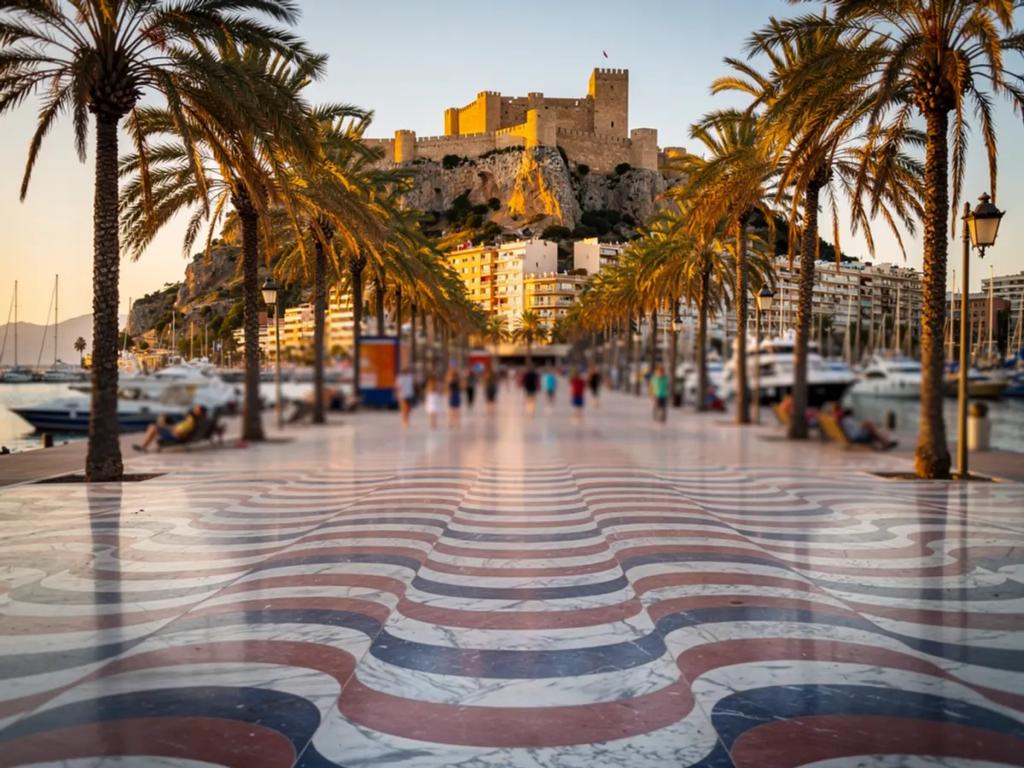
The Explanada de Espana, the wave-patterned promenade of red, cream and black marble tiles under the palms.
The old town, Santa Cruz, all whitewashed houses, flowers and steep lanes below the castle.
Tabarca island, Spain's smallest permanently inhabited island, an hour by boat.
Guadalest, an hour inland, a village on a rock above a turquoise reservoir - the most photographed inland spot on this coast.
The Algar waterfalls, for swimming, in the same direction.
Postiguet at golden hour, with the castle above it.
The salt flats at Santa Pola, pink with flamingos.
The Explanada is paved with around six and a half million marble tiles, laid in a wave pattern that genuinely makes you slightly seasick in bright sun.
Santa Barbara is one of the largest medieval fortresses in Spain, and the rock it sits on has a face in profile - locals call it the Moor's Face and once you are shown it you cannot unsee it.
Turron, Spain's nougat, comes from Jijona just inland, and the town's entire economy is built on it.
Tabarca was settled with Genoese families freed from captivity in Tunisia in the eighteenth century, and it remains Spain's smallest inhabited island.
Alicante has over 300 days of sunshine a year, which is the entire founding premise of the Costa Blanca.
And the Hogueras de San Juan burn enormous satirical sculptures in the streets each June, in a tradition closely related to Valencia's Fallas - months of work, destroyed in a night.
Las Hogueras de San Juan, 20 to 24 June, the city's defining festival: giant papier-mache monuments erected across Alicante and then burned on the night of the 24th, with fireworks, bands and beach bonfires. If you can time a visit for anything, time it for this.
Semana Santa, in the week before Easter, with processions through the old town.
Moros y Cristianos festivals through the spring and summer in the towns inland - Alcoy's is the most famous.
Summer, June to September, is hot, busy and expensive. May, June, September and October are the best months. Winter is mild, quiet and why so many northern Europeans are here at all.
The love: Alicante is easy in every direction. The weather is reliably excellent, the beaches are in the city rather than out of it, the old town under the castle is genuinely pretty, the tapas and rice dishes are very good and cheap, and it is one of the best-connected airports in Spain for cheap flights. The TRAM makes the whole coast accessible without a car, and half an hour inland there are mountains, waterfalls and villages that most visitors never see.
The complaints are consistent. The coast is heavily developed, and Benidorm's skyline an hour north is either a guilty pleasure or a warning depending on your temperament. Parts of the strip are a British-bar monoculture that could be anywhere. August is hot, packed and expensive. The city itself is small and two days covers it. The interior is where the interest is, and reaching it properly needs a car. And the Brexit clocks above have made what used to be a simple long stay into a genuine planning problem.
Come in May or October, take the TRAM up the coast, climb the castle at sunset, and hire a car for one day to see Guadalest and the Algar.
Possibly not. There has been no obligation on UK operators to provide free EU roaming since Brexit, and EE, Vodafone and Three reintroduced daily charges on most newer plans, broadly two to six pounds a day. O2 has kept it included on many plans, as have some smaller providers. Check your specific plan rather than your network's reputation - over a fortnight, a daily fee costs more than a travel eSIM.
90 days in any rolling 180-day period, and that limit applies across the whole Schengen area rather than per country. It is a rolling window, so days spent anywhere in Schengen in the previous 180 count. Longer stays need a Spanish visa or residency. This is what ended the traditional five-month winter for second-home owners.
A cold drop, or DANA - an autumn weather pattern that dumps a season's rain in hours over a small area, causing flash floods in normally dry watercourses. Most autumns pass without incident. Spain sends emergency alerts to mobile phones in affected areas, including roaming ones, so leave your emergency alerts enabled, and if one arrives stay out of ramblas, underpasses and basements.
Not for the coast. The TRAM light rail runs from Alicante along the shoreline to Benidorm and on towards Denia, and it is cheap and scenic. A car earns its place only for the interior - Guadalest, the Algar waterfalls and the mountain villages - which is worth one day of your trip.