Budapest is an easy city to stay online in. Hungary's three networks - Magyar Telekom, Yettel (the former Telenor), and One (the former Vodafone, rebranded in January 2025 after merging with DIGI under new owner 4iG) - all blanket the capital with solid 4G and growing 5G. Your eSIM rides one of these as its host network, and in practice that means fast data across both banks of the Danube: the Pest grid, the Castle District, Margaret Island, and the full length of the tram 4/6 ring.
Less than you would expect. Budapest's metro has mobile coverage deep underground across the network - including the M4, one of the deepest lines in Europe, which was built with indoor antennas along the tunnel - so maps and messages keep working below the Danube. Even the little yellow M1, running since 1896, keeps you connected; it is barely below street level anyway. The honest weak spots are indoors: the thick-walled thermal baths (your phone is in a locker regardless), some Buda Castle cellars-turned-bars, and the odd ruin bar back room in District VII where six brick walls beat any network.
- BudapestGO is the one to install: BKK's official app sells metro, tram and bus tickets, and validation is a live in-app step - on the metro you scan a QR code on the validating machines before entering, so you need working data at the gate, not just a screenshot.
- Pay&GO contactless now covers all four metro lines and the airport bus: tap a bank card or phone at the purple reader and that single tap is both your ticket and your validation. No app needed for single rides.
- Bolt is the ride app locals actually use, for cars and the e-scooters lining every bridgehead. Uber returned in 2024 operating with licensed taxis; for a street pickup, stick to reputable companies like Fotaxi rather than a lurking "freelance" cab.
- Cards work almost everywhere - Hungary uses the forint, not the euro, and tap-to-pay is near-universal in shops and restaurants. But carry some cash anyway: a few bath ticket desks, market stalls at the Great Market Hall, and ruin-bar cloakrooms still prefer it.
From Ferenc Liszt airport, the 100E Airport Express runs direct to Deak Ferenc ter in the center - with one classic gotcha: regular BKK tickets and travelcards are not valid on it, so you need the dedicated airport shuttle single ticket, bought in BudapestGO or by tapping Pay&GO at the door. Buying that ticket, messaging your host, and loading the walking route to your apartment all happen in the first twenty minutes on Hungarian soil - which is why installing your eSIM before you fly beats hunting airport Wi-Fi with your luggage in hand.
A Budapest break is map-moderate (the Pest side is a legible grid) but photo- and translation-heavier than Western Europe - Hungarian is related to nothing you speak, and menu-scanning with your camera becomes a habit fast. For most travelers 1GB per 2-3 days covers maps, messaging, translation and social posting; budget more if you are uploading every bath-and-bridge reel or video-calling home. If Budapest is one stop on a bigger loop, our Eastern Europe eSIM guide covers stitching the region together, and the Europe-wide comparison helps if you are crossing into the EU's west too.
Pack for the season, not the postcard. Summer is genuinely hot (28-33C) and the city is a walking city, so light layers win. Winter sits around freezing and grey - a real coat, hat and waterproof shoes are non-negotiable. For the thermal baths, bring flip-flops (mandatory in practice, rentable in theory) and a swim cap if you want the lap lanes at Szechenyi or Gellert. The State Opera is astonishing value by Western standards, and smart-casual is enough - no tux, but no shorts.
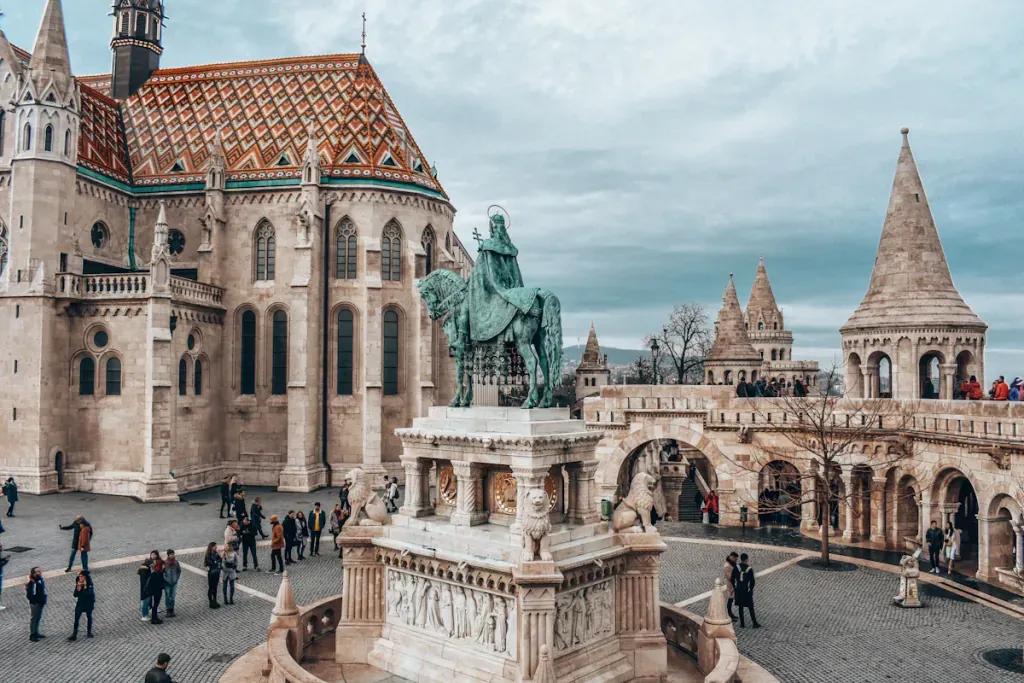
Fisherman's Bastion at sunrise is the trick everyone should know: the upper turrets are ticketed roughly 9:00 to 19:00 (to 21:00 in high summer), but before 9am they are free and nearly empty, with soft light on the Parliament across the river. For the Parliament itself, cross to Batthyany ter on the Buda side at blue hour and shoot across the water as the lights come on. In winter, the outdoor pools at Szechenyi turn the steam golden in low sun - shoot from the water's edge, phone well away from splashes. And skip copying the people climbing Liberty Bridge's girders for photos: it is prohibited, policed, and a long way down.
The M1 Millennium Underground opened in 1896 and is continental Europe's oldest underground railway - it still runs under Andrassy Avenue with its original tiled stations. Budapest has only existed since 1873, when Buda, Pest and Obuda merged into one city. Around 120 thermal springs feed its baths, more than any other capital. And two everyday objects are Hungarian inventions: the Rubik's Cube (Erno Rubik, 1974) and the ballpoint pen (Laszlo Biro).
Sziget Festival takes over Obuda Island in mid-August (11-15 August in 2026) - one of Europe's biggest festivals, a short HEV ride from the center. On 20 August, St Stephen's Day climaxes with an enormous fireworks show over the Danube; the embankments fill hours ahead. September brings the Budapest Wine Festival to the Buda Castle terraces, and from late November the Christmas markets at Vorosmarty ter and St Stephen's Basilica run through the holidays, complete with a light show projected onto the Basilica facade.
The love is well-earned: bathing in 38C outdoor water while it snows, cafe houses and an opera night at prices Western Europe forgot, and grand Habsburg-era architecture on both riverbanks. The complaints are real too: parts of District VII have become a stag-party corridor on weekend nights, some taxis still overcharge tourists (use Bolt or Fotaxi and the problem disappears), Vaci utca's "tourist menu" restaurants are a trap locals never enter, and the winter greyness between Christmas and March tests anyone's mood - though that is precisely when the baths make the most sense.
Yes - all four lines have coverage underground, including the deep M4, which is genuinely rare for a metro this old and this deep. That matters here because BudapestGO ticket validation on the metro involves scanning a QR code live at the gate, so working data underground is not just a convenience.
Card and phone payments are accepted almost everywhere, including metro gates via Pay&GO, and Hungary prices everything in forint (paying in euros, where offered, is a bad exchange rate). Keep a modest cash reserve for market stalls, some bath ticket desks and tips.
Only if you want a Hungarian phone number. For a data-only trip, an eSIM installed before you land means you are online on the 100E bus into town, your home number stays live for bank codes, and you never queue at a phone shop with your passport.