Sardinia runs on Italy's four networks - TIM, Vodafone, WindTre and Iliad - and your eSIM rides one of them as its host. In the coastal towns, the resorts and along the main roads you get solid 4G with 5G in the larger centres. Then you drive inland, and the picture changes completely.
The single most useful thing to understand about Sardinia is its scale. The island covers about 24,000 km² - larger than Wales, comparable to Sicily - and the population is concentrated around the edges. The interior is mountain, forest and stone villages, and it is genuinely empty.
That geography is the connectivity story:
- The coasts are fine. Cagliari, Olbia, Alghero, the Costa Smeralda, the resort strips - dense coverage, no surprises.
- The interior is not. The Barbagia, the Gennargentu massif and the Supramonte are remote by any European standard. Coverage follows the main roads and the villages, and disappears between them.
- The distances are longer than they look. Cagliari to Santa Teresa Gallura is around four hours. There is no motorway network in the mainland sense, and the interior roads are slow, winding and beautiful.
The practical rule: download offline maps of the whole island before you land, not just of the area you think you are staying in. Sardinia is a place where people take a scenic detour and end up two hours from anywhere without a route.
Sardinia's beaches are its glory, and the best of them are the hardest to reach - which is precisely why they are still good.
Cala Goloritzé, Cala Mariolu, Cala Luna and the rest of the Gulf of Orosei sit beneath limestone cliffs reachable only by boat or by a long walk down. At the bottom of a 500 m cliff, on a beach with no road to it, you have no signal. That is part of the appeal and it is also a planning constraint: agree your boat pickup time before you land on the beach, because you will not be calling to renegotiate it.
Several of these beaches now operate daily visitor caps and require booking in advance - Cala Goloritzé among them - so check and reserve before you travel rather than turning up.
The nuraghi. Sardinia has thousands of these Bronze Age stone towers, and the big ones - Su Nuraxi at Barumini, a UNESCO site - are drystone corbelled chambers. Inside, nothing.
The mountain passes through the Gennargentu, particularly around Fonni, the island's highest village.
Grotta di Nettuno at Capo Caccia and the other sea caves, reached by boat or by the 654 steps of the Escala del Cabirol.
On the ferry. If you arrive by sea from Civitavecchia, Genoa or Barcelona, you are offshore for hours - between five and thirteen depending on the route - and coverage goes early and returns late.
- Offline maps, as above. The most important item on this list.
- Beach booking systems. Several of the famous coves require advance reservation and enforce daily caps. Check each one individually; the rules differ.
- A wind app. The mistral decides which coast is swimmable on a given day and whether boat trips run. Locals check it as a matter of course; the west coast in a strong mistral is spectacular and unswimmable.
- The fire situation in summer. Sardinia has serious wildfire seasons, roads close, and the emergency number 1515 exists for exactly that.
- Ferry and flight schedules, which are seasonal and thin out sharply outside summer.
Roaming is a non-issue: Italy is in the EU, so an EU SIM works on home terms. UK visitors should check their operator's current position, which varies by provider.
Three airports, and the choice matters because of those distances:
Olbia (OLB) in the northeast, for the Costa Smeralda and the Maddalena archipelago.
Cagliari (CAG) in the south, for the capital, the southern beaches and Villasimius.
Alghero (AHO) in the northwest, for the Catalan-influenced northwest coast.
Ferries run from Genoa, Civitavecchia, Livorno, Naples and Barcelona, and take a car across if you want one - which you do. Sardinia without a car is a real constraint: public transport links the main towns and essentially ignores the interior and most of the good beaches.
Front-loaded rather than heavy. You will download a lot before you go and use comparatively little on the road, because half the places you want to be have no coverage anyway.
For a week, 1GB per 3 days is a fair baseline, with the pre-download habit built in. Size up if you are working from the island or moving base often.
Beach kit and driving clothes, and something for the wind.
Summer inland is severe - 38C in the Campidano plain is not unusual - while the coast stays several degrees cooler with the sea breeze. Sun protection is not optional; the light here is fierce.
Shoes for the coves. The walks down to Cala Goloritzé and Cala Luna are proper hikes on rough limestone, not beach strolls, and people attempt them in flip-flops every summer with predictable results.
A layer for the evening, especially in spring and autumn, and something warm if you go up into the Gennargentu, where it snows in winter.
Cala Goloritzé, with its limestone pinnacle rising from the beach - the most photographed cove in Italy and worth the walk and the booking. Morning light.
La Pelosa at Stintino, shallow turquoise water with the Aragonese tower behind it - go early, it caps visitor numbers.
The Costa Smeralda's granite, wind-sculpted into shapes at Capo d'Orso and around Palau.
Su Nuraxi at Barumini in late light, when the drystone tower throws long shadows - 3,500 years old and unlike anything elsewhere in Europe.
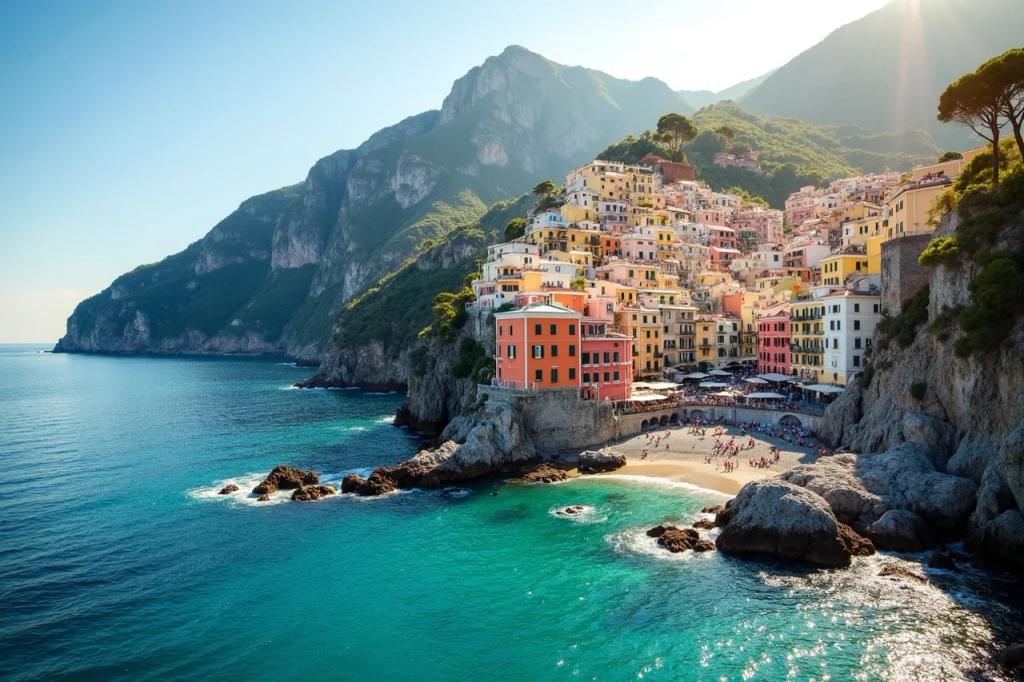
Bosa on the west coast, a river town of pastel houses beneath a castle - the drive along the coast road from Alghero to Bosa is among the best in the Mediterranean.
Orgosolo's murals in the Barbagia, a village painted with political art since the 1960s.
Sardinia has around 7,000 nuraghi - Bronze Age stone towers unique to this island, built between roughly 1800 and 1100 BC by a civilisation that left no written record.
The island is one of the world's original Blue Zones, with an exceptional concentration of people living past 100, particularly in the Barbagia villages of the Ogliastra.
Sardinian is a language, not a dialect - the Romance language closest to Latin, and officially recognised. In Alghero they speak a variety of Catalan, a survival of Aragonese rule.
And Cala Goloritzé was formed by a landslide in 1962, which makes one of Italy's most famous beaches younger than the Beatles.
August is the crunch. Italy takes its holidays in August, prices roughly double, the Costa Smeralda becomes very expensive indeed, and ferries and flights book out weeks ahead. June and September are dramatically better in every respect except sea temperature, which is fine in both.
Sa Sartiglia in Oristano, at carnival, is a masked equestrian tournament with medieval roots.
Sagra di Sant'Efisio in Cagliari on 1 May is one of the largest religious processions in the Mediterranean.
Autunno in Barbagia, through autumn, opens the courtyards of the interior villages to visitors - the best time to see the Sardinia that is not a beach.
The love: the water. Sardinia has the clearest sea in the Mediterranean and beaches that look implausible in photographs and turn out to be accurate. Beyond that, an interior with a genuinely distinct culture, language and food, 7,000 Bronze Age towers, and some of the best driving roads in Europe.
The complaints are practical. You need a car, and in August you need to have booked it months ago. August itself is expensive, crowded and hot, and the Costa Smeralda's prices are startling even by Mediterranean standards. Distances catch people out - this is not an island you tour casually in a long weekend. Several of the best beaches now require advance booking. And the interior, while the most interesting part, is genuinely quiet in a way some visitors find dull.
Come in June or September, hire a car, book the coves, and Sardinia rewards you as few Mediterranean destinations do.
At the resort and town beaches, yes. At the famous coves in the Gulf of Orosei - Cala Goloritzé, Cala Mariolu, Cala Luna - generally not: they sit under high cliffs with no road access. Agree your boat pickup time before you land, because you will not be able to call and change it.
Along the main roads and in the villages, yes. Between them, in the Barbagia, Gennargentu and Supramonte, it thins out considerably. Download offline maps of the whole island before you arrive, not just your immediate area.
Yes - Sardinia is Italy, so an EU SIM works on home terms with no out-of-zone charges. UK visitors should check their own operator's current post-Brexit terms, which vary.
Some of them, yes. Several of the most famous coves now cap daily visitor numbers and require advance reservation - Cala Goloritzé among them, and La Pelosa at Stintino. Rules differ by beach, so check each one before you travel.