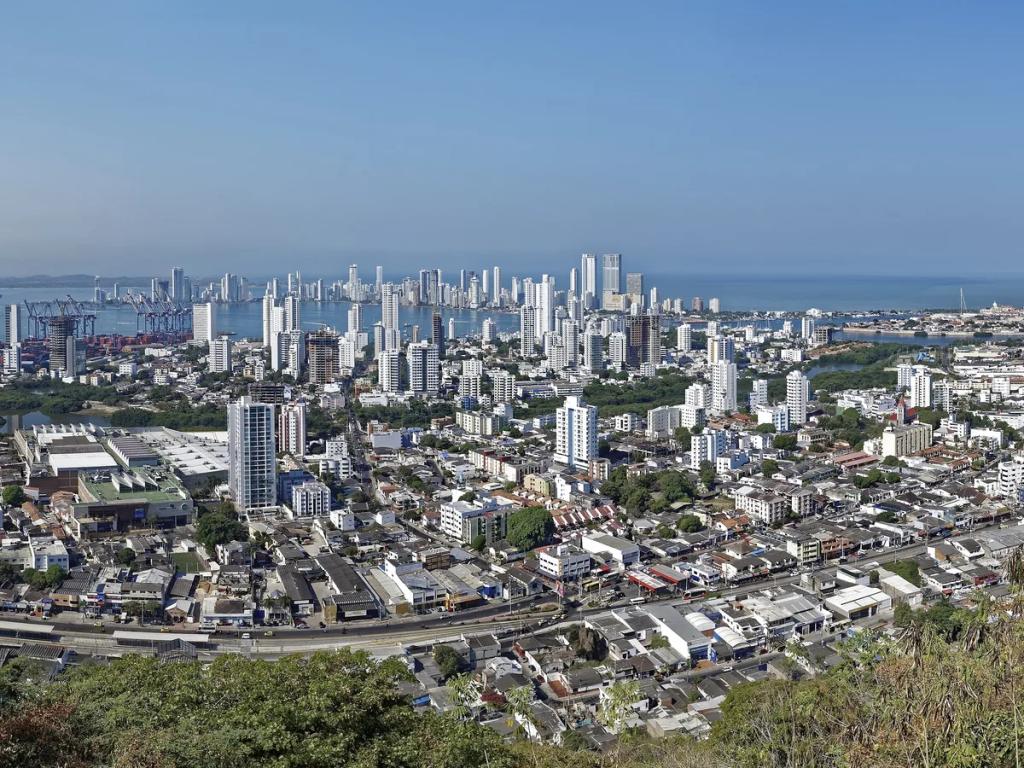
Cartagena runs on Claro, Movistar, Tigo and WOM, and your eSIM rides one of them as its host. Claro has the widest reach on the Caribbean coast and is the safe default. The walled city, Getsemaní and Bocagrande are all densely covered with 4G, and 5G has reached the modern districts. Connectivity is genuinely not the problem here. The thing that will cost you money if you get it wrong is the taxi.
This is the single most useful local fact for a first-time visitor, and it is not about signal at all.
Taxis in Cartagena do not run meters. They work on a zone system, and the fare is agreed before you get in - not after. Drivers are not scamming you by quoting a price; that is how the city works. What varies is whether the price you are quoted is the local one or the one reserved for people who just landed.
So the practical sequence is: know roughly what the zone costs, agree the number out loud, then get in. Your accommodation will tell you the going rate between the old city, Bocagrande and the airport, and it is worth asking on arrival rather than discovering it on day three.
Ride-hailing is the workaround, with a caveat. Uber operates in Colombia in a long-running legal grey area, and inDrive, DiDi and Cabify are all widely used in Cartagena. inDrive is interesting here because you propose the fare and drivers accept or counter - which suits a city that already negotiates. The apps give you a recorded price and a tracked route, which is the real benefit over a street taxi.
That is where your data goes in Cartagena: on transport, and on maps.
The city is easy. The days out are not.
The Rosario Islands. The main day trip - an hour or so by boat into an archipelago of coral islands. Once you are on the water, coverage thins fast, and on the smaller islands there is little or nothing. Boats run to a schedule set by the operator and the sea, and the return time is the number that matters. Confirm it with a person before you step off the boat.
Playa Blanca on Barú. Reachable by boat or by road. The beach itself has patchy service and the day-tripper strip is busy; people who stay overnight report losing signal entirely after dark.
The Volcán del Totumo mud volcano, about an hour north through farmland, is a rural road with gaps.
Inside the churches and the fortress. The Castillo San Felipe de Barajas has tunnels cut into the rock, and they are exactly as connected as tunnels cut into rock usually are.
La Popa monastery, on the hill above the city, is fine at the top and has the best view in Cartagena - but the road up is one you take a taxi for rather than walk, for reasons of both gradient and sense.
- A ride-hailing app, per above - inDrive, DiDi, Cabify or Uber. The recorded fare is worth more than the convenience.
- A currency app. The Colombian peso runs to thousands, and the mental arithmetic defeats people for the first two days. A 50,000 note is not a lot of money and it is very easy to hand over the wrong one.
- A translation app. Spanish is essential outside hotels and the main tourist restaurants. Coastal Colombian Spanish is fast and drops its final consonants, so even confident Spanish speakers find Cartagena harder work than Bogotá.
- Maps, offline. The walled city is small but it is a warren, the streets change name every few blocks, and everything looks like everything else at night.
- WhatsApp. As across Latin America, it is the default channel - your tour operator, your hotel and your driver will all use it.
Rafael Núñez International (CTG) is remarkably close - about 10 minutes from the walled city, and inside the built-up area. It is one of the shortest airport transfers of any city on this list.
That proximity is genuinely useful: no long transfer, no rural road, and you have signal from the moment you land. Agree the taxi fare at the rank, or order a car through an app from the terminal.
Cash matters more than in most places. Cards work in hotels and established restaurants; street food, taxis, tips and the beach vendors are cash. ATMs are plentiful in Bocagrande and inside the walls.
Ordinary city amounts, weighted toward maps and messaging rather than streaming.
For a week, 1GB per 3 days is comfortable. Add headroom if you are doing island days and want to upload as you go - though on the islands there will often be nothing to upload through. Plans top up from your dashboard.
Light, loose and breathable, and more of it than you think. Cartagena is hot and humid every day of the year, and the humidity is the part people underestimate. You will change clothes more often than you planned.
Sun protection is not optional. You are at 10 degrees north, at sea level, with reflected glare off water and pale colonial walls.
Shoes you can walk cobbles in. The walled city is entirely stone, uneven, and slick after rain.
Something modest for the churches - shoulders and knees covered for the cathedral and the Iglesia de San Pedro Claver.
A light layer for the evening only if you are going somewhere air-conditioned, which in Cartagena is aggressively cold by way of compensation.
The walls at sunset, from Café del Mar or anywhere along the ramparts facing west - the classic Cartagena shot, and it is genuinely good.
The balconies of Calle del Curato and Calle Santo Domingo, dripping bougainvillea against ochre and yellow render. Early morning, before the heat and the crowds.
Getsemaní's street art, particularly around Plaza de la Trinidad - a neighbourhood that has changed enormously in fifteen years and is now the most photographed part of the city after the walls.
The Clock Tower gate (Torre del Reloj) at night, floodlit.
La Popa for the whole city, the bay and the modern towers of Bocagrande in one frame.
Rosario Islands from the boat, on the way out, when the water goes from grey-green to that improbable turquoise.
Cartagena's fortifications took the Spanish roughly two centuries to complete and are the most extensive in South America - built because the city kept being attacked, including by Francis Drake, who sacked it in 1586 and left with a ransom.
The old city has been UNESCO-listed since 1984.
Gabriel García Márquez lived and wrote here, and the city stands behind a great deal of his work - Love in the Time of Cholera is set in a Caribbean port that is recognisably this one.
And the full name is Cartagena de Indias, which distinguishes it from Cartagena in Spain - the Colombian city is named after the Spanish one.
The Hay Festival Cartagena in late January brings writers from across the world and fills the walled city - book accommodation months ahead.
Independence Day, 11 November, is Cartagena's own - the city declared independence from Spain in 1811, and the celebration runs for days with parades and street parties.
The Cartagena International Film Festival in March is the oldest in Latin America.
December to April is the dry season and the peak, with the best weather and the highest prices. August to November is wetter, cheaper and still hot.
The love: Cartagena is one of the most beautiful colonial cities anywhere, and the walled city at dusk is a genuinely romantic place to be. The food is excellent, the Caribbean is a short boat ride away, and the whole thing is compact enough to walk. It is warm and lively at every hour, and Colombian hospitality is not an exaggeration.
The complaints are consistent and fair. The heat and humidity are relentless, and visitors who arrive expecting a breeze are disappointed. Persistent street vendors in the walled city and on Playa Blanca wear people down - the answer is a polite, repeated no. It is expensive by Colombian standards, sometimes startlingly so inside the walls, and prices for foreigners are often not the local ones. Playa Blanca is not the beach in the photographs unless you go early or stay over. And Cartagena is a very touristed city, which some travellers find at odds with the rest of Colombia.
Stay inside the walls or in Getsemaní, walk in the morning and the evening, and take the middle of the day off the way the locals do.
Claro has the broadest coverage on the Caribbean coast and is the safest host. Movistar and Tigo are both fine within the city. All of the walled city, Getsemaní and Bocagrande have dense 4G, with 5G in the newer districts.
No. Cartagena taxis work on agreed zone fares, and you settle the price before getting in rather than after. Ask your hotel what the standard rate is between the old city, Bocagrande and the airport. Ride-hailing apps - inDrive, DiDi, Cabify and Uber - give you a recorded fare instead, which is the main reason to use them.
Patchily on the way out and poorly once you are there, with little to nothing on the smaller islands. Confirm your return boat time with a person before you leave the jetty.
No - Rafael Núñez is about 10 minutes away and sits inside the city itself. It is one of the shortest airport transfers you will have anywhere.