Jio, Airtel, Vi and BSNL all operate here, and your eSIM will use whichever performs best in your part of the city. Coverage across Chennai is strong and tariffs are the usual Indian near-nothing. Our Pune guide handles local SIM registration and UPI, and our Mumbai, Hyderabad and Delhi guides cover the wider Indian picture. Two things are genuinely specific to Chennai, and the first will change how you open a conversation.
This is the most useful cultural fact about Tamil Nadu for a visitor, and it is rarely explained.
Tamil is the language of the state, and it is one of the oldest continuously spoken languages in the world with a classical literature going back over two millennia. Tamil identity is built around it.
Hindi is not a lingua franca here. In much of northern and central India you can get by on Hindi. In Chennai many people simply do not speak it, and a significant number who do would rather you did not assume they should.
There is history behind that. Tamil Nadu has resisted the imposition of Hindi as a national language since the 1930s, with major agitations in 1937 and 1965 that shaped the state's politics permanently. The issue is live in Indian politics today.
English is the practical link language. It is widely spoken - in business, in hotels, by anyone with a college education, and on signage - and it carries no political charge. Open in English.
A few words of Tamil go a very long way. Vanakkam for hello, nandri for thank you. The reaction to a visitor attempting Tamil rather than defaulting to Hindi is genuinely warm.
Practically: set your translation app to Tamil, not Hindi. Signage is bilingual Tamil and English, and the Tamil script is not guessable from Devanagari even if you have learned some.
Chennai's weather runs on a different calendar from most of India, and this catches people who packed for the national pattern.
The southwest monsoon that soaks Mumbai and Delhi from June to September largely misses Chennai. The city sits in a rain shadow for it.
Chennai's rain is the northeast monsoon, from roughly October to December. That is when the city floods.
The 2015 floods were catastrophic, with the city inundated for days, the airport closed and hundreds killed. Serious flooding has recurred since, and cyclones make landfall on this coast in the same season.
Cyclone season is October to December, and while direct hits on the city are not annual, the warnings and the disruption are frequent.
So the good months are January to March - warm, dry and comfortable.
April to June is brutal. Locals call the hottest stretch Agni Nakshatram, the fire star, and it earns the name at 40C with coastal humidity.
If you travel in the monsoon window, watch the forecast, avoid tight connections, and expect road flooding to affect ride-hailing and the airport route.
The city is comprehensively covered, including the metro, which is clean, modern and expanding.
Congestion at peak is the usual megacity failure rather than absent coverage.
Marina Beach is well covered along its length - and while it is one of the longest urban beaches in the world, you do not swim here. The undertow is dangerous and the water quality is poor. It is a promenading beach, best at dawn and dusk, and locals treat it as such.
Mahabalipuram, an hour south down the East Coast Road, is covered in town and thinner around the outlying monuments.
The ECR itself is well served, which matters because it is one of the pleasanter drives in south India.
The Western Ghats hill stations - Ooty, Kodaikanal - are several hours away and drop out on the ghat roads.
During flooding, power cuts degrade the network in affected areas; hotel wifi in the better districts generally holds.
Not a connectivity matter, but the single best reason to time a visit.
The Margazhi season runs through December and into January, and it is one of the largest cultural festivals in the world by sheer volume.
Hundreds of concerts of Carnatic music and Bharatanatyam dance take place across the city's sabhas - concert societies - over several weeks.
Much of it is free or nearly free, and the audiences are knowledgeable and vocal.
The canteens are half the point. The sabha canteens serve some of the best food in the city during the season, and there are people who attend primarily for that.
Book nothing and just go. Programmes are published locally, venues are scattered across the city, and dropping into an afternoon concert is entirely normal.
It coincides with the best weather of the year, which is not a coincidence.
- Uber, Ola and Rapido, with Rapido's bike option the fastest way through traffic.
- The Chennai Metro app or a transit app - the metro is genuinely good and underused by visitors.
- Maps, with offline copies for the ECR and any hill trip.
- A translation app set to Tamil.
- A weather app between October and December, for cyclone warnings and flood alerts.
Chennai International (MAA) is about 20 km southwest of the centre, and has been substantially expanded with a new terminal in recent years.
Uber and Ola work from designated zones; prepaid taxis are the alternative.
The metro reaches the airport, which is unusual in India and makes for a cheap, quick and traffic-proof arrival if you are staying near a line.
Budget 45 minutes to an hour by road to the centre, considerably more in monsoon.
Most nationalities need a visa, and India's e-visa is the usual route.
Plenty, and it will cost you almost nothing. Ride apps and maps are in constant use, and in the monsoon window you will be checking conditions repeatedly. Hotel wifi is good. As elsewhere in India there is no case for economising here.
Light cotton, and modest. Chennai is more conservative than Mumbai or Bengaluru, and shoulders and knees covered is the sensible default for everyone.
For temples, this is enforced: covered shoulders and knees, shoes off, and at some South Indian temples men are asked to remove their shirts in the inner sanctum. That surprises visitors and it is normal here.
Sandals you can slip off constantly.
Something for the air conditioning, which is fierce indoors.
A rain layer between October and December.
Nothing warm is ever needed unless you are going up to the hill stations, where it genuinely is cold at night.
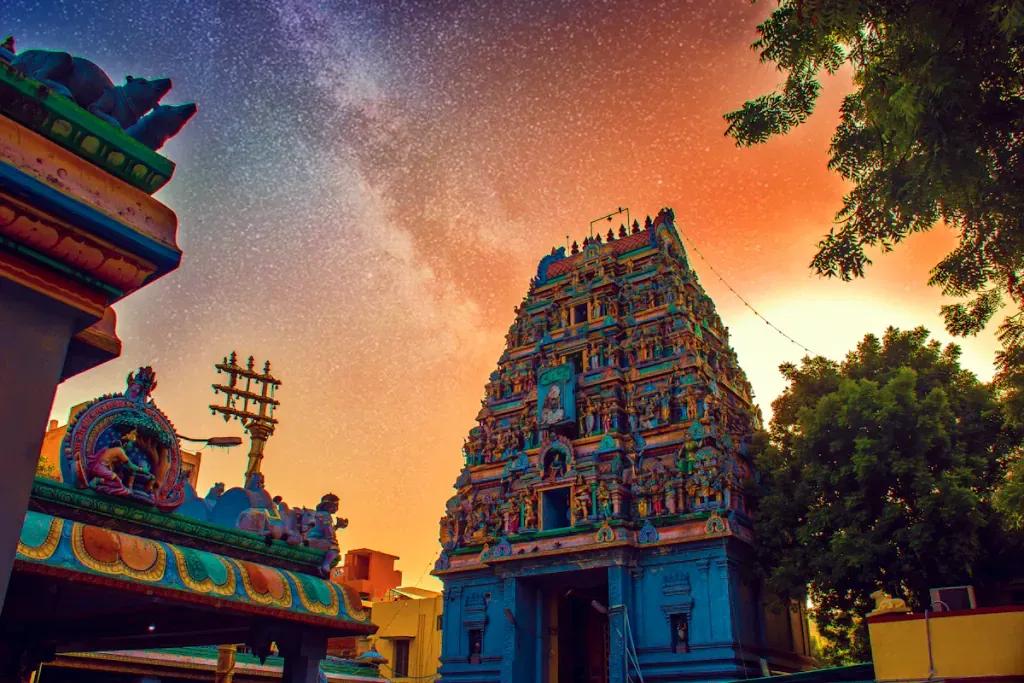
Kapaleeshwarar temple in Mylapore, its gopuram covered in painted figures, in the late afternoon.
Marina Beach at sunrise, with the fishing boats and the walkers, which is when the city is at its best.
Mahabalipuram's Shore Temple and the Five Rathas, a UNESCO site an hour south - seventh-century rock-cut temples right on the sea.
Krishna's Butterball, the enormous balanced boulder at Mahabalipuram, which has not moved in centuries.
San Thome Basilica, built over what is claimed as the tomb of the apostle Thomas.
Fort St George, the first English fortress in India, from 1644, still in use as the state government's seat.
A Margazhi concert, in December, in a sabha hall.
Filter coffee in a steel tumbler and dabarah, poured from a height, which is the correct way to photograph a Chennai morning.
Tamil is one of the world's oldest languages still in everyday use, with a continuous literary tradition going back more than two thousand years, and it was the first language India formally recognised as classical.
Marina Beach is among the longest urban beaches in the world, running about 13 km along the city - and almost nobody swims, because the current is dangerous.
Chennai is India's automotive capital, sometimes called the Detroit of India, and a large share of the country's cars are built here.
The Tamil film industry is enormous. Kollywood is one of the largest in India by output, and its stars have a habit of becoming chief ministers.
Fort St George was the East India Company's first fortified settlement in India, founded in 1644 - Chennai grew outward from it.
And South Indian filter coffee is a genuinely different drink from anything served elsewhere in India, made with chicory, and the pouring between tumbler and dabarah is to cool and froth it.
The Margazhi music season, December into January, described above and the best reason to come.
Pongal, mid-January, the Tamil harvest festival and the biggest holiday of the year - four days, decorated cattle, rice boiled over until it spills as a sign of abundance, and the whole state on holiday.
Tamil New Year, in April.
The northeast monsoon, October to December, which is the season to avoid.
January to March is the window: dry, warm, and it includes both Margazhi's tail and Pongal.
The love: Chennai is the most culturally confident city in India, and it is not performing for anyone. The temples are living rather than monumental, the music and dance season is world-class and largely free, the food is superb and distinct from the north in every respect, and Mahabalipuram is an hour away. It is also cheaper, calmer and considerably less hassling than Delhi, and the metro makes it easy to move around.
The complaints are consistent. The heat rules out three months of the year. The monsoon floods rule out two or three more. It is not a conventionally pretty city - low-rise, sprawling, and the interest is in temples, food and culture rather than skylines. The traffic is heavy. The language barrier is real away from English-speaking contexts. And Chennai is often skipped by visitors heading straight to Kerala or Madurai, which is a fair itinerary decision and a loss.
Come in January, time it for Margazhi or Pongal, take the metro from the airport, and start a morning with filter coffee in Mylapore.
No - open in English. Tamil is the state language and Hindi is neither widely spoken in Chennai nor politically neutral, given Tamil Nadu's long resistance to Hindi imposition. English is universal in business and hotels and carries no baggage. A couple of words of Tamil - vanakkam, nandri - are received very warmly. Set your translation app to Tamil rather than Hindi.
October to December, which is the opposite of most of India. Chennai gets the northeast monsoon rather than the southwest one, and that is also cyclone season on this coast. Serious flooding is a real risk in those months - the 2015 floods closed the airport for days. January to March is the dry, comfortable window.
No. It is one of the longest urban beaches in the world and it is for walking, not swimming - the undertow is dangerous and the water quality is poor. Go at sunrise for the fishing boats and the atmosphere, and swim at Mahabalipuram or further down the coast if you want the sea.
Yes, throughout, and the metro is one of the better things about the city - modern, clean, and it reaches the airport, which is unusual in India. It is also underused by visitors who default to ride-hailing and sit in traffic instead.