Lahore runs on Jazz, Zong, Ufone and Telenor, and your eSIM rides one of them as its host. Pakistani mobile data is cheap and 4G coverage across the city is good and getting better. There are two things here that no European city will have prepared you for, and both are worth understanding before you land: the network is sometimes switched off deliberately, and your handset itself can be blocked from the network if you stay long enough.
This is the connectivity fact that makes Pakistan genuinely different, and it has nothing to do with coverage.
Mobile internet is suspended during political demonstrations, security operations and some large religious gatherings. It is a deliberate administrative measure, it is applied by area, and it has happened repeatedly in recent years around major protests.
It is mobile data specifically. Fixed-line broadband and hotel wifi usually keep working through it, which is the practical escape route.
Everything downstream stops. Ride-hailing, food delivery, card terminals that authorise over mobile networks, and banking apps all fail at once, because so much of daily life here runs over the same pipe.
It is unannounced and usually short, hours rather than days, and lifted without ceremony.
What to do about it: know your hotel's wifi, keep offline maps, carry cash rather than relying on an app to pay for a rickshaw, and do not build a tight airport transfer around a working data connection on a day when a big demonstration is planned.
This is not a reason to avoid Lahore. It is a reason not to make your phone the single point of failure for the day.
Pakistan operates a device registration system that catches long-stay visitors and surprises almost all of them.
The system is DIRBS, run by the telecoms regulator, and it ties handsets to the network by IMEI to stamp out smuggled and counterfeit phones.
A foreign handset works for 60 days from the moment you first put a Pakistani SIM in it. After that the device stops receiving service on Pakistani networks, regardless of which SIM is in it.
Foreign visitors can register free for up to 120 days. The regulator runs a temporary registration route for exactly this case, done online through the official device registration portal, validated against your passport. It costs nothing and it is the correct path for anyone staying more than two months.
For a normal trip, none of this bites. A two-week visit on a travel eSIM never approaches the limit.
Where it matters is a long stay, a repeat visitor who has already burned the clock, or anyone planning to buy a local SIM and settle in. Sort the registration early rather than on day 59.
Local SIMs themselves require your passport and a biometric fingerprint check, which is why a travel eSIM is materially less hassle for a short trip.
Lahore has repeatedly recorded the worst air quality of any city in the world, and the numbers are not close.
November to January is the season. Crop burning, vehicle emissions, industry and winter temperature inversion combine, and the air stops moving.
The readings are extraordinary. Lahore has passed an air quality index of 1,000 and has been recorded well above that, at levels where the scale stops being meaningful. Anything over 300 is hazardous.
The city responds. Schools close, offices shift hours, outdoor work is restricted and there have been partial lockdowns purely because of air.
What it means for a visit: the monuments disappear into haze and photograph badly, anyone with asthma or a heart condition should think hard, and a mask rated for fine particles is not theatre.
February to April is the good window, warm and clear, before the heat arrives in May.
The city is well covered, including the Walled City and the newer suburbs.
The Walled City's narrow lanes have patchy indoor signal, thick old brick and very tight streets.
The Wagah border, 30 km east, is a controlled security zone and coverage there is unreliable by design. Phones are also restricted at the ceremony itself.
Motorway travel towards Islamabad is well covered along the route.
During a suspension, as above, coverage is not the issue: the service has been turned off.
- Careem and inDrive, the ride-hailing apps that work here, and Bykea for motorbike rides and deliveries.
- Maps with offline copies, both for the Walled City and for the suspension days.
- An air quality app between November and January, which is not optional if you have a respiratory condition.
- A translation app. Urdu and Punjabi dominate; English is an official language and widely used in business and by educated speakers, so you will manage, but signage away from the main roads is not in English.
- Foodpanda, which is how much of the city eats.
Allama Iqbal International (LHE) is about 15 km east of the centre, and the drive in takes 30 to 45 minutes.
Careem or inDrive from the airport is straightforward, and prearranged hotel transfers are common and inexpensive.
Pakistan runs an online visa system, and some nationalities have visa on arrival for tourism. The rules have changed several times, so check the current position for your passport rather than relying on a recent-sounding article.
Around the city, ride-hailing is the default. The Orange Line metro runs across the city, is clean and cheap, and covers a useful corridor. Rickshaws are everywhere and want negotiation.
More than a short-trip allowance, mostly because ride-hailing runs constantly and you will want offline maps as a hedge. Hotel wifi is reliable and, on a suspension day, essential. A middling plan is right.
Modest, and this is not a formality. Pakistan is conservative and Lahore, for all its cultural confidence, is not an exception.
Women: loose clothing covering shoulders, arms and legs, and a dupatta or scarf to cover the head at mosques and shrines. The local shalwar kameez is comfortable, cheap to buy here and by far the easiest thing to wear.
Men: long trousers. Shorts are unusual on adults in public.
For summer, the lightest cotton you own. Forty-five degrees with high humidity after the monsoon breaks is serious heat.
A mask in smog season, rated for fine particles rather than a surgical one.
Shoes that come off easily, since you will remove them at every mosque and shrine.
Badshahi Mosque at sunset, when the red sandstone goes gold and the courtyard - one of the largest of any mosque in the world - empties out.
Lahore Fort, and specifically the Sheesh Mahal, the mirrored palace, which is UNESCO-listed along with the Shalimar Gardens.
The Walled City from the rooftop restaurants opposite the mosque, which is the classic Lahore view.
Wazir Khan Mosque, whose tilework is the finest in the city and far less visited than Badshahi.
The Wagah border ceremony at sunset, the theatrical flag-lowering with India, which is genuinely unlike anything else.
Anarkali Bazaar, among the oldest surviving markets in South Asia.
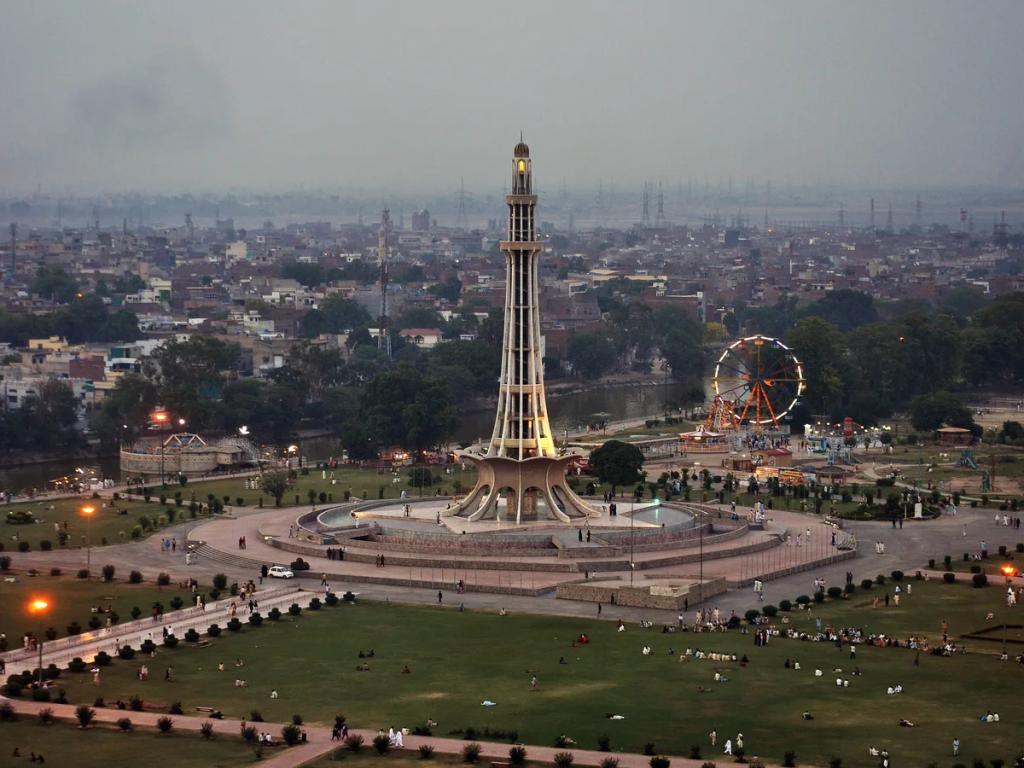
Minar-e-Pakistan, in Iqbal Park.
Food Street in Gawalmandi, at night, with the old havelis lit above the stalls.
Lahore is Pakistan's cultural capital and says so constantly. "Lahore Lahore Aye" - Lahore is Lahore - is the local formulation and it is not modest.
The Badshahi Mosque was the largest in the world for over three hundred years after it was completed in 1673.
The Shalimar Gardens were laid out by the Mughals in 1641 and are on the UNESCO list with the fort.
Basant, the spring kite festival, was once the defining Lahore event and has been banned since 2005 after deaths caused by glass-coated and metal kite strings. It returns only in sporadic, tightly controlled form, and its absence is a genuine sadness locally.
The city changed hands repeatedly - Mughal, Sikh, British - and the layers are legible in a single walk.
Anarkali means pomegranate blossom, and the bazaar is named after a courtesan of legend who was supposedly entombed alive in a wall.
And Lahoris consider their food the best in Pakistan, which the rest of the country grudgingly concedes.
Eid al-Fitr and Eid al-Adha, both major, both moving through the calendar, and both when the city closes and then feasts.
Ramadan, when daytime eating in public stops and the city comes alive after sunset. Restaurant hours change completely.
Independence Day, 14 August, with flags and fireworks and the Wagah ceremony at its most charged.
The Urs of Data Ganj Bakhsh, the annual festival at Data Darbar, one of the largest shrine gatherings in South Asia.
The Lahore Literary Festival, in February, which draws a serious international line-up.
February to April is the window: warm, clear, before the heat and after the smog.
The love: Lahore is one of the great historic cities of South Asia and it is barely visited, which means Mughal architecture of the first rank with almost nobody in front of it. The food is extraordinary and cheap. The hospitality is close to overwhelming - visitors are routinely fed, guided and refused payment. The Walled City restoration work is excellent. And it is a city with a fierce sense of its own culture, poetry and music that has nothing to do with performing for outsiders.
The complaints are consistent. The smog takes three months of the year off the table. The traffic is chaotic even by regional standards. The heat in May and June is brutal. The bureaucracy and security presence are visible, and some sites require permissions. Internet suspensions are a genuine friction. And solo women travellers report a level of staring and attention that is tiring, even where nothing worse occurs.
Come in March, stay near the Walled City, eat on Food Street, and go to Wagah on a Sunday.
Yes. Mobile data is suspended by area during major protests, security operations and some large gatherings. It is usually a matter of hours, it is unannounced, and it takes ride-hailing, delivery and some payment systems down with it. Fixed-line and hotel wifi normally keep working, so know your hotel's connection and keep offline maps.
If you are using a Pakistani SIM, yes. The DIRBS system blocks unregistered foreign handsets from Pakistani networks 60 days after you first insert a local SIM. Foreign visitors can register a device free for up to 120 days through the regulator's online portal, validated against your passport. A short trip on a travel eSIM never reaches the limit.
An eSIM is considerably easier for a short visit. A local SIM requires your passport and a biometric fingerprint check in person, and it starts the 60-day device clock.
November to January, and it is the worst in the world. Lahore has recorded air quality index readings above 1,000, where 300 is already hazardous, and schools and offices close on the worst days. Monuments vanish into haze. February to April is the clear, warm window.