Taipei runs on Chunghwa Telecom, Taiwan Mobile and FarEasTone, and your eSIM rides one of them as its host. This is one of the best-connected cities in the world: fast 5G everywhere, complete MRT coverage, free public wifi, and data priced low. But the most important thing your phone does here has nothing to do with browsing, and it happens whether you ask for it or not.
This is the single most useful thing to understand about connectivity in Taiwan, and it is genuinely reassuring rather than alarming.
Taiwan runs a national Public Warning System over cell broadcast. When the weather administration detects an earthquake of around magnitude 5 or above, it pushes an alert to every active handset in the affected area.
It reaches you automatically. Cell broadcast goes to every phone registered on the local network, including roaming foreign SIMs and travel eSIMs. There is nothing to install, nothing to sign up for, and no way to opt out.
The warning arrives in roughly ten to fifteen seconds after the rupture begins. That sounds trivial and is not: it is enough to get away from glass, stop pouring boiling water, or pull over.
It is extremely loud, overrides silent mode, and is in Chinese with an English follow-up. The first one will frighten you. That is the design.
The same channel carries typhoon and civil defence alerts. If you receive one in the middle of a July afternoon, it is likely weather.
Do not disable it. Some phones let you switch off "emergency alerts" in notification settings. In Taiwan that is a bad trade.
Taiwan sits on the boundary of two plates and takes this seriously. Buildings are engineered for it, people are drilled for it, and the alerting is among the best in the world. A visitor's job is simply to leave the setting alone and know what the noise means.
Buy an EasyCard in the first ten minutes. It is a stored-value card, sold at any MRT station and any convenience store, and it covers the metro, buses, the airport line, YouBike hire and a good deal of intercity rail.
It also pays for things. Taiwan's convenience stores accept it, which matters more than it sounds.
Because the convenience store here is not a corner shop. Taiwan has among the highest densities of them in the world, and a 7-Eleven or FamilyMart will let you pay bills, collect parcels, ship your luggage to your next hotel, buy concert and transport tickets, print documents, use a clean toilet and eat a genuinely decent meal at 3am.
Luggage forwarding is the underrated one. Send your bag ahead to Kaohsiung or the airport for a small fee rather than dragging it onto the MRT.
Cash is still widely used alongside all this, and cards are accepted in larger places. Carry some New Taiwan dollars.
Nowhere in the city. The MRT is fully covered, the tunnels included, and the network is dense and fast.
Yangmingshan, the volcanic national park at the top of the city, thins on the trails.
Taroko Gorge on the east coast is the classic gap - deep marble canyon walls and long tunnels. Note that the gorge suffered major damage in the 2024 earthquake and access has been restricted since, so check what is open before planning around it.
Alishan and the central mountains lose it between settlements.
The east coast rail line through the tunnels drops in and out.
Offshore islands - Green Island, Orchid Island, Penghu - are covered in the villages and patchy elsewhere.
July to October is typhoon season, and a serious one shuts the city down rather than inconveniencing it.
Watch for the typhoon day announcement. Local government announces closures, usually the evening before, and when it does, offices, schools, shops and transport stop. It is a genuine day off and the city treats it as one.
Flights and trains cancel wholesale, and the backlog takes days to clear. Build slack into any itinerary in this window.
The mountains are the danger, not the city. Landslides close roads on the east coast and in the central range, sometimes for weeks.
Indoors in Taipei during a typhoon is safe and slightly festive, and everyone stocks up at the convenience store beforehand.
- Taipei Metro or a general transit app, though the MRT is so well signposted in English that you can manage without.
- Uber and Taiwan Taxi, both of which work; regular taxis are plentiful, metered and honest.
- Google Maps, which handles Taipei unusually well including bus arrivals.
- A translation app with camera input. Menus at the best places are handwritten in Chinese only, and this is where the app earns its place.
- The Central Weather Administration app during typhoon season.
Taoyuan International (TPE) is about 40 km west. The Airport MRT runs to Taipei Main Station in 35 minutes on the express or about 50 on the commuter service, and it takes an EasyCard.
Songshan (TSA) sits inside the city and handles domestic and some regional flights - it is fifteen minutes from the centre on the MRT.
Many nationalities enter visa-free for short stays; check your own before flying.
In the city, the MRT is superb - clean, cheap, frequent, and signed in English. Note the rules: no eating or drinking anywhere inside the system, including water, and it is enforced.
Not much. Free public wifi is widespread, the MRT is covered, and cafes and convenience stores all have connections. A modest plan is ample. What matters more is that your phone stays on a Taiwanese network so the alert system reaches you.
Lightweight and breathable in summer, which is hot and very humid from June to September.
An umbrella, always. It rains here more often than the temperature suggests, and locals carry one year-round - for sun as much as rain.
Layers in winter. It rarely drops below 12C, but the damp grey cold gets into buildings that have no central heating.
Comfortable walking shoes, and shoes you can slip off for temples and some restaurants.
Something for a hot spring - Beitou is on the MRT, and many pools are single-sex and nude, with mixed pools requiring swimwear.
Nothing formal is needed. Taipei dresses casually and comfortably.
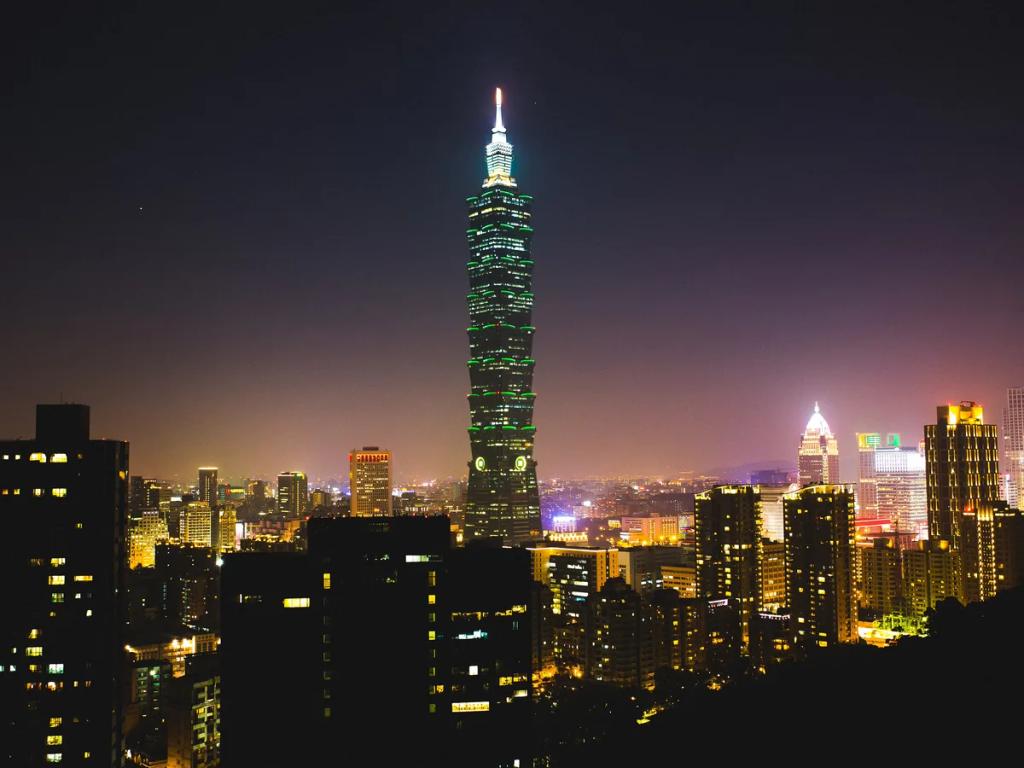
Taipei 101 from Elephant Mountain (Xiangshan), a twenty-minute climb from the MRT, and the classic shot at blue hour.
The observation deck of Taipei 101, and specifically the tuned mass damper - a 660-tonne golden sphere hanging in the tower that counteracts sway, and one of the few great engineering objects you can go and look at.
Jiufen at dusk, the hillside tea-house village with red lanterns, an hour out.
Longshan Temple in the evening incense.
Shifen, where sky lanterns are released over the railway line.
Beitou's thermal valley, steaming, at the end of an MRT branch.
Raohe or Ningxia night market, for the food and the noise.
Yangmingshan's calla lilies in spring or the silvergrass in autumn.
Bubble tea was invented in Taiwan in the 1980s, and the argument over which Taichung tea house did it first has been to court.
Taipei 101 was the tallest building in the world from 2004 to 2010, and was designed to look like a stalk of bamboo in segments.
Taiwan has one of the highest convenience store densities on earth, with well over ten thousand of them for 23 million people.
The island makes most of the world's advanced semiconductors, which is why a place this size occupies so much of the global conversation.
Taiwan's health system is regularly held up internationally as a model, and it runs on a single smart card.
And the seventh lunar month is Ghost Month, when many people avoid swimming, surgery, moving house or starting a business. Hotels are cheaper. Make of that what you will.
Lunar New Year, in January or February, when the city empties as families travel and much closes for several days.
The Lantern Festival, fifteen days after Lunar New Year, and the Pingxi Sky Lantern Festival with it, which is the photograph everyone wants.
Dragon Boat Festival in early summer, with races on the Keelung River.
Ghost Month, in the seventh lunar month, with street offerings everywhere.
Taipei 101's New Year fireworks, fired off the building itself.
Autumn, October and November, is the best weather of the year: dry, mild and clear, after the typhoons and before the winter grey.
The love: Taipei is one of the easiest and friendliest big cities in Asia. It is extremely safe, the transport is excellent and legible in English, the food runs from night-market stalls to serious restaurants and is cheap at every level, the mountains and hot springs start where the MRT ends, and people are helpful to a degree that surprises visitors - being walked to your destination by a stranger is a normal experience here. It is also very good value.
The complaints are consistent. The humidity is punishing from June to September. Winter is grey and damp and the buildings are not heated. It is not a conventionally beautiful city - the architecture is largely functional postwar concrete, and the charm is at street level rather than in the skyline. Typhoons can take days out of a trip. And the language barrier is real once you step away from the MRT and into a neighbourhood restaurant.
Come in October or November, buy an EasyCard on arrival, climb Elephant Mountain at dusk, and leave your emergency alerts switched on.
Yes, automatically. Taiwan's Public Warning System broadcasts to every handset registered on the local network, roaming SIMs and travel eSIMs included. There is nothing to install and no way to opt out, and the warning arrives roughly ten to fifteen seconds after a significant quake begins. Leave your phone's emergency alert setting enabled.
Almost certainly a cell broadcast alert - earthquake, typhoon or a civil defence drill. It overrides silent mode by design, and comes in Chinese with an English follow-up. It is not a scam or a misdial.
Wifi is genuinely widespread and free in public spaces, so a light data plan goes a long way. The argument for being on a Taiwanese network is the alert system and having maps and translation work while moving.
The MRT is fully covered, tunnels included. The mountains are where it stops - Yangmingshan's trails, Alishan, the central range and Taroko Gorge, which in any case has had restricted access since the 2024 earthquake. Download offline maps for anything outside the city.