Tashkent runs on Ucell, Beeline, Mobiuz, UMS and Uzmobile, and this eSIM uses Beeline, Ucell or Uzmobile, on 4G/5G. The capital is well covered - 4G throughout and 5G across the central districts - and Uzbekistan has invested seriously in mobile infrastructure over the last decade. Data is inexpensive. The thing worth knowing before you arrive is a device rule that catches long-stay visitors, and a piece of paper that catches everyone.
Uzbekistan operates a handset registration scheme. A phone used with an Uzbek SIM card must have its IMEI registered, and beyond a grace period generally quoted as 30 days an unregistered device is blocked from the local networks. Registration involves a fee and paperwork, and the block is on the handset, so swapping operator does not help.
The important detail: it is triggered by the local SIM. Roaming and travel eSIMs sit outside the scheme entirely, so a normal trip never encounters it.
This only matters if Uzbekistan is a base rather than a stop - and Tashkent does have a growing long-stay foreign community, so it comes up more here than the length of the average visit would suggest.
Uzbekistan requires visitors to be registered at their place of stay. Hotels do this automatically and issue a small paper slip for each night.
Keep them all. They are checked on departure and occasionally in between, and the traveller who binned them at the last hotel is a recurring figure at Tashkent airport. If you stay in private accommodation or with friends, registration becomes your responsibility rather than a formality - check the current rule for your length of stay before you rely on it.
On the visa side, many nationalities enter visa-free for 30 days and others use a straightforward e-visa. This has been liberalised substantially since 2018 and older advice is unduly gloomy.
Tashkent's metro is one of the most beautiful in the world - marble, chandeliers, carved columns and mosaics, each station on its own theme, built deep because it doubled as a nuclear shelter.
Photography inside was banned until 2018. It is now permitted, and this is the single change that most affects what a visitor does here. If you read an older guide saying you cannot photograph the metro, ignore it.
Practically:
- Coverage on the platforms is decent; in the tunnels it drops. Download your route.
- Stations to prioritise: Kosmonavtlar for the space-themed medallions, Alisher Navoi for the domes, Pakhtakor for the cotton mosaics.
- It costs almost nothing and is the fastest way across a city that is very spread out.
Chorsu Bazaar, under its great blue dome, is dense, busy and built of concrete - patchy inside, and in any case not somewhere to have a phone out.
The Afrosiyob high-speed train to Samarkand and Bukhara crosses open steppe at 250 km/h, and coverage along the line is intermittent. Samarkand is about two hours away and the train is the right way to do it - book ahead, it sells out.
The mountains at Chimgan and Charvak, roughly two hours east, are the weekend escape from the summer heat, and coverage thins as you climb.
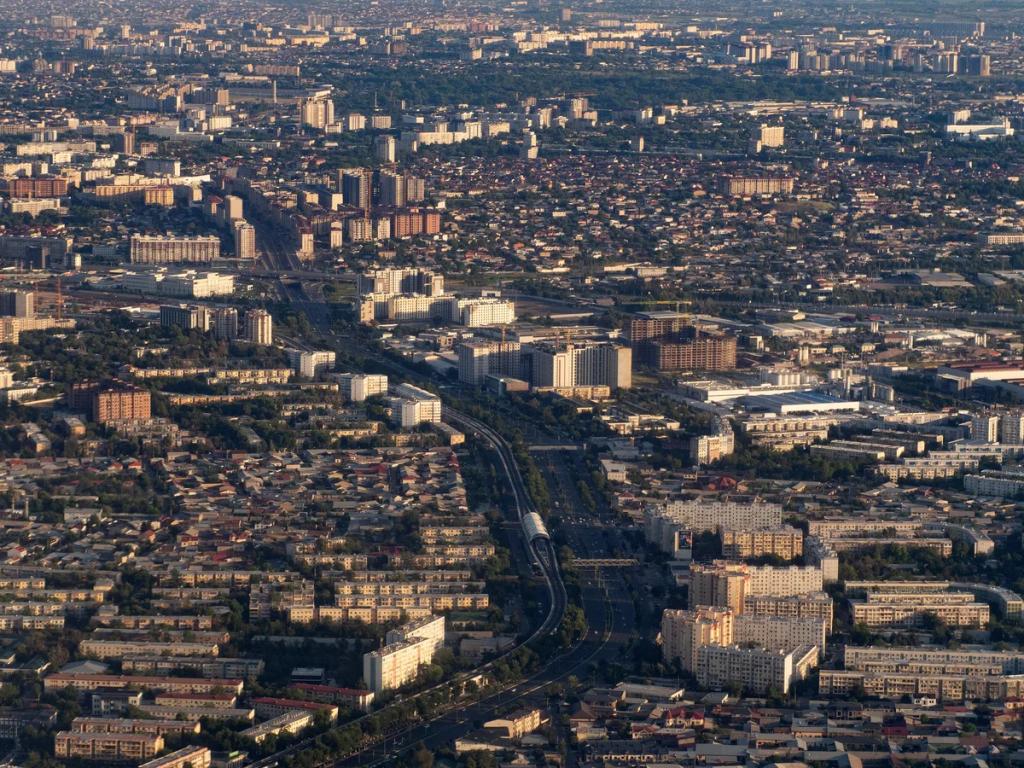
Tashkent itself is the easy part: wide Soviet boulevards, a grid, and good signal throughout.
- Yandex Go is the dominant ride-hailing app and works well. Taxis are also informally hailed - many private cars will stop - but the app gives you a fixed price and a record.
- A translation app. Uzbek is a Turkic language, now written in Latin script, and Russian remains very widely spoken and is often more useful to a visitor than English, which is limited outside hotels.
- A currency app. The som runs into large numbers and the arithmetic takes a day or two to internalise.
- Maps, offline, particularly for the bazaars and the older mahalla neighbourhoods where the grid gives way to lanes.
- A train booking app or site for the Afrosiyob, which genuinely does sell out in season.
Tashkent International (TAS) is about 10 km from the centre, a short drive. Flights come from Istanbul, Moscow, Dubai, Seoul, Frankfurt and increasingly from elsewhere in Europe and Asia.
Uzbekistan has moved a long way from cash-only: cards now work in hotels, restaurants and larger shops in Tashkent, though the bazaars and small vendors remain cash. ATMs are common in the centre. Bring clean US dollars or euros to change if you want a fallback.
Arrive with data working - between the hotel, the registration paperwork and arranging onward train tickets, the first evening wants connectivity.
Ordinary amounts. Tashkent is a city where you use maps and translation constantly and stream comparatively little.
For a week, 1GB per 3 days is comfortable. If you are continuing to Samarkand, Bukhara and Khiva, size for the whole Silk Road run rather than topping up between cities. Plans top up from your dashboard.
Summer is severe - 35 to 40C and dry, with the sun genuinely punishing in the middle of the day. Light, loose, covered, and a hat.
Winter is cold, below freezing, with snow and grey days.
Spring and autumn are the reason to come, and want layers.
Dress is relaxed by regional standards - Uzbekistan is a secular state and Tashkent is a cosmopolitan capital, so ordinary Western clothing is unremarkable. Modest cover for the mosques and madrasas: shoulders and knees, and a headscarf for women entering active prayer halls.
Comfortable shoes. The city is built on a Soviet scale and the distances between things are long.
The metro stations, now that you can - Kosmonavtlar above all, with its cosmonaut medallions on deep blue.
Khast Imam complex, which holds the Uthman Quran, believed to be among the oldest Quranic manuscripts in existence.
Chorsu Bazaar from the gallery above, looking down into the dome at the spice and dried fruit stalls.
Amir Timur Square and the monument to Tamerlane, who looms over Uzbek national identity.
The Soviet modernist architecture - the Hotel Uzbekistan, the Palace of Friendship of Peoples - which is having a critical rediscovery and is genuinely striking.
Minor Mosque, white marble and modern, particularly at dusk.
An earthquake destroyed much of Tashkent in 1966, and the city was rebuilt in a Soviet modernist style by teams from across the union - which is why the centre looks unlike anywhere else in Central Asia.
The Tashkent metro was the first in Central Asia, opened in 1977, and its stations were designed as public art.
Uzbekistan is one of only two doubly landlocked countries in the world - you must cross two borders to reach a sea - the other being Liechtenstein.
And the Uthman Quran at Khast Imam is one of the oldest surviving copies anywhere, and drew Tamerlane's empire and later the Soviets into a long argument about where it should live.
Navruz, 21 March, the Persian new year, is the biggest celebration of the year and fills the parks and squares.
Independence Day, 1 September, with ceremony across the capital.
Spring, April and May, and autumn, September and October, are the travel seasons - the summer heat is genuinely limiting and winter is bleak.
Silk and Spice Festival in Bukhara in late May draws people through Tashkent on the way.
The love: Tashkent is green, orderly and much more relaxed than its reputation, with excellent food, a metro that is a museum, and an unusual layering of Soviet, Islamic and modern Uzbek that exists nowhere else. It is very cheap by European standards, people are notably hospitable, and it works as the comfortable base for the Silk Road cities that most visitors actually came for.
The complaints are fair. Tashkent is not the Silk Road - the earthquake and the Soviet rebuild took most of the old city, so travellers arriving expecting Samarkand's blue domes find a modern capital instead. It is spread out and walking between sights is a mistake in summer. English is limited and signage often is not translated. The bureaucracy - registration slips, occasional document checks - is mild but real. And the summer heat rules out the middle of the day.
Give Tashkent two days at the start or end, take the Afrosiyob to Samarkand, and come in spring.
Only if you use an Uzbek SIM card in an unregistered handset beyond the grace period, generally quoted as 30 days, under the country's IMEI registration scheme. Roaming and travel eSIMs sit outside it entirely, so an ordinary trip never runs into it. It matters if you are staying long term.
Yes. The ban was lifted in 2018 and the stations are now among the most photographed things in the country. Older guides still say otherwise. Platform coverage is decent; the tunnels are patchy, so download your route.
Yes - keep every slip your hotel gives you. Registration at your place of stay is required and the slips are checked on departure. If you are not in a hotel, registration becomes your own responsibility, so check the current rule for your length of stay.
Ucell and Beeline have the broadest reach and either works well as a host, with Mobiuz and UMS also solid in the capital. Expect good 4G across the city and 5G in the central districts.