Luxembourg City runs on POST, Orange and Tango, and this eSIM uses Orange, POST or Tango, on 4G/5G. Coverage is comprehensive, 5G is widespread and EU roaming applies without qualification. Two things make connectivity here genuinely unusual, and both come from the same source: this is a very small country with a great many people crossing into it every day.
Luxembourg did something in 2020 that no other country has done, and visitors routinely fail to believe it.
Since 1 March 2020, public transport across the entire country has been free. Luxembourg was the first country in the world to do this nationally.
It covers essentially everything: the RGTR and municipal buses, the Luxembourg City tram, and CFL trains in second class, across the whole territory.
It applies to everyone. Residents, commuters, tourists, regardless of nationality. There is nothing to buy, nothing to validate and nothing to register.
You simply board. No ticket, no tap, no app.
What is not free: first class on the trains, which starts at a few euros for a couple of hours, and cross-border journeys - the moment the train crosses into France, Belgium or Germany, you need a ticket for the part outside the country.
Carry ID. Conductors can ask you to identify yourself, and that is the only check there is.
The practical effect is that the airport tram, the trip to Echternach, the train to Vianden and every bus in the capital cost nothing. For a short visit, this is the single largest saving available and it requires no action at all.
A genuine quirk of somewhere this small, and worth knowing before you see it on a bill.
Luxembourg is about 2,600 square kilometres, and it is bordered by France, Belgium and Germany. From much of the country you are within a few kilometres of a foreign mast.
Handsets hop networks near the frontier. You can be standing well inside Luxembourg and find yourself registered on a French or German network.
Inside the EU this costs nothing - Roam Like at Home covers all four countries and there is no surcharge either way.
But it can confuse a plan tied to a specific country, and some travel eSIMs sold as country-specific rather than regional will behave oddly. A European regional plan avoids the whole question.
The cross-border traffic is not incidental here. A very large share of Luxembourg's workforce commutes in daily from the three neighbours, and the city's population swells and drains accordingly. The networks, the roads and the trains are all built around it.
Luxembourgish is the national language, a Moselle Franconian tongue that is what people actually speak to each other.
French is the language of administration and daily commerce. Menus, shop signs and official forms are usually French, and it is the safest one to open with.
German is the language of much of the press and of primary schooling, and is widely understood.
English is very widely spoken, particularly in the financial and EU institutions, and you will not struggle.
Nobody expects Luxembourgish from a visitor, though moien for hello is appreciated. If in doubt, start in French and switch to English; both are entirely normal.
Nowhere significant. The country is small, wealthy and comprehensively covered.
The casemates - the tunnels bored through the rock beneath the old fortifications - lose signal, which is unsurprising given they are inside a cliff.
The deeper parts of the Grund and Pfaffenthal, down in the valley beneath the city, are occasionally patchy in the way steep-sided river gorges are.
The Mullerthal, Luxembourg's "Little Switzerland" hiking region, thins in the rock formations and forest.
The Ardennes in the north have gaps in the valleys.
Border areas, as above, where the network you are on may not be the country you are in.
Some context, because the wealth is the first thing visitors notice.
Luxembourg has among the highest GDP per capita in the world, built on steel, then banking, then funds and EU institutions.
It shows in the public realm - the transport, the buildings, the parks, the museums are all extremely well kept.
And in the prices. Eating out, hotels and drinks are expensive, comparable with Zurich or Copenhagen.
Fuel and tobacco are the exception, cheaper than in the neighbours, which is why the petrol stations near the borders are the size they are.
The EU presence is substantial - the Court of Justice, the European Investment Bank and much else sit on the Kirchberg plateau, which is a district of glass and institutions quite separate in character from the old town.
- Mobiliteit.lu, the national transport planner, which covers every bus and train. You still do not need a ticket; you need to know when it leaves.
- Maps, which is all you need in a city this size.
- A translation app is optional, though useful for reading French menus and German notices.
- Nothing for payments. Cards are universal and contactless is standard.
Luxembourg Airport (LUX) at Findel is about 6 km from the centre, and the tram runs into the city free of charge, as does the bus.
By train the city is directly connected to Brussels, Paris, Trier and Koblenz, and the station is a short tram ride from the old town. Remember that the free fare stops at the border, so an international ticket is needed for the foreign portion.
By car, the motorways are excellent, and this is a common stop on a Brussels-to-Strasbourg route.
The city itself is compact and best walked, with the free Pfaffenthal panoramic lift and the funicular connecting the upper town to the valley - both spectacular and, of course, free.
Very little. It is a small city, wifi is everywhere, EU visitors are on their home allowance, and you will not be navigating for long. A light plan is more than enough - and a European regional one rather than a Luxembourg-specific one, for the border-hopping reason above.
A raincoat. Luxembourg is grey and damp for much of the year and the rain is persistent rather than dramatic.
Layers, in every season.
Comfortable shoes with grip. This is a city of steep steps, cobbles and gorge paths, and the walk from the upper town down to the Grund is a proper descent.
Winter needs a proper coat but rarely anything extreme.
Smart-casual for dinner. Luxembourg is a wealthy, well-dressed city and its restaurant scene is serious - it has one of the higher densities of Michelin stars per head anywhere.
The Chemin de la Corniche, called the most beautiful balcony in Europe, looking down over the Grund and the Alzette valley.
The Bock casemates, the tunnels cut through the promontory where the city began, UNESCO-listed along with the old quarters and fortifications.
The Grund from the Pfaffenthal lift or the viaducts above it, especially when lit at night.
Adolphe Bridge, the great stone arch across the Petrusse valley.
Place d'Armes and the Palace of the Grand Duke, with the guard outside.
Vianden Castle, half an hour north, one of the finest restored medieval castles in Europe - and free to reach.
The Mullerthal's rock formations, an hour away, all moss and sandstone clefts.
Kirchberg, if modern architecture is your thing - the Philharmonie and the Mudam are both serious buildings.
Schengen is a Luxembourgish village. The agreement that abolished Europe's internal borders was signed in 1985 on a boat on the Moselle at Schengen, in the corner where Luxembourg, France and Germany meet. There is a small museum.
Luxembourg is the world's only remaining Grand Duchy, ruled by a Grand Duke rather than a king or a president.
Roughly half the population are foreign nationals, and a very large share of the workforce commutes in daily from three countries. It is one of the most international places in Europe by a distance.
It was one of the six founding members of the EEC, and its capital remains one of the EU's three official seats.
The Echternach hopping procession is on the UNESCO list - a religious procession in which participants hop in ranks through the streets, and has been going for centuries.
And Radio Luxembourg broadcast pop music across Europe for decades from here, reaching listeners in countries whose own stations would not play it.
The Schueberfouer, from late August into September, a funfair dating from 1340 that takes over the Glacis field and is the biggest event of the Luxembourgish year.
National Day, 23 June, the Grand Duke's official birthday, with a torchlight procession and fireworks the evening before.
The Echternach Hopping Procession, on Whit Tuesday, in the town of the same name.
The Octave, a religious pilgrimage over two weeks in spring, with a market on the Place Guillaume II.
Winterlights, the Christmas market season, from late November across several squares in the capital.
May, June and September are the pleasant months. Note that Sunday is genuinely quiet here and much closes.
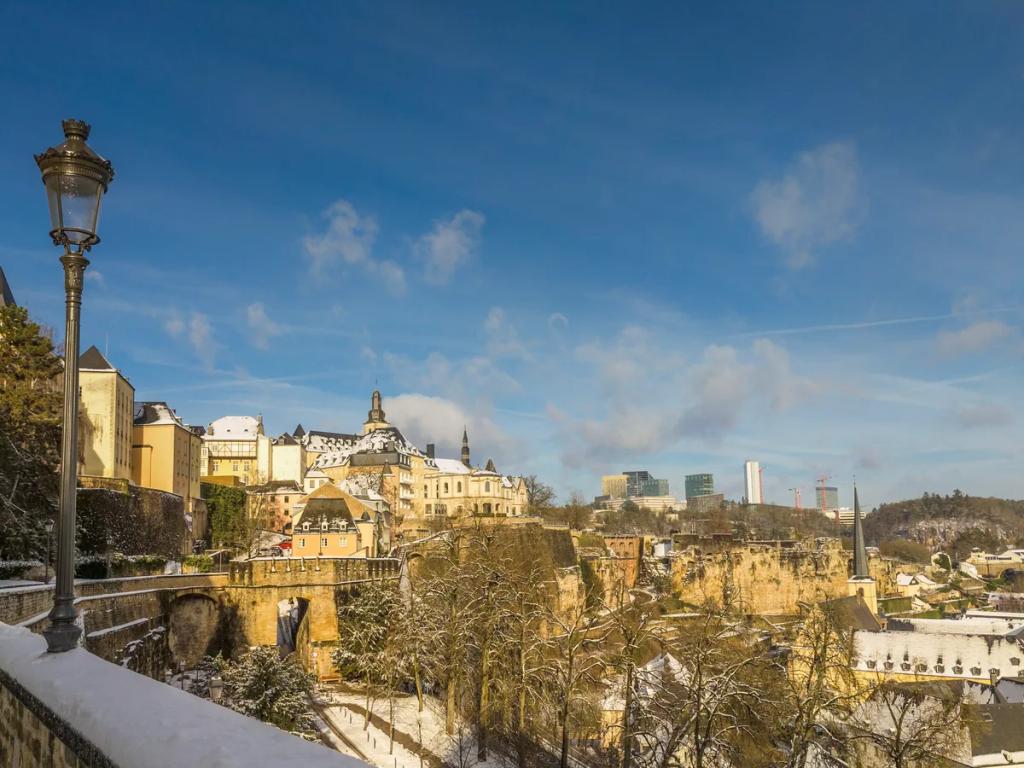
The love: Luxembourg City has one of the most dramatic settings of any European capital - a fortified old town on a rock, wrapped around a deep green gorge, with viaducts and casemates and a valley quarter below. It is UNESCO-listed and largely unvisited compared with what it deserves. It is spotlessly kept, very safe, easy to reach, genuinely trilingual, and the transport is free, which makes day trips to castles and hiking country effectively costless.
The complaints are consistent. It is expensive - among the priciest cities in Europe for eating and sleeping. It is small, and two days covers the capital comfortably. It can feel corporate, with the banking and EU quarters dominating and emptying at weekends. Sundays are dead. The weather is grey. And a few visitors find it lacking in edge - very well ordered, very prosperous, and short on the friction that makes a city interesting.
Come between May and September, walk the Corniche, take the lift down to the Grund, and use the free trains to get out to Vianden and the Mullerthal.
Yes, nationwide, since March 2020 - the first country in the world to do it. Buses, the city tram and second-class train travel are free to everyone including tourists, with nothing to buy or validate. First class and any journey crossing into France, Belgium or Germany still need a ticket, and you should carry ID in case a conductor asks.
Because Luxembourg is small enough that foreign masts reach well inside it. All four countries are in the EU, so Roam Like at Home means this costs you nothing, but a country-specific data plan can behave unexpectedly. A European regional eSIM avoids the issue entirely.
French is the safest opening, and English is very widely spoken. Luxembourgish is the national language and what people use among themselves; German is common in the press. Nobody expects a visitor to speak Luxembourgish, though moien goes down well.
Completely. Luxembourg is a founding EU member, in the eurozone and in Schengen - which was signed in a Luxembourgish village on the Moselle. Your allowance, your money and your passport all behave exactly as at home.