Vivo, Claro and TIM all cover Rio, and your eSIM will pick up whichever is strongest between the mountains. Coverage across the Zona Sul and the centre is good, though the terrain does things to it that flat cities do not - see below. Our São Paulo guide covers Brazilian networks and the Pix payment system that visitors mostly cannot use. Rio's own peculiarity is cultural rather than technical: the single most local thing you can do here is leave your phone in the hotel.
Watch a Rio beach for ten minutes and you will notice what is missing.
People bring almost nothing. A canga to sit on, a pair of flip-flops, and a folded note tucked into a waistband. No bag, no wallet, no phone.
Because everything comes to you. Vendors walk the sand selling mate, biscoito Globo, beer, grilled cheese, açaí and sarongs, all day, and they take cash or card on a portable machine.
Chairs and umbrellas are rented from the barraca operators at the back of the beach, who will also mind a small bag if you have used them all afternoon.
This is partly practical and partly sensible. Opportunistic theft on beaches is real, phones are the obvious target, and locals simply do not create the opportunity.
So do what they do. Take a small amount of cash, one card if you must, and leave the phone behind. If you want photographs, go with someone and take turns, or go early when the beach is quiet.
The wider rule follows from it: in Rio, do not walk along holding your phone out. Step into a shop or a café to check the map. This is normal behaviour here rather than paranoia, and it is what everyone around you is already doing.
Ride apps make this easy. Uber and 99 both work well and are inexpensive, and calling one from inside a bar rather than on the pavement is the standard move.
Rio's setting is not a backdrop; it is structural, and it affects everything including your signal.
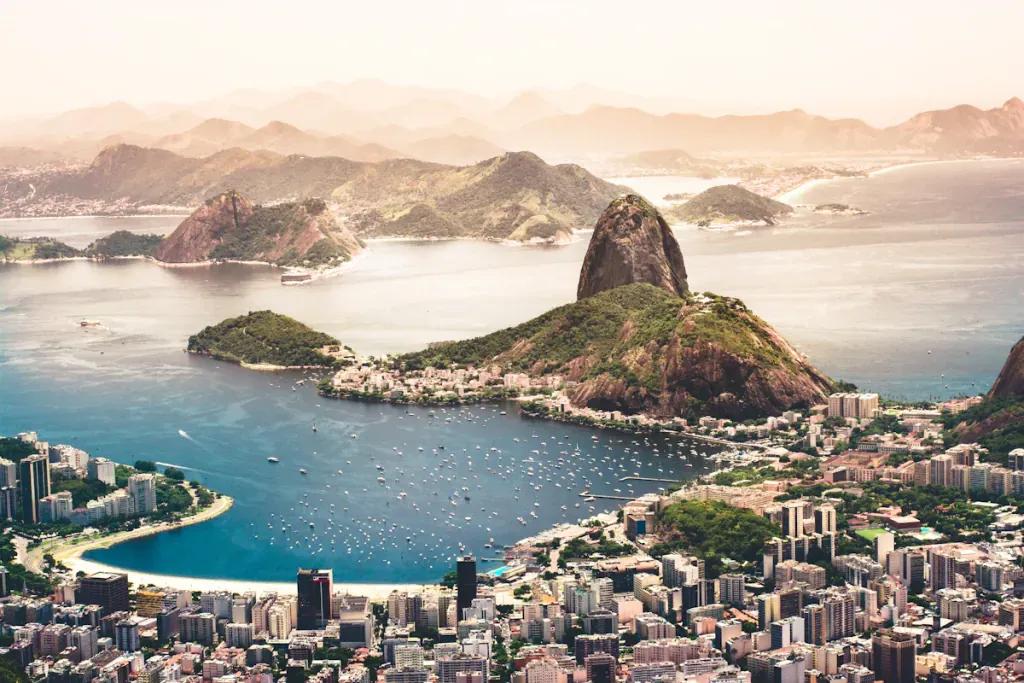
Granite peaks come down into the middle of the built city. Sugarloaf, Corcovado, Dois Irmãos and the Tijuca massif are not on the outskirts - neighbourhoods wrap around them.
Tijuca is the world's largest urban forest, and it was planted by hand. The hillsides had been stripped for coffee, the water supply failed, and from the 1860s the forest was deliberately replanted. What looks like untouched jungle above Rio is a nineteenth-century restoration project.
The favelas are on the hills, which is a legacy of who was allowed to build where, and it means the most spectacular views in the city look out from the least wealthy parts of it.
The geography splits the city. Zona Sul - Copacabana, Ipanema, Leblon, Botafogo - sits between the mountains and the sea. The Centro is round the headland. Barra is far west. Journeys that look short cross ridges through tunnels.
Which is why the tunnels matter. Rio's road tunnels are numerous and long, and your signal drops in most of them - a small thing that becomes annoying when navigating.
The beaches and Zona Sul are well covered, as is the metro.
The road tunnels - Rebouças, Santa Bárbara and the rest - drop out. If you are navigating by phone, expect to lose the route for a minute at a time.
On Corcovado, signal is fine at the top and patchy on the cog railway through the forest.
Sugarloaf's cable car has coverage at both stations and wobbles between them.
Deep in Tijuca forest, on the trails to Pedra da Gávea or Pico da Tijuca, there is very little. These are proper hikes with steep scrambles and people get into difficulty on them - go with a guide or in a group and tell someone.
In the favelas, coverage is generally fine - they are dense and well served - but do not go wandering into one to test that. Visits should be with a resident-led operator or not at all.
On the ferry to Niterói, coverage holds and the view back at the city is the best value in Rio at the price of a bus fare.
Worth understanding before booking, because most visitors picture only part of it.
The Sambadrome parades are the televised competition - the big samba schools, the floats, the scoring. Tickets are sold months ahead, it runs through the night, and it is a stadium event.
The blocos are the actual city-wide party. Hundreds of free street parties, each with a band on a truck, moving through neighbourhoods from early morning to late night for about a week. This is where most cariocas are.
Dates move. Carnival falls in February or March depending on Easter, and the city fills completely - accommodation prices multiply and book out months ahead.
It is not a good week for a quiet trip. Museums close, transport is overwhelmed and the beaches are packed.
New Year is the other one. Réveillon at Copacabana draws around two million people, everyone dresses in white, and the fireworks go up from barges offshore.
- Uber and 99, both of which work well; 99 is the Brazilian one and often cheaper.
- Maps, with offline copies for the forest trails.
- A transit app for the metro and the BRT lines.
- A translation app. Portuguese is essential outside hotels and the tourist strip - Brazilian Portuguese, and Spanish will not carry you as far as people assume.
- Pix dominates local payments and generally needs a Brazilian account; our São Paulo guide covers why visitors usually cannot use it. Cards work widely instead.
Galeão / Tom Jobim (GIG) handles international flights and is about 20 km north of the centre - 40 minutes to an hour to Zona Sul depending on traffic.
Santos Dumont (SDU) sits on the bay right beside the Centro and handles domestic flights. The approach over the water is one of the great landings, and it is fifteen minutes from Copacabana.
Use Uber or 99 from the airport, or a pre-booked transfer. Both are straightforward and considerably cheaper than airport taxis.
In the city, the metro is clean, safe and useful along the Zona Sul-Centro axis, and it connects to Ipanema and Leblon. Buses cover the rest and are cheap. The ferry to Niterói from Praça XV is worth doing for the view.
Moderate. Ride apps and maps run constantly, wifi is common, and Brazilian data is reasonably priced. But note the pattern of use here is different: if you are following local practice you will be offline on the beach for hours at a time, which is rather the point.
Very little, and casually. Rio is the most informally dressed major city in this series. Shorts, flip-flops and a T-shirt is acceptable almost everywhere in the daytime.
Beachwear stays at the beach, though the boundary is looser here than in most places - a sarong over swimwear is fine in a beachfront café.
Something smarter for dinner in Leblon or Ipanema, where restaurants do dress up.
Trainers or boots for the trails. Tijuca's paths are steep, rooty and slippery.
Sun protection that you actually reapply. The UV here is severe and the sea breeze hides it completely.
Light rain layer in summer, when tropical downpours arrive in the afternoon and clear.
Sugarloaf at sunset, from the first cable car station or from Praia Vermelha below it - and the second-best view in Rio is from the top of Sugarloaf looking at Corcovado.
Christ the Redeemer, early, before the cloud and the crowds. Book the cog railway ahead.
Ipanema from Arpoador rock at sunset, when the beach applauds as the sun drops behind Dois Irmãos. The applause is a real thing and it happens most evenings.
Copacabana's pavement, the black-and-white wave design, from above.
Parque Lage, the mansion with the courtyard and pool framing Corcovado behind it.
Escadaria Selarón, the tiled steps in Lapa.
The Niterói ferry, looking back at the whole city profile.
Pedra do Telégrafo, west of the city, for the famous cliff-edge illusion photograph - which is exactly that, an illusion, and the drop behind is small.
Rio was once the capital of Portugal. When Napoleon invaded in 1808 the Portuguese court fled here, and for over a decade Rio was the seat of the Portuguese Empire - the only time a European capital has sat outside Europe.
The Tijuca forest was replanted by hand from the 1860s onward, after coffee farming destroyed the original cover and the city's water supply began to fail.
Copacabana's wave pavement was laid to a design associated with Roberto Burle Marx, and the pattern runs for four kilometres.
The Maracanã once held an official crowd of around 200,000 for the 1950 World Cup final, a record that will not be broken.
Cariocas applaud the sunset at Arpoador. It is spontaneous, it happens most clear evenings, and it is a good summary of the city.
And the name comes from a mistake. Portuguese navigators arrived in January 1502 and took Guanabara Bay for a river mouth - Rio de Janeiro, river of January. There is no river.
Carnival, in February or March, which is both the Sambadrome competition and hundreds of free street blocos across the city for about a week.
Réveillon, 31 December, when around two million people in white gather on Copacabana beach for the fireworks.
Rock in Rio, in September of alternate years.
The football, at the Maracanã - Flamengo, Fluminense, Vasco and Botafogo all play in the city and a derby there is an experience in itself.
June to August is the best weather: mild, dry, clear, and the mountains are visible. December to March is hot, humid and stormy, and is also when Carnival and Réveillon fall.
The love: Rio has a setting no other city can match - granite peaks, rainforest and beaches inside the urban area - and a culture that uses all of it constantly. The beach life is genuinely communal rather than a resort experience, the music is everywhere and unforced, the food and the caipirinhas are excellent and cheap, and cariocas are welcoming in a way that surprises visitors. Sunset from Arpoador or Sugarloaf is among the best free experiences anywhere.
The complaints are consistent and some are serious. Street crime is a genuine concern that requires adjusting how you carry things, and it puts some visitors permanently on edge. The inequality is stark and unavoidable. Summer heat and humidity are punishing. Getting between neighbourhoods takes longer than the map suggests. Carnival week is wonderful or overwhelming depending entirely on what you wanted. And the city has real infrastructure problems that a visitor sees the edges of.
Come in July, stay in Ipanema or Botafogo, do Sugarloaf at sunset rather than Christ, and spend one afternoon on the beach with nothing but a note and a towel.
Locals mostly do not, and copying them is the single best piece of advice in this guide. Cariocas bring a canga, flip-flops and a folded note - vendors come to you with food, drinks and card machines, and chair operators rent umbrellas. Opportunistic theft targets phones, and the simplest defence is not creating the opportunity.
Rio's road tunnels. The city is built around granite peaks, so getting between neighbourhoods means passing through long tunnels, and most of them drop service. Download your route before setting off rather than relying on live navigation.
At the top of both, yes. The cog railway up through Tijuca forest is patchy, and the Sugarloaf cable car wavers between stations. The real gaps are the forest trails - Pedra da Gávea and Pico da Tijuca have very little, and they are serious hikes.
Almost certainly not - it needs a Brazilian account, and our São Paulo guide explains the situation. Cards work widely across Rio, and cash in small notes is what you want for the beach.