Dubrovnik runs on Hrvatski Telekom, A1 Hrvatska and Telemach, and your eSIM rides one of them as its host. The old town, Lapad and Gruž are thoroughly covered with 4G and 5G reaches most of the city. Connectivity here is easy. Two other things are not, and both have changed recently enough that older guidebooks get them wrong.
If you are reading anything published before 2023, check it against this.
- Croatia joined the EU in 2013, so Roam Like at Home applies: an EU or EEA SIM roams here on its domestic allowance with no surcharge.
- The euro replaced the kuna on 1 January 2023. Guidebooks and blog posts still quoting kuna prices are out of date, and so is any advice about changing money before you arrive.
- Croatia joined Schengen on the same day, which removed the border checks that used to shape journeys along this coast.
So: coming from elsewhere in the EU, your existing plan very likely covers Dubrovnik. From the UK, check your operator's current policy. From outside Europe, a travel eSIM is worth it as usual - and worth more if you are hopping to Montenegro or Bosnia, which are outside the zone and a short drive away.
Until recently, driving from Split to Dubrovnik meant leaving Croatia and re-entering it. The Neum corridor - a nine-kilometre strip of coast belonging to Bosnia and Herzegovina - sits between the two, and everyone travelling the coast road crossed two international borders each way.
The Pelješac Bridge opened in 2022 and bypasses it entirely. The coastal route now stays inside Croatia.
Why this belongs on a connectivity page: if you take the old road, or detour into Bosnia deliberately, you leave EU roaming the moment you cross. A phone that has been happily roaming on its home allowance starts billing at non-EU rates, often without an obvious warning, and people have collected genuinely unpleasant bills on a nine-kilometre stretch of road they did not realise was another country.
Check your route. If it crosses Neum, turn off data roaming for the crossing or make sure you know what it costs.
On the walls. The circuit is about 2 km and takes a couple of hours, and coverage is good throughout - the problem up there is not signal but heat. There is almost no shade, the limestone reflects, and the walls close in stages. Go at opening or in the last two hours.
Inside the old town's stone. The lanes are narrow and the buildings are thick limestone, so the deep alleys off the Stradun and the interiors of the monasteries and the cathedral are patchy.
Lokrum island, ten minutes by boat, is well covered near the jetty and thinner in the interior.
The Elafiti islands - Koločep, Lopud, Šipan - are a half-day or full-day boat trip, and coverage varies island to island. Boat times are the thing to confirm in person.
The Mount Srđ cable car runs to the ridge above the city; the top has signal and the single best view in Croatia. The road up is a series of hairpins with gaps.
The bura. Worth knowing as a connectivity-adjacent fact: this cold downslope wind can arrive quickly and cancels boats and sometimes the cable car. If your day depends on a sailing, check in the morning rather than assuming.
- A boat and ferry app, or at least the Jadrolinija timetable. Getting to the islands is the main activity and schedules are seasonal.
- Maps, though the old town is tiny and entirely pedestrian - you will navigate by the Stradun and give up on street names.
- Uber and Bolt both operate in Dubrovnik, alongside regulated taxis. The city is spread out beyond the walls and Lapad to the old town is not a walk in August.
- A weather app that shows wind, for the bura and for boat days.
- Timed-entry bookings for the walls and for Lokrum in high season.
Dubrovnik Airport (DBV) is at Čilipi, about 20 km southeast, roughly 30-40 minutes by road. The airport shuttle bus runs to the Pile Gate and Gruž and is cheap and reliable.
There is no railway to Dubrovnik. None. The city is reached by road, by sea or by air, and this surprises people planning a rail trip down the coast.
Cruise ships dock at Gruž. Since 2019 the city has capped arrivals - broadly two ships and around 4,000 passengers a day - after over-tourism became genuinely unmanageable. It is much better than it was, and still busy.
Modest. This is a walk-and-swim destination, and a lot of the day is spent somewhere you would rather not be holding a phone.
For a week, 1GB per 3 days is ample. Add headroom if you are island-hopping and uploading. Plans top up from your dashboard.
Serious sun protection. The walls walk in July, on white limestone with no shade, is the single most underestimated physical activity in this guide. Hat, water, sunscreen, and do not start it at noon.
Shoes with grip. The Stradun's limestone has been polished by centuries of feet and is genuinely slippery, especially wet.
Swimwear you can walk in, because the swimming spots are rocky ledges rather than beaches - Banje is the closest proper beach, and the best swimming is off the rocks outside the walls.
Modest cover for the churches and monasteries, shoulders and knees.
A windproof layer in shoulder season, when the bura makes a warm day feel cold.
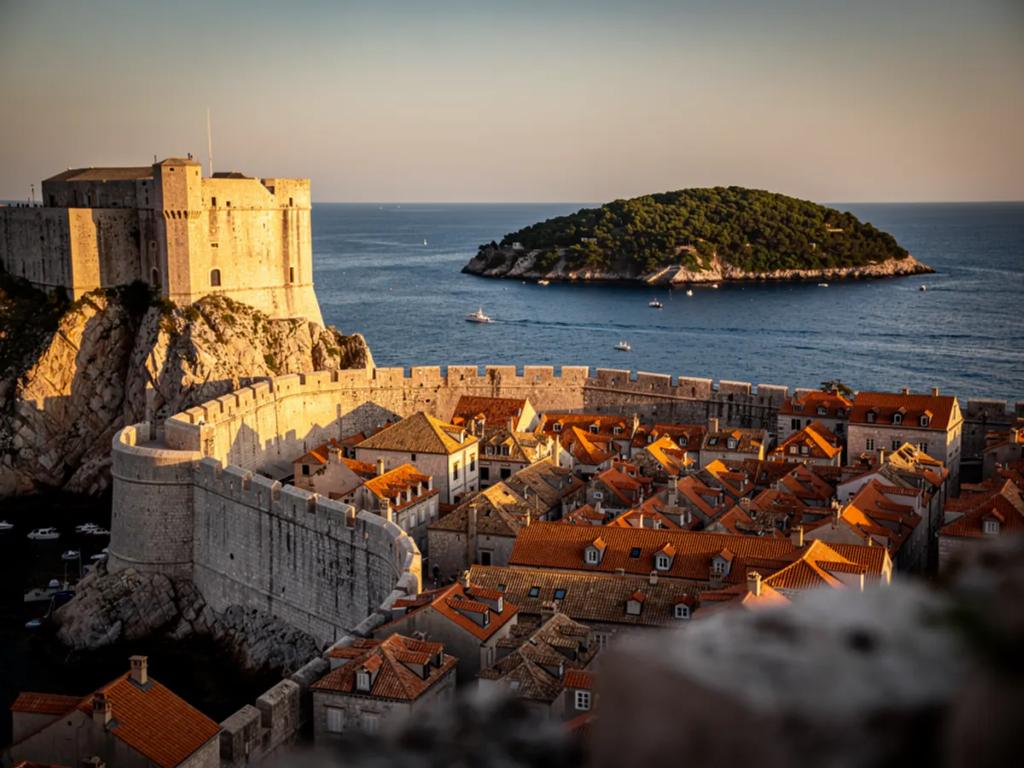
The rooftops from the walls, looking over terracotta to the Adriatic - the definitive Dubrovnik image, and best in the first hour of opening.
Mount Srđ at sunset, with the whole walled city below and Lokrum offshore.
The Stradun early, empty and glowing, before the day-trippers arrive - this means before about nine.
Fort Lovrijenac from the water, the fortress on its rock outside the walls.
Buža bar, the hole-in-the-wall cliff bar on the seaward side, at golden hour.
Lokrum's peacocks, which have the run of the island and are entirely unbothered.
Dubrovnik was the Republic of Ragusa, an independent maritime state for over 450 years, and it kept that independence by diplomacy and tribute rather than by fighting.
Its walls were never breached. What did the damage was the earthquake of 1667, which destroyed most of the city and killed thousands - which is why the architecture inside is largely uniform baroque rather than medieval.
Ragusa abolished the slave trade in 1416, among the earliest anywhere in Europe.
The city has been UNESCO-listed since 1979, and was shelled during the 1991-92 siege - the restoration of the roofs is why the terracotta is such a consistent colour.
And it was King's Landing, which transformed visitor numbers and is why the walls now need timed tickets.
The Dubrovnik Summer Festival, July and August, with theatre and music staged in the courtyards and on the fortresses - it has run since 1950.
The Feast of St Blaise, 3 February, the city's patron saint, and a genuinely local occasion in the quietest month.
Peak season is July and August, when it is hot, full and expensive.
May, June, September and October are far better - warm sea, manageable crowds, and the walls walk is survivable.
The love: it is one of the most spectacular walled cities in the world, and the first sight of it from the Srđ road or the sea is genuinely startling. The stone, the sea, the light and the compactness of it are hard to argue with, and the island trips give the visit range beyond the walls.
The complaints are loud and largely justified. It is crowded - even with the cruise cap, the old town in August is shoulder to shoulder. It is very expensive, the most in Croatia by a distance, and the restaurants immediately on the Stradun are not where locals eat. It is small: the old town is walkable in twenty minutes, and people booking a week without island trips get restless. There is no beach to speak of in the old town, and the rocky swimming surprises families. And the summer heat inside the walls, which trap it, is fierce.
Go in shoulder season, stay outside the walls, walk them at opening, and spend at least two days on the islands.
Yes. Croatia joined the EU in 2013, so Roam Like at Home applies to EU and EEA SIMs with no surcharge. Croatia also adopted the euro and joined Schengen on 1 January 2023, so guidance mentioning kuna or border checks is out of date.
Only if you take the old coast road through Neum, a nine-kilometre strip belonging to Bosnia and Herzegovina, which is outside the EU roaming zone. The Pelješac Bridge, open since 2022, bypasses it and keeps you inside Croatia. If your route does cross Neum, know what your operator charges there.
No. There is no rail connection at all - the city is reached by road, sea or air. Dubrovnik Airport is about 20 km away with a reliable shuttle bus to the Pile Gate and Gruž.
Yes, throughout the circuit. Heat is the real problem up there, not coverage: roughly 2 km with almost no shade on reflective limestone. Walk it at opening or late afternoon.