Batumi runs on Magti, Silknet and Cellfie, and your eSIM rides one of them as its host. Georgian networks are good and cheap, coverage along the coast and into the main valleys is solid, and the country is not in the EU so an EU SIM will bill at out-of-zone rates - a travel eSIM sorts that in a sentence. The more interesting thing about connectivity here is why so many people on the promenade are working on laptops, and that comes down to an immigration rule unlike any other in the region.
Georgia has quietly one of the most generous entry policies in the world, and it explains a great deal about what Batumi has become.
Citizens of around 95 countries can enter Georgia visa-free and stay for 365 days. Not 90 days. Not a permit to apply for. A full year, granted at the border on arrival with a passport.
Remote work for foreign employers or clients is permitted during that stay, which is the part that matters.
There is nothing to apply for. Georgia did launch a formal digital nomad programme, and it has since become largely redundant and is not the route anyone uses - the visa-free year already does the job more simply.
The practical effect on Batumi has been substantial. A subtropical Black Sea town with cheap rent, fast internet and a year-long welcome has drawn a sizeable population of remote workers, and there are co-working spaces, long-stay flats and cafes built around them.
A year is long enough to change your tax position, in Georgia and possibly at home, so anyone actually planning to stay should take advice rather than assume the immigration rule is the whole story.
For a two-week visitor none of this applies, but it explains why the town feels more international than its size suggests, and why the wifi is better than you would expect.
Batumi's setting is genuinely odd and it is the reason to come.
It is subtropical. Palm trees, bamboo, magnolias and tea plantations, on the same latitude as places with a far harsher climate, because the Black Sea and the mountains trap warm wet air against the coast.
The mountains rise immediately behind and hold snow into spring, so you can photograph palm trees with snowfields above them.
Which also means rain. Batumi is one of the wettest places in Georgia, and it rains in every month. Do not plan a beach week without a plan B.
The beach is pebbles, not sand, which surprises people. Bring something for your feet.
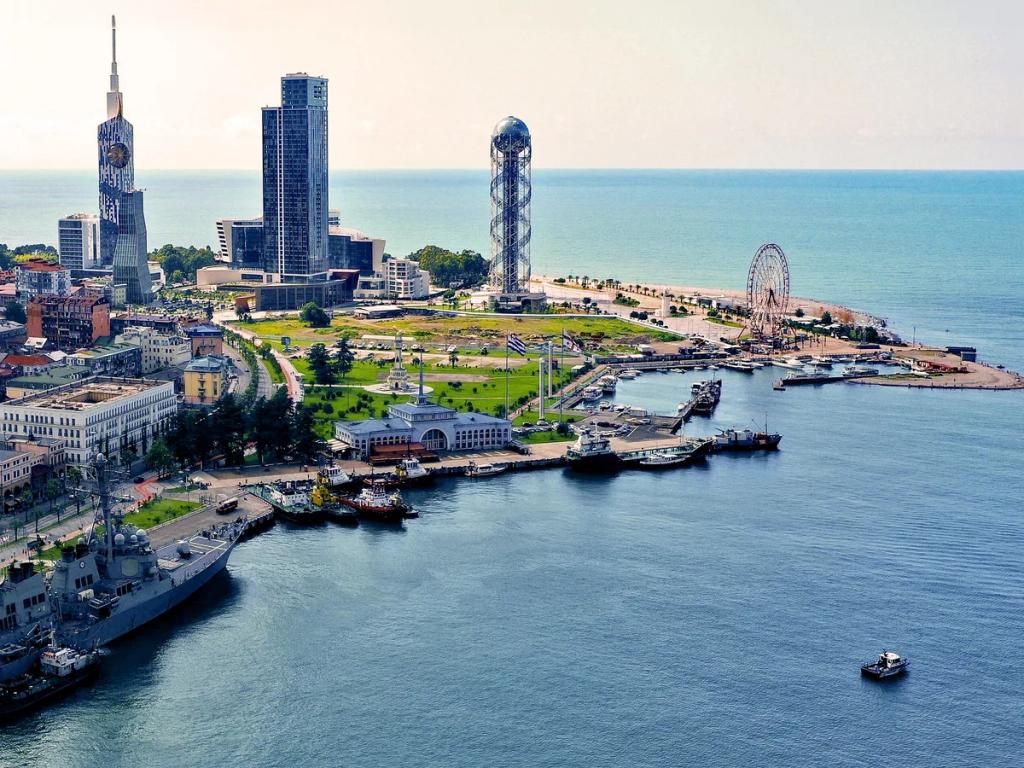
The skyline is unlike anywhere. A cluster of tall, mismatched, sometimes half-finished towers - a Ferris wheel embedded in one building, an Alphabet Tower spiralling the Georgian script up its frame - built fast in a boom and now settling into itself. Visitors find it either exhilarating or ridiculous.
Half an hour inland you are in the Machakhela and Mtirala valleys, all waterfalls, arched stone bridges and rainforest, and the contrast with the promenade is total.
Batumi and the coast road are well covered, as is most of Adjara's populated lowland.
The mountain valleys behind the city - Mtirala, Machakhela, the road up to Khulo - thin out quickly, and the higher you go the less there is.
The Khulo cable car and the villages beyond it drop out.
Mtirala National Park, which is rainforest, has coverage at the entrance and very little inside.
The Turkish border at Sarpi is fifteen kilometres south, and your phone will happily register on a Turkish network well before you reach it. Turn data roaming off if you are driving down, because Turkey is a separate roaming zone from Georgia on most plans.
Along the coast north towards Kobuleti and Poti, coverage is fine.
The currency is the lari, and Georgia is comfortably card-friendly - contactless works in shops, restaurants and taxis in Batumi, and ATMs are plentiful.
Carry some cash for markets, small bakeries and the mountain villages.
Georgian is written in its own alphabet, one of only a handful of unique writing systems still in daily use, and it is UNESCO-listed. You will not be able to guess at it, so a translation app with camera input earns its place.
Russian is widely understood, English increasingly so among younger people and everyone in tourism.
And the food is a genuine reason to come. Khachapuri Acharuli - the boat-shaped bread with cheese, butter and a raw egg stirred in at the table - is from here, Adjara, and eating it anywhere else is a compromise.
- Bolt and Yandex Go, both of which work here and are extremely cheap.
- A translation app with camera input, for the alphabet.
- Maps with offline copies for the mountain valleys.
- A weather app, used more here than in most beach towns for obvious reasons.
- Wolt or Glovo for delivery, both of which operate.
Batumi International (BUS) is about 6 km from the centre - small, quick, and a ten-minute taxi ride into town.
Kutaisi (KUT), two hours north, is the low-cost hub with a great many cheap European flights, and a bus or transfer down the coast is straightforward. For a lot of visitors this is the cheaper way in.
From Tbilisi, the train takes around five to six hours and is comfortable and cheap; the road is similar.
Turkey is fifteen kilometres away at the Sarpi crossing, and this is a common overland route in and out.
In town, Batumi is small and walkable along the boulevard, with taxis for everything else.
Modest for a visit, and the wifi is genuinely good - this is a town with a remote-working population and the infrastructure reflects it. Budget more if you are heading into the mountains, where offline maps stop being optional.
Bring rain gear regardless of season. This is the single most useful packing note for Batumi.
Light clothes in summer, which is warm and very humid.
Layers in winter, which is mild on the coast and cold in the mountains behind - a day trip up to Khulo can be fifteen degrees colder than the promenade.
Beach shoes for the pebbles.
Something for a night out. Batumi dresses up in season and the promenade is a parade in July.
Modest dress for monasteries if you are heading inland - shoulders covered, a scarf for women's heads.
Ali and Nino, the moving steel sculpture on the boulevard of a man and woman who slide towards each other, merge and pass through - based on the novel, and it runs a full cycle every few minutes at dusk.
The Alphabet Tower, with the Georgian script spiralling up it.
The promenade at sunset, palms against the Black Sea.
The skyline from the pier, which is the strangest cityscape in the Caucasus.
Gonio Fortress, Roman walls fifteen minutes south, near the Turkish border.
Mtirala's waterfalls, in the rainforest half an hour inland.
The Batumi Botanical Garden, north of the city on a headland, which is genuinely world-class and where the subtropical thing becomes obvious.
Khulo and the Adjaran highlands, up the winding road, for wooden villages and the cable car.
Georgia may be the oldest wine region on earth. Winemaking here goes back around 8,000 years, and the qvevri method - fermenting in clay vessels buried in the ground - is on the UNESCO list and still in everyday use.
The Georgian alphabet is unique, unrelated to any other script, and three of its historical forms are UNESCO-listed together.
Khachapuri Acharuli comes from Adjara, the region Batumi is the capital of, and its boat shape with the egg for a sun is said to represent the Black Sea.
Adjara is an autonomous republic within Georgia, with its own parliament, a legacy of the Ottoman period and the treaty that returned it.
Batumi has a working Ferris wheel built into the side of an apartment building, which is exactly as odd as it sounds.
And Georgia has no word for "cheers" that means what you think - a supra feast runs on toasts led by a tamada, and each toast is a small speech. Being toasted is an honour and refusing one is not really available.
The Black Sea Jazz Festival, in July, which draws serious international names to the seafront.
Batumoba, in early September, the city's birthday festival.
Georgian Independence Day, 26 May.
Summer, June to September, is high season, when the town fills with Georgians, Turks, Armenians and Israelis and the promenade runs all night.
Out of season, roughly November to March, a good deal closes and the town is quiet, wet and cheap - which some people prefer.
The love: Batumi is a genuinely strange and likeable place - a subtropical Soviet resort town that grew a skyline of experimental towers, sitting between the Black Sea and rainforest mountains, with some of the best food in a country famous for it. It is very cheap, extremely welcoming, easy to reach from Europe via Kutaisi, and the year-long visa-free stay makes it one of the simplest places in the world to settle into for a while. Georgian hospitality is not a marketing line; it is a genuine social obligation, and visitors feel it.
The complaints are consistent. It rains a great deal. The beach is pebbles and the sea is not the Mediterranean. The building boom left gaps - half-finished towers and abrupt transitions between glossy and derelict. The casino and party trade gives parts of the seafront a stag-weekend character that not everyone wants. Out of season it is genuinely dead. And Batumi is not Georgia - the mountains, Tbilisi, Svaneti and the wine country are the rest of the case, and anyone judging the country by the promenade is missing it.
Come in June or September, eat the khachapuri where it was invented, go up to Mtirala on the first clear morning, and take the train to Tbilisi rather than flying home from here.
Up to 365 days visa-free, for citizens of around 95 countries, granted on arrival with no application. Remote work for foreign employers is permitted during that stay. It is one of the most generous entry policies anywhere, and it is why Batumi has the remote-working population it does. A long stay can affect your tax position, so take advice if you are actually settling in.
No - Georgia is not in the EU or EEA, so an EU SIM roams at out-of-zone rates. Local data is cheap and coverage is good, so a travel eSIM is the simple answer. Note that Turkey, fifteen kilometres south, is a different roaming zone again.
Because the border at Sarpi is only about fifteen kilometres from the city and Turkish masts reach up the coast. If you are driving south, turn data roaming off, because Turkey is billed separately from Georgia on almost every plan.
Yes, unusually so for a town this size - it is one of the reasons the remote-working community settled here. Cafes and long-stay flats have solid connections, and mobile data is fast and cheap. The mountains behind the city are where it stops.