Vienna runs on A1, Magenta and Drei, and your eSIM rides one of them as its host. Austrian networks are very good and unusually complete: 5G across the city, 4G everywhere else, and coverage that holds in the U-Bahn tunnels, which is not something every European capital manages. Connectivity is the easy part of this trip. The thing that catches visitors out here is not the signal, it is the money.
This is the single most useful thing to know before arriving, because it contradicts what people expect from a wealthy Western European capital.
Austria is deeply attached to cash. Not in the way a developing economy is, but by preference and habit. Card acceptance has improved a great deal and most restaurants and shops now take it, but the exceptions are exactly the places you will want to go: traditional coffee houses, the Wurstelstand sausage stands, small Beisl taverns, market stalls, bakeries, and the odd museum cloakroom.
Carry notes and coins. An ATM here is a Bankomat and they are everywhere. Take out more than feels necessary and expect to use it.
Watch for card minimums. A ten-euro floor on card payments is common in smaller places, and it is usually posted at the till rather than announced.
The reason people trip over this is that Vienna is otherwise so thoroughly modern that cash feels like an anachronism. It is not going anywhere. Treat it as part of the local texture rather than a failure of infrastructure and the city becomes much easier.
Vienna's Kaffeehauskultur is on the UNESCO list of intangible cultural heritage, which tells you it is taken seriously.
You are renting the table, not buying the coffee. Sitting for three hours over one Melange with a newspaper is the intended use, not an imposition. Nobody will hurry you and nobody will bring the bill until you ask.
Do not order "a coffee". It is a genuine category error. A Melange is the standard one, roughly a cappuccino. A Kleiner Brauner is an espresso with a little cream. An Einspanner is a strong black coffee under whipped cream in a glass. A Verlangerter is the long one.
The water glass is the point. Every coffee comes with a glass of Vienna tap water, and refills are normal. The water is piped from Alpine springs through two nineteenth-century aqueducts and is genuinely excellent.
The waiter is called Herr Ober and his professional brusqueness is a recognised institution. It is not rudeness aimed at you, and warming up over repeat visits is part of the game.
Many of the old houses are cash-only, which is where the previous section stops being abstract.
Almost nowhere, in the city. Vienna is the rare capital where the metro is properly covered, so you keep signal through the U-Bahn. Trams, buses and the S-Bahn are all fine.
The Wienerwald, the woods on the western edge, thin out once you are properly into them. This matters more than it sounds, because the forest starts where the tram stops and it is easy to walk from full bars to nothing in twenty minutes.
The Danube Island is well covered along its length, but it is 21 km long and the far ends are quiet in every sense.
Deep inside the big stone buildings - the Hofburg complex, parts of the Kunsthistorisches Museum, the Prunksaal of the National Library - the walls are thick enough to matter.
The Alps are two hours away and behave like mountains everywhere: coverage follows the valleys and the roads, and stops above them.
Worth planning around, because it surprises people every week.
Almost all shops close on Sundays, and this is law rather than custom. Supermarkets, clothes shops, most of the retail city: shut.
What stays open: restaurants, cafes, museums, the Prater, pharmacies on a rota, and the shops inside the main railway stations and the airport. Those station supermarkets are the standard Sunday fallback and everyone uses them.
Saturday afternoon is when to do any shopping the trip requires. Many places close early on Saturday too.
Sunday in Vienna is for museums, coffee houses and the woods, which is a fair trade once you know it is coming.
- WienMobil, from Wiener Linien, for the U-Bahn, trams, buses and tickets. The network is dense and the app is the fastest way to buy.
- OBB Scotty for Austrian rail, and worth having even for day trips.
- Maps, with an offline copy if you are heading into the Wienerwald or the mountains.
- A translation app is genuinely useful. English is widely spoken in tourist Vienna and much less so in an ordinary Beisl or at a market stall.
- A Bankomat finder, given everything above.
Vienna International (VIE) at Schwechat is about 18 km southeast. The City Airport Train runs non-stop to Wien Mitte in 16 minutes; the S7 suburban train takes about 25 minutes on an ordinary transport ticket for a fraction of the price and is what most locals take. Railjet services also run from the airport to the main station.
Some low-cost flights land at Bratislava (BTS) in Slovakia, roughly an hour away by bus. It is a real airport in a different country, so check the code on the booking rather than the city name in the advert.
Once here, the transport system is superb and you will not need a taxi. Note that ticketing runs on trust: there are no barriers, you validate before travelling, and inspectors are frequent and unsympathetic.
Not a lot. Wifi is common, the city is compact, and most of what you do is above ground and well signposted. A modest plan covers maps, transport and messaging comfortably. Push it up if you are streaming or working, and remember that day trips to Salzburg, the Wachau valley or Bratislava are all easy and all want offline maps.
Vienna is a formal city by Western European standards, and dressing slightly up costs nothing and fits better.
Winter is properly cold, from November to March, with damp grey stretches and occasional snow. A real coat, not a jacket.
Summer is hot, regularly above 30C in July and August, and the city is built of stone that holds it. Light clothes, and the Danube is where everyone goes.
Comfortable shoes for cobbles and distance. The centre is walkable and you will walk it.
Something smarter for the opera or a concert. There is no strict dress code for the standing places at the Staatsoper, but the room is dressed and you will feel it if you are not.
Schonbrunn and the Gloriette, with the palace below and the city beyond. Go early; the gardens are free and open before the palace is.
The Belvedere, for the building and for Klimt's The Kiss, which lives there.
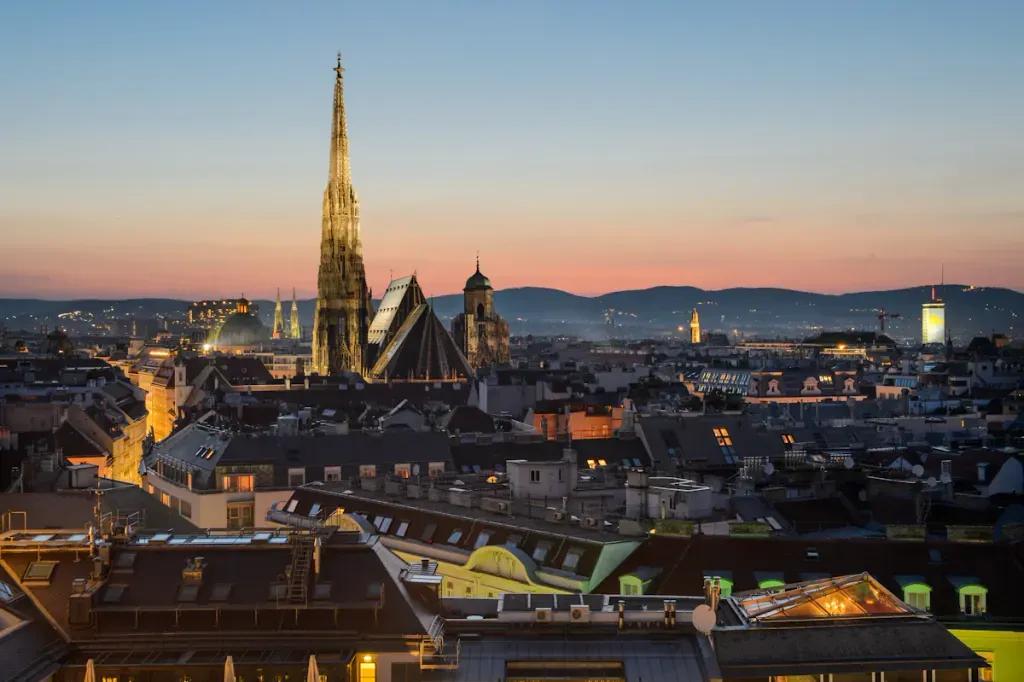
Stephansdom's roof, whose glazed tiles form the patterned mosaic, best seen from the Haas Haus opposite.
Karlskirche reflected in the pool in front of it, which is the shot on the front of this guide.
The Prater's Riesenrad, the 1897 ferris wheel, at dusk.
Hundertwasserhaus, the undulating municipal housing block with trees growing out of it.
The Prunksaal of the Austrian National Library, one of the most beautiful rooms in Europe and much less crowded than it deserves.
Naschmarkt on a Saturday, when the flea market runs alongside it.
The snow globe was invented here, by Erwin Perzy in 1900, and his grandson still makes them by hand in the same Vienna workshop.
Schonbrunn's Tiergarten is the oldest zoo in the world, founded in 1752 as an imperial menagerie.
The Zentralfriedhof is very nearly the size of the entire Innere Stadt and holds Beethoven, Brahms, Schubert and Strauss. Vienna's relationship with death is famously elaborate, and a schone Leich - a beautiful funeral - is a real compliment.
The sewers under the city are the ones from The Third Man, and you can tour them.
Vienna has topped global quality-of-life rankings repeatedly, and roughly a quarter of Viennese live in council housing that is nothing like what that phrase suggests elsewhere.
And the croissant is arguably Viennese, by way of the Kipferl, which went to Paris with Marie Antoinette.
The ball season, January to March, culminating in the Opernball at the State Opera in February. Over 400 balls run across the city and many are open to anyone who can hire the outfit.
The Christmas markets, mid-November to Christmas, with the one in front of the Rathaus the largest and the ones at Spittelberg and Karlsplatz the better ones.
Donauinselfest in late June, on the Danube Island - free, enormous, and one of the largest open-air festivals in Europe.
The New Year's Concert, 1 January, from the Musikverein, which is broadcast worldwide and effectively impossible to get into.
Wiener Festwochen in May and June, the city's big arts festival.
The love: Vienna is a capital built for an empire three times its current size, so everything is grander than the city needs, and it is all still working. The music is not a museum exhibit, the coffee houses are real institutions rather than heritage theatre, the transport is faultless, the drinking water is Alpine, and the whole thing is unusually calm and unusually safe. It is a very easy city to be happy in.
The complaints are consistent and fair. It is reserved, and visitors who want warmth on arrival find it slow to give. The service style reads as rude until you understand it is a role being played. It can feel like a stage set, beautifully preserved and slightly airless, particularly in the first district. Sundays are dead if you have not planned. It is expensive, though noticeably less so than Zurich or Copenhagen. And a few people find it staid, a city of institutions where nothing much is being invented.
Go in May or September, buy a transport pass on the first morning, and treat the coffee house as somewhere to spend an afternoon rather than twenty minutes.
Yes, straightforwardly. Austria is in the EU, so Roam Like at Home applies and an EU or EEA SIM uses its domestic allowance with no surcharge. UK operators vary post-Brexit and should be checked. Travellers from outside Europe want a travel eSIM as usual.
Yes. Vienna's metro is covered throughout, which is worth knowing because several comparable European systems are not. The places to lose signal here are the Wienerwald and the mountains, not the tunnels.
Not exclusively, but far more than the city's wealth suggests. Traditional coffee houses, sausage stands, small taverns and market stalls are the usual cash-only cases, and ten-euro card minimums are common elsewhere. Carry notes; Bankomat machines are everywhere.
Yes, and it is a legal restriction rather than a habit, so there are no exceptions to shop around. Restaurants, cafes, museums and pharmacies on rota stay open, and the supermarkets inside the main stations and the airport are the standard workaround.