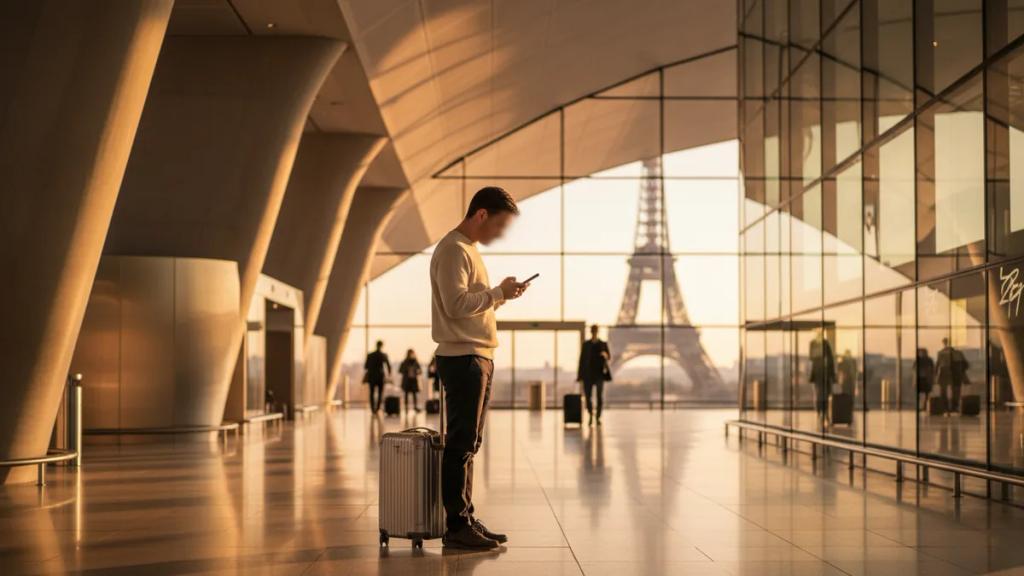
Paris runs on four mobile networks - Orange, SFR, Bouygues Telecom and Free Mobile - and all four blanket the city with 4G and 5G. Your eSIM rides one of them as its host, so above ground you get solid data everywhere from the Marais to Montmartre. The pleasant surprise is below ground: the four operators jointly wired the entire Métro - all 300-plus underground stations and the tunnels between them - and the network has had 100% 4G since 2020. Maps, messages and ticket apps keep working while you ride; expect only brief stutters on some RER tunnel sections.
This is the most connectivity-dependent thing about Paris right now. Cardboard ticket sales ended in November 2025, and since June 2026 paper tickets are no longer accepted on the Métro, RER and trains at all. Your two options: the Île-de-France Mobilités app (buy tickets on your phone and tap the phone at the gates) or a €2 Navigo Easy card topped up at machines - and buying through the app needs data. Unlike London, you cannot tap a contactless bank card at Métro gates; bank-card payment is only being rolled out on buses during 2026. Fares got simpler though: a single Métro-Train-RER ticket is a flat €2.55 anywhere in the Île-de-France region.
The Louvre no longer sells general-admission tickets at a walk-up queue - timed-slot booking at ticket.louvre.fr is effectively mandatory, and summer 2026 slots are formally reservation-only. Versailles, the Musée d'Orsay and the Eiffel Tower summit work the same way: book a slot, keep the QR on your phone, keep data live for the inevitable slot change. For rides, Uber is the default, with Bolt and FreeNow also active and the G7 app covering official taxis. Tap-to-pay with card or phone is accepted almost everywhere, from boulangeries to market stalls.
From Charles de Gaulle, the RER B runs straight into the city; from Orly, Métro Line 14 goes direct since its 2024 extension. Airports are the one exception to the flat fare - they need the roughly €14 Paris Region-Airports ticket, bought in the same app. The flat €2.55 ticket is great news for day trips: the RER C to Versailles and the RER A to Disneyland Paris (Marne-la-Vallée Chessy) are now ordinary tickets, no zone arithmetic, and both rides are mostly above ground so you stay online the whole way.
Line 1 strings together the Louvre, Champs-Élysées and Bastille, making it the most tourist-dense - and most pickpocket-worked - line in the city. Copy the local habit: load your route before boarding, keep the phone zipped away near the doors, check it mid-carriage rather than in the crush. If the worst happens, an eSIM has a quiet advantage - there is no physical SIM for a thief to pull, and your home number stays reachable for bank codes and Find My.
Paris trips are maps-heavy (Haussmann blocks all look alike), booking-heavy (all those timed slots) and photo-upload-heavy. Café Wi-Fi exists but is patchy and often gated behind a purchase or login page - a bonus, not a plan. For most travelers 1GB per 2-3 days covers navigation, messaging and the ticket apps; budget more for video calls or streaming. The France network comparison covers how the host networks differ, and you can top up from your dashboard mid-trip.
Parisians dress up a notch, and you will feel it: smart-casual reads as normal, full athleisure reads as tourist. You do not need a blazer - just lean tidy over sporty, and pack comfortable shoes because cobbles and 20,000-step days are the Paris reality. A scarf is the universal local fix for a grey morning, an over-air-conditioned museum, or an outfit that needs upgrading for dinner. And even in a heatwave, churches like Notre-Dame and Sacre-Coeur expect covered shoulders.
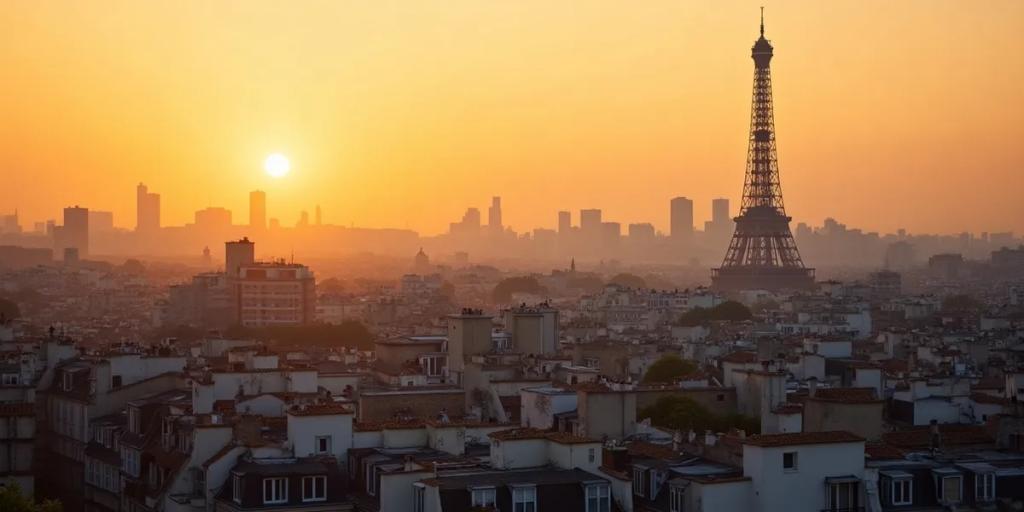
For the Eiffel Tower, the Trocadero esplanade at sunrise gets you the postcard frame with almost nobody in it; by 10am it is a crowd scene. The side-street angle from Rue de l'Universite gives you the tower rising between Haussmann facades - shoot from low, phone tilted up. At the Louvre, the pinch-the-pyramid pose is a cliche for a reason; go at dawn before the courtyard fills. Montmartre's steps below Sacre-Coeur glow at golden hour, facing back over the whole city. Two rules: drones are banned over Paris without a permit, and the Eiffel Tower's night-time light show is technically copyrighted - personal photos are fine, but commercial use needs authorization.
The Eiffel Tower was meant to be temporary - built for the 1889 World's Fair with a 20-year permit, it survived because it made a superb radio antenna. Paris has zero stop signs: the city's famous last one, in the 16th arrondissement, kept getting stolen and was finally removed around 2016. And the Louvre is genuinely unfinishable in a visit - even a few seconds per work would take months.
Bastille Day (14 July) brings the Champs-Elysees military parade and fireworks over the Eiffel Tower. Fete de la Musique (21 June) turns every street corner into a free stage. Roland-Garros runs late May into early June, overlapping with Nuit Blanche, the free all-night contemporary art festival held on one night in early June. And the Fashion Weeks land several times a year, with the biggest ready-to-wear editions in late February-March and late September-October - hotel prices spike accordingly.
The love is deserved: Paris is absurdly beautiful street by street, the food runs from perfect 6 euro baguette sandwiches to once-a-decade dinners, and almost everything worth seeing is walkable or one Metro hop apart. The complaints are real too: pickpockets work the tourist lines hard, the marquee museums mean queues even with timed tickets, August brings peak crowds while many local spots close, and the brisk service culture reads as rude if you expect American-style warmth (a "bonjour" before any request fixes half of it). "Paris syndrome" - the documented letdown when the real city meets the filtered one - is best avoided by expecting a real, busy metropolis.
Yes - the whole network. The four French operators finished covering every underground station and tunnel with 4G back in 2020, so data works on moving trains deep under the city. Occasional drops happen on some RER segments, but on the Métro staying online is the norm.
Not at Métro gates as of mid-2026 - bank-card tap-in is arriving on buses first. You need either a phone ticket in the Île-de-France Mobilités app or a €2 Navigo Easy card loaded with tickets. Since paper tickets are gone, having data from the moment you land makes the app route painless - install your eSIM before you fly.
More than you would think. The Louvre alone is over 70,000 square metres and its timed-entry, QR-based admission lives on your phone, as do last-minute slot changes. Indoor signal in the big museums is generally fine on all four networks - keep data on for tickets, floor maps and translation.