Kyiv runs on Kyivstar, Vodafone Ukraine and lifecell, and your eSIM rides one of them as its host. Ukraine's mobile internet is genuinely good - fast, cheap by European standards, and used for everything from parking to government paperwork. Coverage across the capital is dense.
Before anything else: Ukraine is at war, and this page is about connectivity rather than safety in the round. Check your own government's current travel advice and your insurer's position before you plan anything, because both change and both matter more here than in an ordinary destination.
This is the connectivity fact that is unique to Ukraine, and it is a wartime innovation worth understanding.
Under national roaming, if your operator's network is unavailable in a given place, your phone can connect through a different Ukrainian operator's network instead. Kyivstar, Vodafone Ukraine and lifecell effectively back each other up. It was introduced so that damage to one network does not disconnect its subscribers, and it means the practical resilience of mobile service here is higher than the state of any single network would suggest.
For a visitor the effect is simple: coverage is more robust than you might expect, and a bar or two of signal is usually available even when one operator is having a bad day.
Kyiv Digital is the city's official app and the one residents actually use. It announces air-raid alerts and their end, carries an up-to-date map of shelters, and maps the Invincibility Points - heated hubs with power and connectivity that the city stands up during outages. uAlert is a widely used alternative that pushes alerts sourced from official regional administrations.
Two things follow:
- These need data and location to be useful, which is the concrete reason to arrive already connected rather than planning to sort a SIM out later.
- Install and configure before you travel, while you have time to read the settings rather than during your first alert.
Sirens sound citywide as well, but the app tells you what is happening, where the nearest shelter is, and when it is over.
The grid has been a target, and how much that affects a given week varies. As of August 2026 Kyiv's supply has been broadly stable with no scheduled outages, though localised interruptions still happen.
Plan as residents do anyway, because it costs nothing:
- Carry a power bank. This is not optional kit here; it is what everyone has in their bag. A phone that is your alert system, your map and your payment method should not be at 8%.
- Charge opportunistically rather than overnight only.
- Invincibility Points are the fallback - heated, powered, connected, and mapped in Kyiv Digital.
- Cafés and hotels widely run generators and Starlink, and a surprising number advertise it.
The metro is the big one, and it works in an unusual way. Kyiv's metro doubles as the city's principal shelter system, and coverage has been built out in the stations for exactly that reason - during an alert, a platform full of people needs to be able to reach the outside world. Deep tunnels between stations are patchier.
Note a quirk of the network itself: the metro runs on its underground sections, and crossing between the right and left banks of the Dnipro is not possible by metro - that is ground transport, taxi or car.
Deep shelters and basements, as anywhere.
The Lavra's caves - the monastery's narrow underground burial passages - offer nothing at all, which is arguably fitting.
- Kyiv Digital, as above. It is also the transit ticketing app, so it does double duty.
- A ride-hailing app. Uber and Bolt both operate, and taxis are inexpensive. Given the curfew (see below), knowing you can get a ride quickly matters.
- Diia, the Ukrainian digital-state app, is remarkable - documents, services, everything - but it is built around Ukrainian ID and a Ukrainian number, so it is something to admire rather than use as a visitor.
- Translation with camera. Ukrainian is Cyrillic; English is common among younger people in the centre and thinner elsewhere. Note that using Russian is a fraught choice - Ukrainian or English is the courteous default.
Kyiv operates a night curfew, and its hours have changed repeatedly. Whatever it is during your stay, the practical effect is fixed: restaurants and bars close in time for staff and customers to be home, and being out after it is not a small matter.
Check the current hours on arrival - your hotel will know precisely - and treat the last hour before it as your hard deadline rather than a suggestion. This is the single most common way visitors get caught out.
Most visitors arrive overland, because Ukrainian airspace is closed to civil aviation - typically the train from Poland, Hungary, Slovakia or Moldova, or a bus. The overnight trains are comfortable, punctual to a degree that surprises people, and the border stop is long.
Your data will hand off at the frontier, and this is a good reason to have a plan that covers Ukraine specifically rather than assuming a neighbouring country's arrangement continues.
Ukrainian Railways runs a proper booking app and the system is genuinely well organised; book ahead, because the popular routes sell out.
More than a comparable city break. You will keep an alert app live, use transit ticketing on your phone, navigate a large city, and translate constantly.
For a week, budget around 1GB per 2 days, and treat that as a floor rather than a target. Plans top up from your dashboard.
Winter is the real one: -8C with wind is an ordinary January day, and the city keeps functioning through it. Proper coat, hat, gloves, boots with grip - pavements ice over. Layers matter because interiors are heated hard.
Summer is warm and pleasant, 25C and green, with the Dnipro beaches genuinely in use.
Kyivans dress well and the city is not casual by, say, Berlin standards. Modest dress for churches and monasteries, and a headscarf for women in Orthodox sites is the convention.
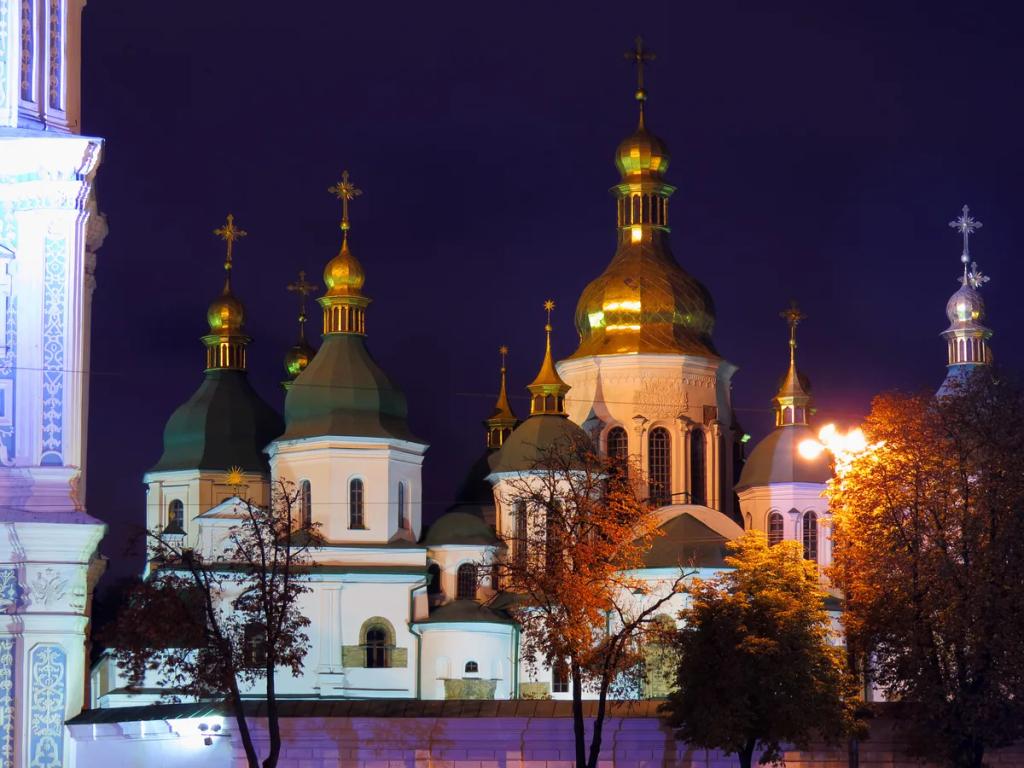
St Sophia's Cathedral and St Michael's Golden-Domed Monastery face each other along the same axis, and the gold against a low winter sky is the classic Kyiv frame. Climb St Sophia's bell tower for the view down the axis.
The Kyiv Pechersk Lavra from across the slopes, with the gold domes stacked above the Dnipro.
Andriyivskyy Descent, the cobbled street winding down from the upper town, with St Andrew's Church at the top.
The Motherland Monument on the right bank, which was re-crested with the Ukrainian trident in 2023 - a photograph that carries its own history.
The Dnipro from the pedestrian bridge at sunset, which is where the city goes to walk.
Be thoughtful about what you photograph. Images of military infrastructure, checkpoints, air defence and damage sites are restricted, and people are reasonably sensitive about cameras. Ask.
Kyiv is far older than most of the capitals that surround it - founded well over 1,500 years ago, and the seat of Kyivan Rus.
The Arsenalna metro station is the deepest in the world at around 105 metres, a consequence of the geography of the right bank and the reason the escalator ride is memorably long.
The chestnut is the city's emblem and lines its central streets.
And Diia made Ukraine one of the first countries anywhere where a digital passport on your phone is legally equivalent to the paper one.
Independence Day, 24 August, and Constitution Day, 28 June, are the fixed national dates.
Christmas on 25 December is now the official date, moved from 7 January - a deliberate and widely noted break with the Russian church calendar.
Cultural life has continued through the war with determination: theatres, concerts and clubs operate around the curfew, and the city's coffee culture is as good as anywhere in Europe.
The love: Kyiv is a genuinely great European capital that most Western visitors never saw - enormous, green, layered with a thousand years of history, with a food and coffee scene that would be celebrated anywhere and prices that are a fraction of Berlin's. Ukrainians are direct, warm and remarkably unsentimental hosts.
The complaints are not really complaints. This is a country at war, and that governs everything: the curfew, the alerts, the closed airspace, the long overland journey, the insurance question, and the fact that a night's sleep may be interrupted. Some visitors find the contrast between ordinary café life and air-raid sirens hard to hold in their head. Travel advisories from most governments are restrictive.
Anyone going should be doing so with clear eyes, current official advice, appropriate insurance and a fully charged power bank.
A wartime arrangement under which your phone can connect through a different Ukrainian operator's network if your own operator's is unavailable in that place. Kyivstar, Vodafone Ukraine and lifecell back each other up, so service is more resilient than any single network's condition would suggest.
Kyiv Digital is the city's official app - alerts, a shelter map, and a map of Invincibility Points during outages - and it doubles as the transit ticketing app. uAlert is a widely used alternative carrying official regional alerts. Install and configure both before you travel; they need data and location to work.
In the stations, yes - the metro is the city's main shelter system and coverage there has been built out deliberately. Deep tunnels between stations are patchier. Note the metro cannot take you across the Dnipro between the right and left banks.
Yes. Kyiv's supply has been broadly stable through 2026 with no scheduled outages, but localised interruptions happen and every resident carries one. Your phone is your alert system, map and ticket - keep it charged.