Hyderabad runs on Jio, Airtel and Vi, and your eSIM rides one of them as its host. Indian mobile data is among the cheapest on the planet and Hyderabad's coverage is excellent - dense 4G, wide 5G, and signal throughout a modern metro. Note that getting an Indian SIM as a foreigner is genuinely difficult, and our Pune guide covers that and the UPI payments question in detail; a travel eSIM sidesteps the whole business. What this guide is about is something more specific to Hyderabad: it is two cities that happen to share a name, and which one you are in changes almost everything.
This is the thing to understand before you book a hotel, because getting it wrong costs you an hour of traffic twice a day.
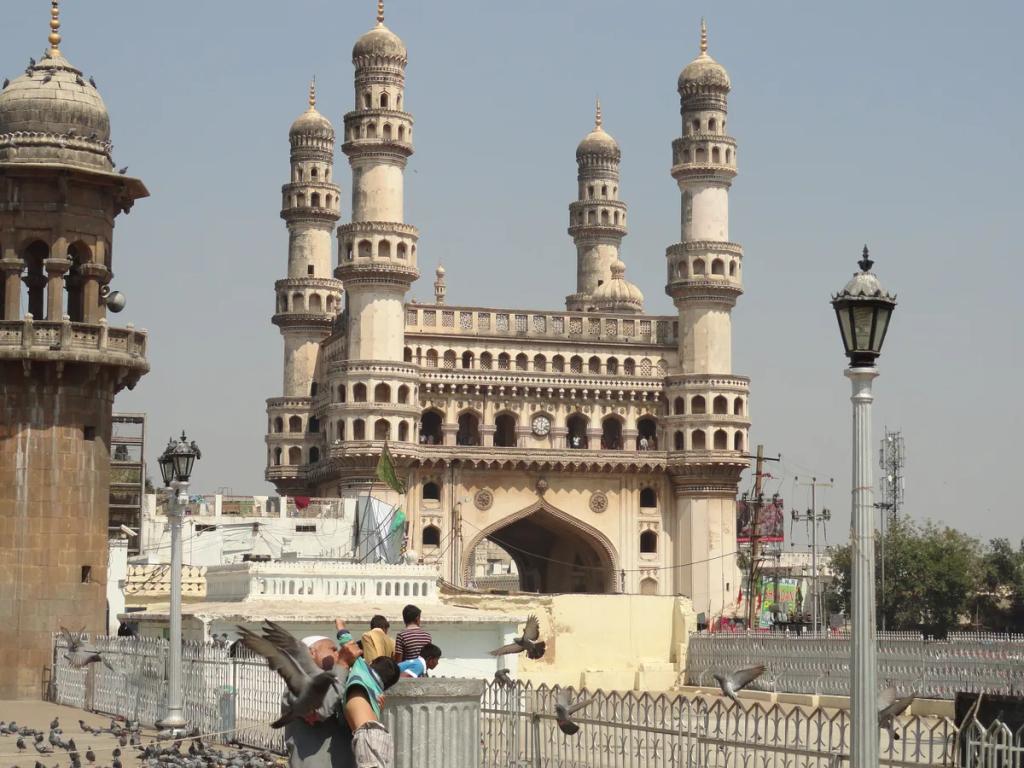
The Old City, south of the Musi river, is built around the Charminar of 1591. Narrow lanes, bangle sellers, biryani houses, Deccani Urdu on the street, the Mecca Masjid, and a rhythm that has not changed much in generations.
Cyberabad, out west, is HITEC City, Gachibowli and Madhapur - glass towers, the Indian campuses of Microsoft, Google, Amazon and Meta, eight-lane roads, and a skyline that did not exist thirty years ago.
They are about 20 km apart and the traffic between them is serious. An Old City hotel and a business meeting in HITEC City is a bad combination; so is the reverse.
Language shifts with the geography. Telugu is the state language, Hyderabadi Urdu is what much of the Old City speaks, and English dominates in the tech corridor.
So does connectivity, slightly. The tech corridor has the strongest 5G in the city. The Old City's lanes are covered but the buildings are old and thick, and indoor signal in the bazaars is patchier than the coverage map suggests.
Base yourself for what you came for. Banjara Hills and Jubilee Hills sit roughly between the two and are the usual compromise.
Hyderabad Metro is among the largest metro systems built under a public-private partnership anywhere, and it is clean, air-conditioned, cheap and fast.
Three lines cover the main corridors, including the tech city and much of the centre.
It has signal throughout, including in the elevated and underground sections.
Where it does not go, and this is the catch, is deep into the Old City - Charminar itself is a walk or a ride from the nearest station, through exactly the traffic you were trying to avoid.
Uber, Ola and Rapido all operate. Rapido's motorbike option is what locals use to beat congestion, and it is the fastest way across the city at rush hour if you are comfortable on the back of a bike.
Auto-rickshaws are everywhere and want negotiating unless you hail one through an app.
The city is very well covered, tech corridor and metro included.
Inside the Old City bazaars, thick masonry and dense lanes make indoor signal unreliable even where coverage is fine outside.
Golconda Fort is a large stone hill with a fort on it, and the upper levels are patchy.
Ramoji Film City, out on the eastern edge, is covered around the visitor areas and thins across the enormous back lots.
The Deccan countryside beyond the ring road is covered along the highways and sparser between them.
Monsoon flooding is the practical disruption rather than coverage: Hyderabad's drainage struggles with a heavy downpour, roads close, and ride-hailing surges or simply stops. Between June and September, build slack into any timed journey.
April and May are brutal. The Deccan plateau regularly runs above 40C, and the dry heat is deceptive - you dehydrate quickly without feeling as though you are sweating.
Plan around it. Sightseeing early and late, indoors in the middle of the day. The Old City in particular is unshaded and unforgiving at two in the afternoon.
November to February is the reward - warm days, cool evenings, and the only time the city is genuinely comfortable outdoors all day.
The monsoon cools things but replaces heat with flooding and humidity.
Carry more water than you think, and remember that a phone left on a dashboard in May will overheat and shut down.
- Uber, Ola and Rapido, with Rapido's bike option as the traffic solution.
- The Hyderabad Metro app or a general transit app.
- Maps, used constantly, and worth downloading offline for the Old City lanes where GPS drifts between tall buildings.
- A translation app. Telugu, Urdu and Hindi are all in play; English is widely spoken in business, hotels and the tech corridor, and less so in the bazaars.
- A food delivery app, because Hyderabad takes its food extremely seriously and much of the best of it will come to you.
Rajiv Gandhi International (HYD) is about 35 km south of the centre and is consistently rated among the better airports in India.
The airport expressway makes the run into the city quicker than the distance suggests - around 45 minutes to Banjara Hills outside peak, longer to the Old City.
Uber and Ola work from designated pickup zones; prepaid airport taxis are also straightforward.
Most nationalities need a visa, and India's e-visa system is the usual route. Arrange it well before travel.
A decent amount, and it costs almost nothing here. Ride-hailing and maps run continuously, the city is spread out, and you will use delivery apps more than you expect. Hotel wifi is generally good. There is no reason to buy a small plan in a country with data this cheap.
Modest and light. India is conservative by European standards and Hyderabad has a large Muslim population, particularly in the Old City.
Women: shoulders, arms and knees covered. A scarf for mosques - the Mecca Masjid requires head covering.
Men: long trousers. Shorts are unusual on adults outside the gym.
Natural fabrics in the heat, and something long-sleeved that still breathes for sun protection.
Shoes that come off easily - you will remove them at mosques, temples and some homes and shops.
A layer for indoors. Air conditioning in malls and offices is set aggressively cold.
The Charminar at dusk, lit, with the traffic and the bangle stalls of Laad Bazaar swirling around it.
Golconda Fort at sunset, from the upper ramparts, looking back over the city.
The Qutb Shahi Tombs, a necropolis of domed mausoleums recently and beautifully restored, and far quieter than it deserves.
Chowmahalla Palace, the Nizams' seat, with its durbar hall and chandeliers.
Mecca Masjid, one of the oldest and largest mosques in India, next to the Charminar.
Hussain Sagar at night, with the monolithic Buddha statue standing on its island.
Ramoji Film City, the largest film studio complex in the world by Guinness reckoning, which is a genuinely strange day out.
A biryani, properly photographed, because you will be asked.
The Golconda mines produced the world's most famous diamonds. The Koh-i-Noor and the Hope Diamond both came from this region, and for centuries Golconda was effectively the world's only significant diamond source - which is why the name became a byword for wealth.
The last Nizam was once considered the richest man in the world, and appeared on the cover of Time in 1937.
Hyderabad is called the City of Pearls, a trade the Nizams established, and Laad Bazaar still sells them.
Hyderabadi haleem is GI-tagged - a slow-cooked wheat and meat dish made in enormous quantities during Ramadan, and the Old City in that month is one of the great food experiences in India.
Ramoji Film City holds the Guinness record for the largest film studio complex on earth, at around 2,000 acres.
And Hyderabad stopped being a joint capital in June 2024. When Telangana split from Andhra Pradesh in 2014, the city was designated the shared capital of both for up to ten years. That decade expired on 2 June 2024, and Hyderabad now belongs solely to Telangana.
Ramadan, when the Old City around the Charminar comes alive after dark and the haleem shops run all night. If you can time a visit for anything, time it for this.
Bonalu, in July or August, a Telangana folk festival honouring the goddess Mahakali, with processions and drumming.
Bathukamma, in September or October, Telangana's flower festival, when women build conical arrangements of seasonal blooms and float them on water. It is distinctive to this state and genuinely beautiful.
Ganesh Chaturthi, with the enormous Khairatabad Ganesh idol and an immersion procession into Hussain Sagar that shuts much of the city.
Deepavali, in October or November.
November to February is the season. Avoid April and May unless you have a reason.
The love: Hyderabad is the most underrated big city in India for visitors. It has genuine Deccan history - forts, tombs, palaces - with a fraction of the crowds of Delhi or Agra, some of the best food in the country, a working modern metro, and a tech economy that makes it prosperous and outward-looking. It is also noticeably calmer and cheaper than Mumbai or Bengaluru, and the mix of Muslim and Telugu culture gives it a texture found nowhere else in India.
The complaints are consistent. The traffic between the two halves of the city is genuinely bad and eats days. The heat in April and May rules out a third of the year. Monsoon flooding disrupts everything. Air quality is mediocre and worse in winter. The sights are spread out, so a day is often one fort and a lot of car. And visitors expecting the Rajasthan-and-Taj version of India find a working, modern, industrial city that is not performing for them - which is exactly what others like about it.
Come between November and February, stay in Banjara Hills, use the metro where it goes and a Rapido bike where it does not, and eat biryani in the Old City rather than at the airport.
An eSIM, for a short visit. Getting a local Indian SIM as a foreigner is genuinely difficult - our Pune guide covers the process and the illegal shortcuts people are offered. Indian mobile data is extremely cheap either way, so there is no reason to economise on your plan.
Yes, throughout, including the underground sections. The metro is clean, cheap and the single most reliable way to cross the city. Its limitation is that it does not reach deep into the Old City, so the Charminar still involves a ride or a walk through traffic.
It depends entirely on why you came. The Old City and Cyberabad are about 20 km and a great deal of traffic apart. Banjara Hills and Jubilee Hills sit between the two and are the usual compromise. Choosing the wrong end costs you an hour twice a day.
Yes, more than coverage does. Hyderabad's drainage struggles with heavy rain, roads flood, and ride-hailing surges or becomes unavailable. Between June and September, leave real slack around anything with a fixed time, especially flights.