Hamburg runs on Telekom, Vodafone and O2, and your eSIM rides one of them as its host. Coverage is comprehensive and EU roaming applies without qualification - our Berlin guide covers the German questions of U-Bahn signal, card acceptance and whether a local SIM is worth it, and the answers are the same here. What Berlin cannot tell you is the thing that actually shapes Hamburg: this is one of the largest ports in Europe, and it sits a hundred kilometres from the sea on a river that goes up and down twice a day.
Hamburg's whole existence is a trick of geography, and it explains the city's shape, its weather and one genuine hazard.
The port is not on the coast. The Elbe runs roughly 100 km from the North Sea to Hamburg, and ocean-going container ships come all the way up it. Standing at the Landungsbrücken watching a 400-metre vessel pass a city centre is a strange and specific pleasure.
The river is tidal here. The Elbe rises and falls by around three and a half metres at Hamburg, twice a day. Pontoons float up and down, and the gangways to them change angle through the day.
Storm surges are a real feature. When a North Sea depression pushes water up the funnel of the Elbe, the level rises far beyond the normal tide. The Fischmarkt building floods regularly - locals photograph it rather than panic - and the city has an extensive flood protection system built after the catastrophic 1962 surge, which killed more than 300 people.
Warnings reach your phone. Germany operates cell broadcast emergency alerts, which reach handsets on a German network including roaming ones. If you get one during a winter storm here, it is worth reading rather than dismissing.
In practice a visitor is very unlikely to be affected. But if you are staying near the water in winter, note that a Sturmflut is an ordinary part of Hamburg's year rather than a disaster movie.
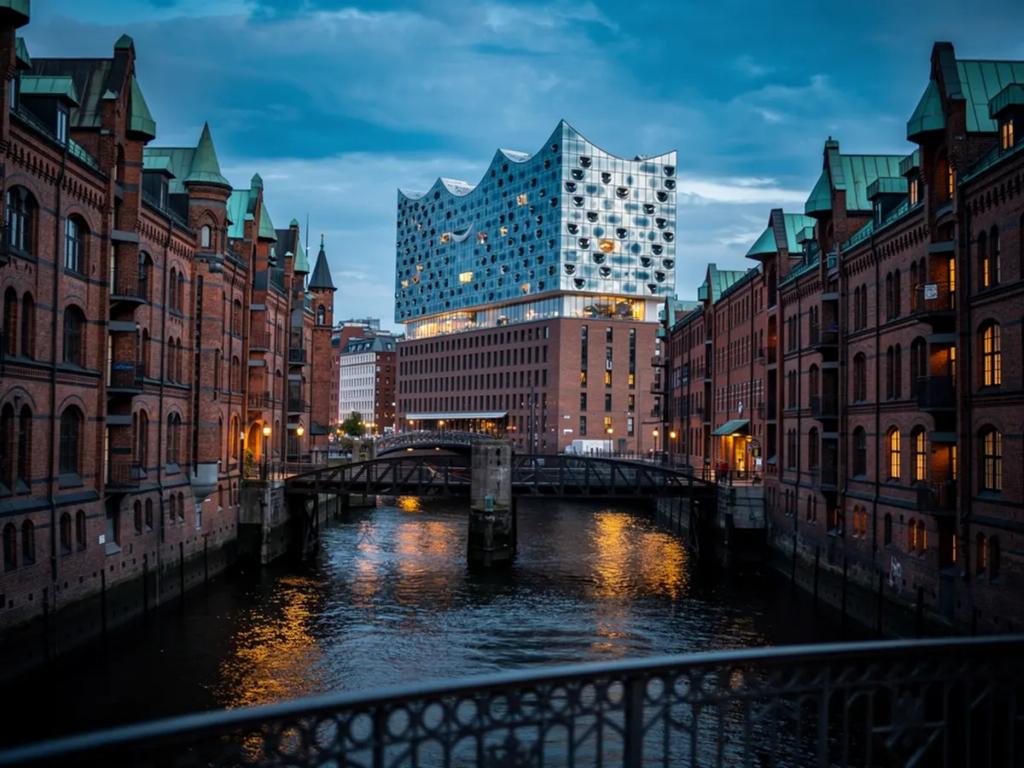
The Speicherstadt is the largest warehouse district in the world built on timber piles, and it is UNESCO-listed along with the neighbouring Kontorhaus district.
It was a customs-free zone. Built from the 1880s, it let goods be stored, sorted and processed without entering German customs territory - which is why the warehouses have hoists on every floor and canals running between them rather than roads.
The brick is the point. Red-brick Gothic revival at industrial scale, seven storeys of it, reflected in the water.
It is best at dusk, lit, from the Poggenmühlen bridge, which is the shot everyone comes for.
HafenCity next door is one of the largest inner-city redevelopment projects in Europe, and the Elbphilharmonie sits at the hinge between the two - a glass wave on top of an old cocoa warehouse. The Plaza viewing level is free, though you need a timed ticket, and it gives you the port from 37 metres up.
The city is thoroughly covered, U-Bahn and S-Bahn included.
Inside the Speicherstadt warehouses and the old Kontorhaus buildings, the brick is thick and interior signal can be poor.
The Elbtunnel, the old 1911 tunnel under the river with its car lifts, is a hole in the ground and behaves like one.
On the harbour ferries, coverage is fine - these are public transport boats on an HVV ticket and one of the best-value things in the city.
Out in the Wadden Sea and on the North Sea islands, a couple of hours away, coverage thins on the mudflats and tidal crossings, which is worth knowing because guided mudflat walking is a regional pastime and the tide there is not negotiable.
The Lüneburg Heath to the south has gaps between villages.
Hamburg has a word for its own weather. Schietwetter - roughly "crap weather" - is used affectionately and constantly.
It rains often rather than heavily, and the wind is what makes it. An umbrella is close to useless on the Landungsbrücken; a hooded waterproof is not.
Locals do not cancel plans for it. The saying here is that there is no bad weather, only bad clothing, and the city genuinely lives by it - the Alster is full of rowers in drizzle.
Winter is dark and damp rather than severely cold, which some people find harder than a proper frost.
Summer is genuinely lovely and the city moves outdoors completely - the Alster lakes, the Elbe beaches at Övelgönne, the Stadtpark.
- HVV, which covers the U-Bahn, S-Bahn, buses and the harbour ferries on one ticket. The ferries are public transport here, not a tour.
- Maps, though the city is legible and the transport signage is good.
- DB Navigator for regional and long-distance trains.
- A weather app, used constantly by everyone.
- NINA, the German federal warning app, if you are here in storm season - though cell broadcast alerts reach you regardless.
- A translation app is optional. English is widely spoken, particularly by anyone under fifty.
Hamburg Airport (HAM) is about 8.5 km north of the centre, and the S1 S-Bahn runs from beneath the terminal to the Hauptbahnhof in around 25 minutes on an ordinary HVV ticket. It is the obvious way in.
By train, Hamburg Hauptbahnhof is one of the busiest stations in Europe, with direct services to Berlin in under two hours and onward to Copenhagen and Amsterdam.
Cruise ships dock at three terminals along the Elbe, and the city is a major Northern European turnaround port.
In the city, the U-Bahn and S-Bahn are excellent, and the harbour ferries - lines 62 and 72 in particular - are the cheapest boat trip you will ever take.
Very little. Wifi is widespread, transport is well signposted, and EU visitors are on their home allowance. A light plan covers maps and messaging. Save any extra for a trip out to the coast or the heath.
A hooded, windproof waterproof. This is the single most useful item for Hamburg in any season.
Layers, because a bright morning turns.
Comfortable shoes, and something with grip for wet cobbles in the Speicherstadt.
Warm gear in winter - it is not deeply cold but the damp wind gets through.
Hamburg dresses well but understatedly. It is a wealthy merchant city and the style is quiet: good coats, no display. Nothing formal is needed except for the Elbphilharmonie, where people dress.
The Speicherstadt from Poggenmühlen bridge at blue hour, with the warehouses lit and reflected.
The Elbphilharmonie from the water, or the view from its free Plaza level.
Landungsbrücken with a container ship passing behind it.
The Fischmarkt at dawn on a Sunday, when it opens at five in the morning and the auction hall has a live band and beer at seven.
Miniatur Wunderland, the largest model railway in the world, which is far better than that description suggests and books out.
The Alster lakes from the Lombardsbrücke, with the city skyline behind.
St Michaelis church tower for the view over the whole port.
Övelgönne beach, where people sit on the sand and watch ships go by, which is a very Hamburg way to spend an evening.
Hamburg is a city-state, formally the Free and Hanseatic City of Hamburg, one of Germany's sixteen federal states in its own right - and the "Hanseatic" is not decorative, it descends directly from the medieval trading league.
It has more consulates than almost any city in the world, second only to New York by most counts, a legacy of the port.
The Beatles were made here. They played long residencies in St Pauli between 1960 and 1962, several hundred hours on stage, and the band that returned to Liverpool was not the one that left.
Miniatur Wunderland holds the world record for the largest model railway, with its own airport whose aircraft actually take off.
The Speicherstadt stands on oak piles driven into the marsh, tens of thousands of them, and has done for well over a century.
And the Elbtunnel of 1911 lowers cars into the ground on lifts, still works, and is free to walk through.
Hafengeburtstag, in May, the port's birthday and the largest port festival in the world - three days of ships, tall-ship parades and a million-odd people on the waterfront.
The Hamburger DOM, a funfair held three times a year on the Heiligengeistfeld, in spring, summer and winter.
Reeperbahn Festival, in September, one of Europe's biggest club festivals for new music, spread across St Pauli.
The Christmas markets, from late November, with the one in front of the Rathaus the handsomest.
Summer, June to August, is when the city is at its best. Winter is dark and wet, and the storm season runs through it.
The love: Hamburg is Germany's most quietly self-assured city - wealthy, maritime, red-brick and unshowy. The port gives it a scale and a working edge that most beautiful cities lack, the Speicherstadt and HafenCity are genuinely world-class urban set pieces, the Elbphilharmonie is one of the best concert halls built this century, and the music and nightlife around St Pauli are serious. It is also greener and more watery than people expect, with the Alster lakes in the middle of the city.
The complaints are consistent. The weather is grey and wet for a large part of the year and puts people off. It is expensive, among Germany's dearest cities. It lacks Berlin's edge and can feel buttoned-up and bourgeois by comparison. The Reeperbahn is either a highlight or a seedy disappointment depending on expectations. And the sights are spread along the water rather than concentrated, so you walk a lot in that weather.
Come in June, take a harbour ferry rather than a tour boat, get up for the Fischmarkt once, and book Miniatur Wunderland before you arrive.
Yes, fully - Germany is in the EU and the eurozone, so an EU or EEA SIM uses its domestic allowance with no surcharge. Our Berlin guide covers the German specifics of U-Bahn signal and whether a local SIM is ever worth it; the answers apply here.
Germany uses cell broadcast for emergency warnings, which reaches every handset on a German network including roaming foreign ones. In Hamburg in winter that most often means a storm surge warning on the Elbe. It is worth reading rather than swiping away.
Yes, and the ferries are worth knowing about for a different reason: lines 62 and 72 are public transport on an ordinary HVV ticket, not tourist boats, so a harbour trip costs the price of a bus fare.
Inside the thick brick of the Speicherstadt warehouses and the Kontorhaus buildings, in the old Elbtunnel, and out on the Wadden Sea mudflats and North Sea islands a couple of hours away. The city itself, including both rail networks, is comprehensively covered.