A1, Hrvatski Telekom and Telemach cover Zagreb, and your eSIM will use one of them. Croatia's EU, euro and Schengen status - all of it recent - is covered in our Dubrovnik guide, along with the border quirks on the coastal drive. None of that changes inland. What is specific to Zagreb is that the city has spent six years under scaffolding, and that almost nobody who visits Croatia comes here at all.
If you arrive without knowing this, you will spend a day wondering what happened.
An earthquake struck Zagreb on 22 March 2020, magnitude 5.5, centred a few kilometres north of the centre. It hit during the first week of the country's Covid lockdown, which is why it received so little international attention.
The cathedral lost a spire. The southern tower's top collapsed, and the damaged north spire had to be brought down in a controlled demolition the following month.
The historic core took the worst of it. Zagreb's upper town is largely nineteenth-century masonry, poorly suited to shaking, and hundreds of buildings were damaged.
Nine months later came a second one. In December 2020 a magnitude 6.4 quake struck near Petrinja, about fifty kilometres away, killing several people and devastating the town. Zagreb felt it hard.
The rebuilding has been slow and is very visible. Scaffolding, netting and closed facades are a normal feature of the streetscape, and Croatians are frank about the pace.
The cathedral reopened to visitors in 2026, after the first phase of structural work inside. The exterior and the towers come next, and full completion is not expected before about 2030.
None of this makes the city less worth visiting. But it explains the wrapped buildings, and it is the reason some interiors you read about are still closed.
Worth stating plainly, because it is the single best argument for coming here.
Croatia receives enormous numbers of visitors - tens of millions a year - and almost all of them go to the coast and the islands.
Zagreb is not on that circuit. Most people fly into Split or Dubrovnik, or drive down from Austria, and never see the capital.
Which makes it cheap and uncrowded. Coffee, food, accommodation and museums cost a fraction of Dubrovnik's summer prices, and you will not queue for anything.
It is a central European city, not a Mediterranean one. Habsburg architecture, coffee-house culture, parks laid out in a horseshoe, trams, and a rhythm much closer to Vienna or Budapest than to the Adriatic.
The coffee ritual is genuinely important. Saturday morning špica - dressing up to sit on a terrace on Tkalčićeva or Bogovićeva and be seen - is the city's defining social institution. Nobody hurries.
Two hours from the coast, and less to Plitvice. Zagreb works well as a start or end point rather than as a place skipped between airports.
The city is comprehensively covered, trams included.
Inside the scaffolded buildings and the cathedral, thick stone and steel wrapping do the expected.
Medvednica, the mountain immediately north of the city with a ski slope and a castle on it, thins on the trails and in the forest.
Plitvice Lakes, about two hours south, has coverage at the entrances and hotels and very little on the boardwalks between the lakes - which is a national park where people do get separated from their group.
The Zagorje countryside north towards Slovenia is fine along the roads and patchy in the hills.
The tunnel under Grič - a Second World War shelter running beneath the upper town, now open as a public walkway - has no signal, which is part of its appeal.
Zagreb's charm is largely in details that no other city has.
The Grič cannon has been fired from Lotrščak Tower at noon every single day since 1877. Set your watch by it, and do not be standing directly beneath it.
The funicular connecting the lower and upper towns is among the shortest public funiculars in the world - 66 metres, about 64 seconds - and it is a listed monument.
The Museum of Broken Relationships began here as a travelling exhibition of objects donated by the newly separated, each with its story. It won a European museum award and has been widely copied. It is much better than it sounds and rather sadder.
The necktie is Croatian. Seventeenth-century Croatian soldiers wore knotted neckcloths that the French adopted as the cravate - from Croat. There are shops in the upper town that will sell you one on the strength of it.
Dolac market sits directly above the main square under red umbrellas, and it is a working market rather than a tourist one.
- ZET, for the tram network, which is dense, cheap and the way to move around.
- Bolt and Uber, both of which operate and are inexpensive.
- Maps, with offline copies for Plitvice or the Zagorje.
- A translation app. Croatian is the language; English is very widely spoken by younger people and in hospitality, and German by many older ones.
- Cards work everywhere. Croatia adopted the euro in 2023 - see our Dubrovnik guide - and contactless is standard.
Franjo Tuđman Airport (ZAG) is about 17 km southeast, small and quick to clear.
The airport bus runs to the main bus station in around 30 minutes; Bolt and Uber work from the terminal and are cheap.
By train, Zagreb connects to Ljubljana, Vienna and Budapest, though Croatian rail is slower than the road.
By road, the motorway to Split takes around four hours and to Dubrovnik about eight - Zagreb is genuinely far from the southern coast.
In the city, trams cover everything, the centre is walkable, and the funicular saves you a hill.
Very little. Wifi is universal in cafes, the city is small and flat in its centre, and EU visitors are on their home allowance. Download offline maps only for Plitvice or a drive into the hills.
Layers, and a proper coat in winter. This is a continental climate - Zagreb gets snow, and January is genuinely cold in a way the Croatian coast never is.
Something presentable for coffee. Zagreb dresses up for the Saturday terrace ritual more than most cities dress for dinner, and it is noticeable.
Comfortable shoes for the cobbles of the upper town.
Summer is warm and humid, and the city empties towards the coast in August.
An umbrella in spring and autumn.
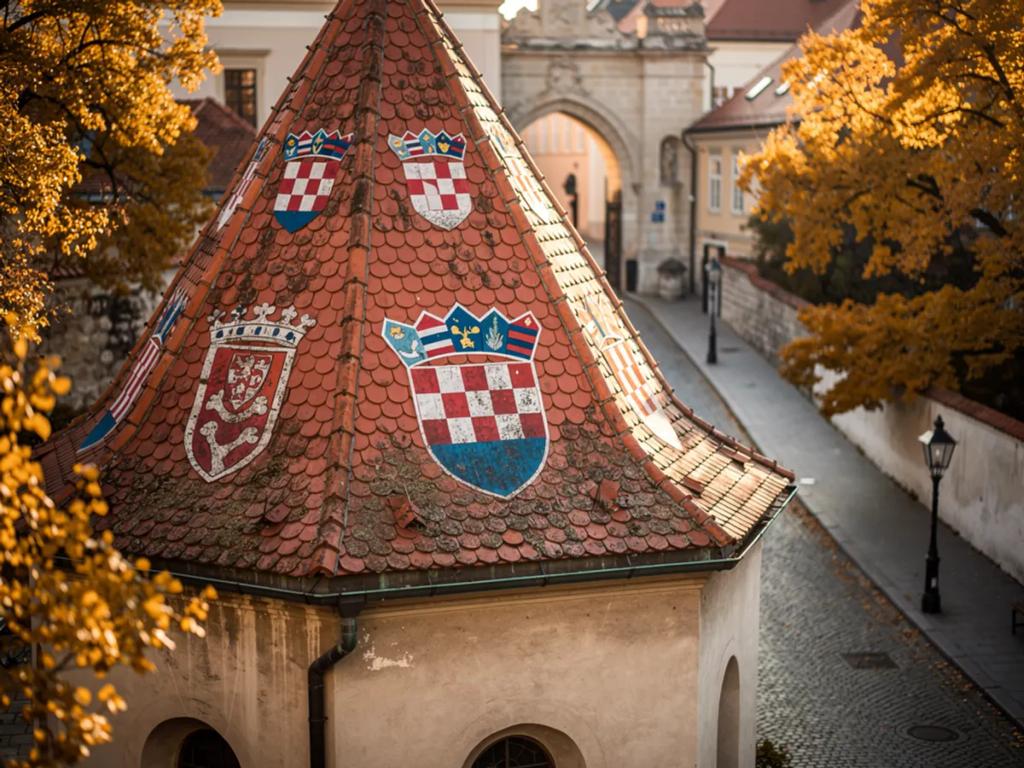
St Mark's Church roof, with the two coats of arms tiled into it, in the upper town square.
The cathedral's twin spires - and note the scaffolding, which is part of the current picture and will be for years.
Dolac market from above, the red umbrellas in rows.
Tkalčićeva in the evening, the terrace street.
The funicular, which takes about a minute and is worth doing once.
Lotrščak Tower at noon, for the cannon.
Mirogoj cemetery, whose arcades and domes are among the most beautiful in Europe and which almost no visitor sees.
Plitvice Lakes, two hours south, and go early - the boardwalks are one-way and jam badly by mid-morning.
The necktie originates here. Croatian mercenaries in French service in the 1600s wore distinctive knotted neckcloths, and the French word cravate derives from Croat.
The Grič cannon has been fired at noon every day since 1877, originally to synchronise the city's church bells.
Zagreb's funicular is one of the shortest public funiculars in the world, at 66 metres, and it is a protected cultural monument.
The Museum of Broken Relationships started as a travelling art project by two Zagreb artists after their own separation, and it now has a permanent home in the upper town.
Mirogoj cemetery was designed by Hermann Bollé, who also worked on the cathedral, and it is non-denominational - Catholic, Orthodox, Muslim and Jewish graves side by side, which in this region is worth noting.
And Zagreb's Advent market was voted the best in Europe three years running, which is not a phrase most people associate with Croatia.
Advent in Zagreb, from late November to early January, which is the city's biggest season - the parks, the squares and Zrinjevac fill with lights, food stalls and skating, and it has repeatedly been voted Europe's best Christmas market.
INmusic Festival, in June, on the islands of Lake Jarun.
Animafest, one of the world's oldest animation festivals, in June.
The Saturday špica, weekly, which is not an event but functions like one.
May, June and September are the best months for weather. December is the best month for atmosphere, and it is cold.
The love: Zagreb is an unhurried, handsome, genuinely central European capital that costs a fraction of what its neighbours do and receives almost none of the crowds that overwhelm the Croatian coast. The coffee culture is real, the museums are excellent and eccentric, the food is central European rather than Mediterranean and none the worse for it, and the Advent season is exceptional. It is also a comfortable base for Plitvice and the Zagorje.
The complaints are consistent. The reconstruction means scaffolding, closures and a slightly battered upper town, and it will be years yet. It is small - two days covers the centre. It is not the Croatia people came for, and visitors expecting Adriatic light and stone find a Habsburg city in the rain. Winter is cold and grey outside the Advent weeks. And August is dead, when the city decants to the coast.
Come in June or in December, take the funicular once, be at Lotrščak at noon, and give Mirogoj an hour.
A magnitude 5.5 earthquake struck Zagreb in March 2020, during the first week of lockdown, badly damaging the historic core and bringing down one of the cathedral's spires. A second, stronger quake hit near Petrinja that December. Reconstruction has been slow: the cathedral reopened to visitors in 2026 after internal structural work, and full restoration is not expected before around 2030.
Yes. Croatia is in the EU, the eurozone and Schengen, all of it relatively recent - our Dubrovnik guide covers the detail and the border quirks that affect the coastal drive. Inland, none of it complicates anything.
That is precisely the question most people answer by skipping it, and it is why the city is cheap and uncrowded. Zagreb is a central European capital rather than a Mediterranean one, and it is a different trip rather than a lesser version of the same one. Two days is enough, and it is four hours from Split.
At the entrances and hotels, yes. On the boardwalks between the lakes, largely not - and it is a large park with one-way routes where groups do get separated. Download the map offline and agree a meeting point before you go in.