Buenos Aires runs on Personal, Claro and Movistar, and your eSIM rides one of them as its host. Coverage across the city is comprehensive, 4G is fast and universal, and 5G has been rolling out through the central barrios. The connectivity is unremarkable in the best sense. What has changed enormously, and what almost every guide still gets wrong, is the money.
For twenty years the single most repeated piece of Argentina travel advice was this: bring crisp US hundred-dollar bills, find a cueva, and change them on the parallel market at a rate far better than the official one. That advice is now largely obsolete, and following it costs you time and risk for almost nothing.
Currency controls were lifted in April 2025. The cepo cambiario that created the gap is gone, and Argentines can buy dollars at the official rate.
The rates have converged. The official rate, the MEP rate and the blue dollar now sit within a few percent of each other rather than the 100% gap of the bad years. The arbitrage that made cash king simply is not there any more.
So use your card. A foreign Visa or Mastercard is processed at a tourist rate that is competitive, it carries no risk, and it involves no meeting anyone in a back room on Calle Florida.
Bring some cash anyway, but as a working float rather than a strategy. Small vendors, ferias, some taxis and tips still want pesos, and a few places prefer dollars.
Ignore any article that does not carry a 2026 date. This is the one topic where the internet's collective memory is actively harmful. The men shouting "cambio, cambio" on Florida are still there; the reason to use them is not.
Not a connectivity matter, but the thing that most disorients first-time visitors.
Restaurants fill at 10pm. Arriving at 8 gets you an empty dining room and a confused waiter. Many kitchens do not open until 8 or 8:30.
Bars run to 3am and clubs open at 2. A boliche before one in the morning is empty.
Lunch is late too, from about 1:30.
The merienda at around 5 or 6pm, coffee and medialunas, is what bridges the gap, and it is a real meal in its own right.
Adjust on the first day rather than fighting it, because nothing here moves earlier to accommodate you.
Buenos Aires is a walking city, which is precisely why this needs saying.
Phone snatching from the hand is the common crime, often from a moving motorbike. It is opportunistic and it targets the visible device rather than the person.
Do not walk along navigating. Stop, step into a doorway or a cafe, check the map, put it away.
On the Subte and on buses, keep it out of sight near the doors, which is where a grab happens as they close.
La Boca is the one neighbourhood where the advice is geographic: the Caminito strip is fine in daylight and the surrounding blocks are genuinely not, and the boundary is abrupt.
Retiro and Constitucion stations and their surroundings warrant the same care after dark.
Otherwise Palermo, Recoleta, San Telmo and the centre are ordinary big-city environments, and the overwhelming majority of visitors have no trouble at all.
The Subte has coverage in the stations and is patchy in the tunnels between them, which is the usual pattern for a system of its age.
The older buildings in Monserrat and San Telmo have thick masonry and poor interior signal.
The Delta del Parana, an hour north at Tigre, thins out quickly once you are among the islands, and the further channels have very little.
The Pampas, if you are heading out to an estancia, are well covered along the highways and sparse in between.
Large events - a River or Boca match, a demonstration on Avenida de Mayo - congest the network locally in the way large events do everywhere. Agree a meeting point rather than relying on messaging.
- SUBE is the transport card, and you need the physical card for the Subte, buses and trains. Buses do not take cash at all. Buy one at a station or kiosk and load it with cash.
- Cabify, Uber and DiDi all operate. Uber's legal status has been contested for years, which is why locals often use the others.
- BA Como Llego, the city's own transport router, which is better than the general apps for buses.
- Maps, used stopped rather than while walking.
- A translation app. English is less widely spoken here than visitors expect, and Argentine Spanish has its own accent, vocabulary and the vos form.
Ezeiza (EZE) is the international airport, about 35 km southwest, and the transfer takes 45 minutes to an hour and a half depending on traffic. Official airport taxi desks and the ride apps both work; agree the arrangement inside the terminal rather than with anyone approaching you.
Aeroparque (AEP) sits in the city on the riverfront and handles domestic and some regional flights. It is fifteen minutes from Palermo, and connections between the two airports need real time.
The city itself is best covered on foot within a barrio and by Subte or taxi between them. Get the SUBE card in the first hour.
Moderate. Cafe and hotel wifi is good and widespread, the grid is easy to navigate, and much of a day here is spent sitting down. Budget more if you are using ride apps heavily or heading out to Tigre, Colonia or an estancia.
Remember the seasons are inverted. July is winter. December is high summer.
Summer is hot and humid, often above 30C, and the city empties towards the coast in January.
Winter is mild rather than cold, roughly 8-16C, but buildings are poorly heated and it feels colder indoors than the numbers suggest.
Portenos dress well. Buenos Aires is the best-dressed city in South America and dressing slightly up is normal for dinner.
Comfortable shoes, because this is a city you walk, and the pavements are uneven.
A light layer year-round, because the sudestada wind off the river can drop the temperature quickly.
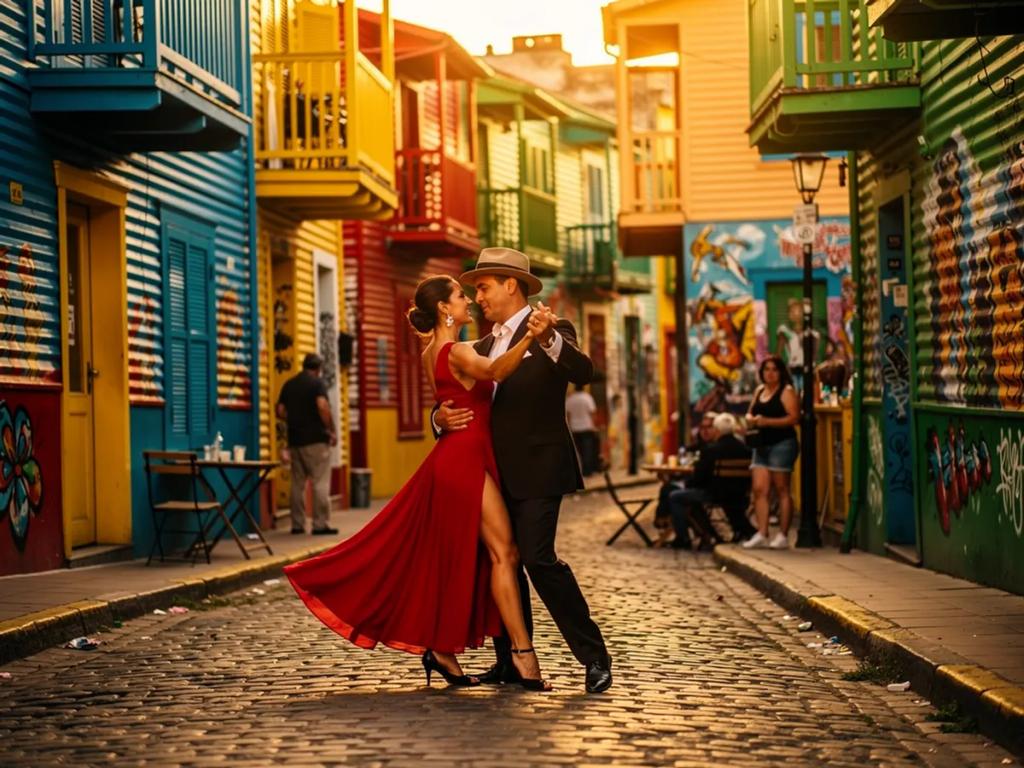
Caminito in La Boca, the painted corrugated houses, in the morning and on the strip itself.
Recoleta Cemetery, a city of marble mausoleums where Eva Peron is buried, and one of the great cemeteries anywhere.
El Ateneo Grand Splendid, a bookshop in a converted 1919 theatre, with the shelves in the boxes and a cafe on the stage.
Teatro Colon, whose auditorium is regularly rated among the finest acoustics in the world. The tour is worth it.
Casa Rosada on the Plaza de Mayo at dusk.
The Floralis Generica, the steel flower that opens and closes with the light.
San Telmo's Sunday feria along Defensa, antiques and tango and crowds.
Palermo's street art, which is world-class and largely legal.
Avenida 9 de Julio is claimed as the widest avenue in the world, at sixteen lanes, and crossing it on one green light is a genuine achievement.
Buenos Aires has among the most bookshops per person of any city on earth, which is a statistic locals will offer you unprompted.
Argentina has more psychologists per capita than anywhere else, and Palermo has a district nicknamed Villa Freud.
The residents are called portenos, meaning people of the port, which is how a city of immigrants named itself.
Tango was born in the port districts and was disreputable for decades before it became the national symbol.
Dulce de leche is on or in almost everything, and the alfajor is the national biscuit by a distance.
And the Obelisco has been dressed up repeatedly - given a giant condom for World AIDS Day, and painted pink - which tells you something about the city's sense of itself.
The Tango Buenos Aires Festival and World Cup, in August, when the world championship is danced here.
Carnival, in February, smaller than Brazil's and built around neighbourhood murgas.
La Noche de los Museos, one night in late spring when the museums open until the small hours and the city is out.
The Superclasico, River Plate against Boca Juniors, which is unlike any other fixture in world football and very difficult to get into.
Feria de Mataderos on Sundays, for folk music and gaucho skills rather than tango.
Spring, September to November, and autumn, March to May, are the best times. January is hot and half the city is at the coast.
The love: Buenos Aires is a European-looking city with a South American temperament, and the combination is unlike anywhere else. The architecture is grand and slightly faded, the cafe culture is genuine and unhurried, the theatre and music scenes are enormous, the steak and the Malbec live up to it, and the city is affordable in a way western Europe no longer is. It also stays up all night, which people either love or find exhausting.
The complaints are consistent. The late hours defeat some visitors entirely. Inflation has made prices a moving target, and though the currency chaos has calmed, costs have risen in dollar terms. Phone snatching makes people wary in a city that is otherwise a joy to walk. La Boca is a two-block tourist strip in an area you are told not to leave. The bureaucracy surfaces in odd places. And a few find it melancholic, a city that talks constantly about its own decline.
Come in October or April, eat at ten, take the Colon tour, and put your phone away while you walk.
Not as a strategy. Currency controls were lifted in April 2025 and the official, MEP and blue rates have converged to within a few percent, so the parallel market no longer pays for the hassle or the risk. Use a foreign card for most things and carry some cash as a float for small vendors, ferias and tips.
In restaurants, shops and hotels, generally yes, and contactless is normal. Buses do not take cards or cash at all - they take the SUBE transport card, which you buy and load with cash. Some small vendors and ferias are cash only.
Use it stopped rather than while walking. Snatching from the hand, often from a motorbike, is the common crime and it targets the visible device. Palermo, Recoleta, San Telmo and the centre are ordinary big-city environments; La Boca beyond the Caminito strip is the one place where the advice is firmly geographic.
More than in most capitals on this list. English is less widely spoken than visitors expect outside hotels and tourist restaurants, and Argentine Spanish has a distinctive accent and uses vos rather than tu. A translation app earns its place here.